|
ISSUE NO. 26 |
|
|
HVAC CONTRACTOR · EXECUTIVE INTELLIGENCE
This is a management week, not a weather week. Turn August service calls into September installs. |
|
|
|
|
WEEKLY BRIEF · WEEK OF AUG 31 2026 · FOR OWNERS, PRESIDENTS & SENIOR OPERATORS |
|
|
What changed this week
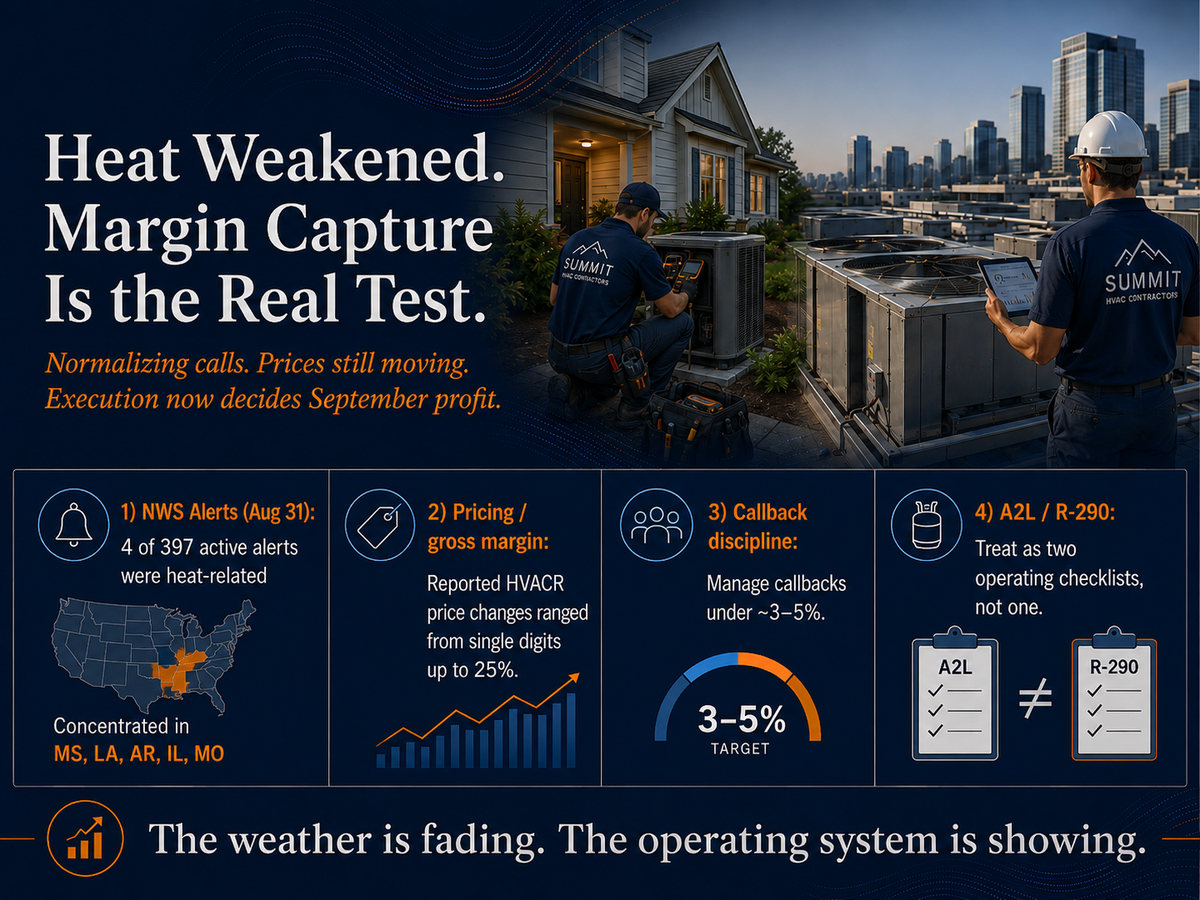
1. Heat-related emergency demand has weakened nationally. Aug. 31 NWS showed only 4 of 397 active alerts were heat-related, concentrated in parts of Mississippi, Louisiana, Arkansas, Illinois, and Missouri — a sharp drop from Aug. 24's 58 heat alerts across TX/OK/AZ/CA and the broader South.
2. August cost increases are still moving through inventory and price books. Reported HVACR price changes ran from single digits to as high as 25% across selected equipment, parts, controls, valves, and accessories.
3. Refrigerant readiness and callbacks are becoming execution and warranty issues. A2L and R-290 field workflows — tools, recovery, documentation, technician confidence — are now visible on the callback log before they hit the P&L.
What it means: This week's job is to turn August service activity into September gross profit while protecting installed margin and recovering capacity lost to rework.
NWS alerts (Aug 31) → | ACHR commercial feed → | ACHR A2L vs R-290 → |
|
 |
|
Stance shift from Issue 25
| Last week |
This week |
Management shift |
| Heat-driven urgency |
Normalizing call volume |
Capacity triage → margin capture |
| Quote aging |
Handoff and callback quality |
Fast response → clean conversion |
| Price-book updates |
Installed-margin review |
Pricing intent → delivered economics |
|
|
|
CEO/President/Owner/GM Readout |
| Stance |
A busy August does not guarantee a strong September. The contractor that wins this week can show exactly which August service calls became replacement estimates, scheduled installs, maintenance agreements, commercial follow-up, and profitable backlog. The contractor that loses simply watches call volume normalize while stale proposals, callbacks, and weak follow-up consume the value created during peak season. |
Three decisions
this week |
1. Pull every open replacement quote older than 14 days — reconfirm equipment cost, labor assumptions, accessories, availability, and financing before scheduling. 2. Run an August service-call harvest — prioritize systems over 10 years old, repeat repairs, refrigerant leaks, major component failures, high-ticket repairs, and declined estimates. 3. Review the last 14 days of callbacks by cause — diagnostic misses, workmanship, parts failures, refrigerant, and customer-expectation gaps. |
|
|
|
Five signals. Each tagged NEW / CONTINUING / ESCALATING / WEAKENING and paired with one operating action. |
| Heat / service demand |
▼ WEAKENING NATIONALLY · REGIONAL POCKETS |
| TAG: NEW THIS WEEK |
VS. LAST WEEK: 58 heat alerts → 4 of 397 active alerts (Aug 31) |
NWS on Aug. 31 showed only 4 heat-related alerts out of 397 active alerts, concentrated in the lower Mississippi Valley (Miss./La./Ark.) and parts of Illinois and Missouri. Broad national no-cool pressure is gone. Heat-exposed branches should protect emergency response and first-time fix. Other markets should shift capacity toward maintenance, callbacks, replacement follow-up, and commercial PM work.
Do this → rebalance dispatch by branch and market; track gross profit per tech day, not just calls completed
|
| Pricing / gross margin |
▲ CONTINUING · MARGIN-SENSITIVE |
| TAG: CONTINUING |
August increases: single digits up to 25% across equipment, parts, controls, valves, accessories |
An old proposal can become an underpriced install before the job reaches the board. Strong revenue does not fix stale costing. The bigger risk right now is not that customers refuse a new price — it is that your own team honors the old one out of habit.
Do this → reprice proposals older than 14 days; confirm current supplier cost before scheduling; compare sold margin with installed margin weekly
|
| Commercial / light commercial |
▲ CONTINUING · SELECTIVE |
| TAG: CONTINUING |
ACHR feed still weighted to VRF, adaptable systems, IAQ, retrofit |
Commercial service, PM agreements, RTU replacements, controls, IAQ, retrofit, and selected VRF/ductless remain useful backlog opportunities. This is better work only when scope, labor, billing, change orders, and collections are controlled. Bad commercial paper can consume cash faster than residential growth.
Do this → review commercial GM by job type; flag any growth accompanied by rising AR over 60 days
|
| Labor / capacity |
◆ CONTINUING · MORE CONTROLLABLE |
| TAG: CONTINUING |
Callback benchmark: manage under ~3–5% (see caveats in scorecard) |
As emergency volume eases, callbacks and weak routing become easier to see. Technician hours remain the scarce asset. A callback is not a quality problem — it is a second truck roll, lost billable capacity, and reduced gross profit per tech day. This is the week to fix routing before September install work loads up.
Do this → break callbacks down by technician, job type, equipment, part, diagnosis, workmanship, and refrigerant issue — count is not root cause
|
| A2L and R-290 readiness |
▲ ESCALATING · FIELD-LEVEL RISK |
| TAG: ESCALATING |
Treat as two operating checklists, not one — different charge, application, and safety profiles |
A2L and R-290 are not interchangeable implementation problems. A2Ls carry mildly flammable classification, model-specific procedures, and evolving tool/documentation requirements. R-290 carries materially different charge limits, application boundaries, ventilation and ignition-control practices, storage rules, and warranty compliance. Uneven readiness shows up first as technician hesitation, repeat visits, and documentation errors — well before it hits the financial statement.
Do this → run two audits, not one: A2L (training, leak detection, model procedures, docs) and R-290 (technician authorization, charge limits, storage, ventilation, manufacturer instructions)
|
|
|
Also worth watching
| ▸ |
Cash-flow discipline as commercial mix grows. HVACR Business continues to flag contractor risk on change orders, slow pay, and contract clauses. As shops lean more commercial, deposit language, retainage, escalation clauses, WIP margin, and AR aging matter more — good revenue can become weak cash conversion in a single quarter. Action: pair every commercial pipeline push with a monthly WIP and AR-over-60 review. HVACR Business · Ongoing |
| ▸ |
Q2 OEM read: cooling rebounded, heat pumps kept climbing. ACHR's Q2 OEM recap notes cooling-equipment shipments rebounded and heat pumps continued to climb — supportive for backlog quality where a shop can hold installed margin. It is the same lesson Carrier's earlier margin pressure has already shown: volume is not the constraint; installed GM is. Action: track sold-vs-installed margin by comfort advisor and by equipment tier weekly. ACHR News · Aug 2026 |
|
|
|
What the tape is telling us — 7-day moves
| CARR |
−2.26% |
|
TT |
−0.47% |
|
LII |
−3.12% |
| WSO |
−1.17% |
|
FERG |
−4.57% |
|
|
All five majors down on the week. One weak trading week is not a valuation conclusion — company-specific issues, rates, and rotation all move the tape short-term. The broader lesson still holds: public and private markets reward durable earnings, recurring relationships, management depth, and margin control — not category exposure alone. That is the read-through for private contractors and their investors, not a call on any one name. |
|
|
|
Featured Insight · Same call volume. Different profit. |
|
Two branches can each run 100 service calls and report similar revenue. The branch that produces more replacement leads, fewer callbacks, faster follow-up, and stronger maintenance conversion will create more gross profit and better September backlog. The difference is not demand. It is handoff quality.
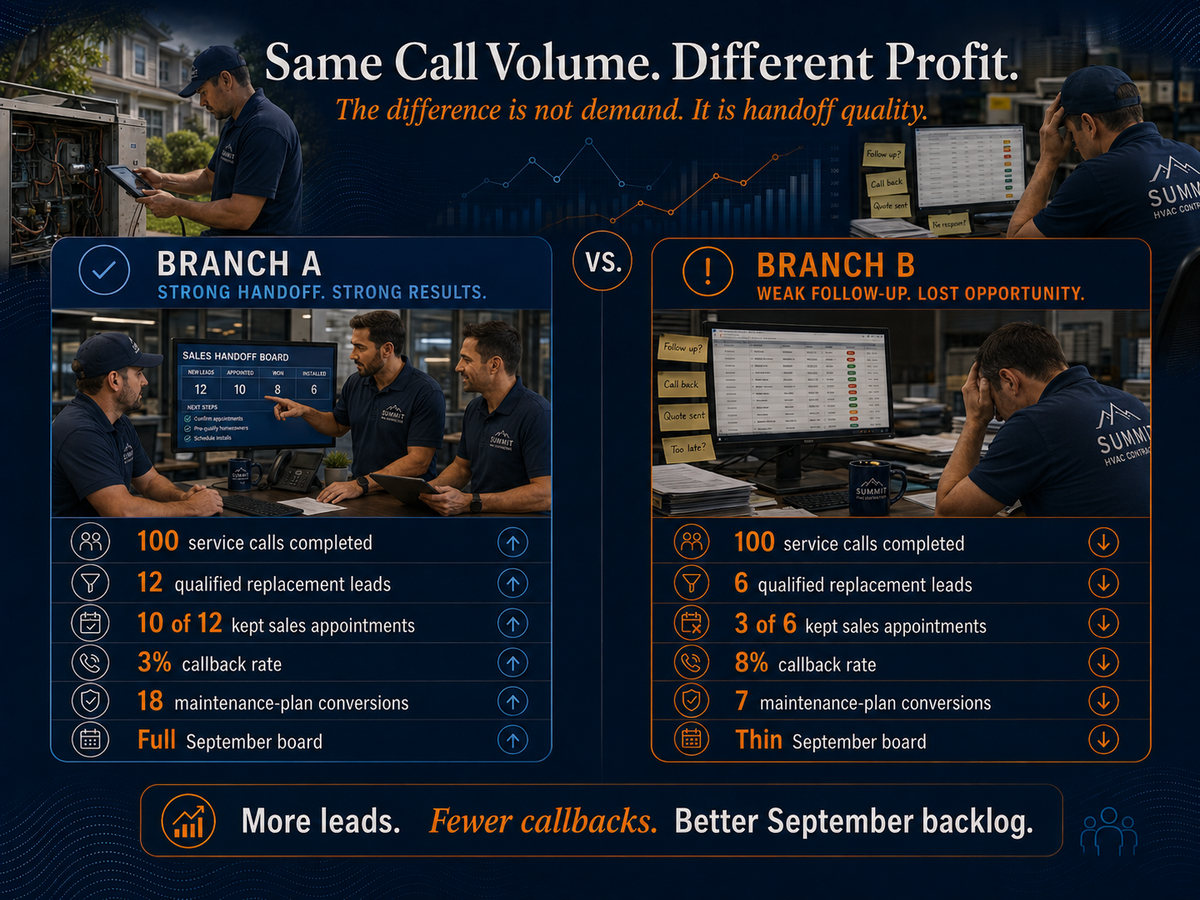
All figures illustrative. Actual gaps vary by service mix, system age, technician experience, comfort-advisor process, and financing adoption. Use it as a shape, not a benchmark — then run your own numbers. |
Where value is won — or lost: dispatch (right tech to right customer), diagnosis (immediate problem solved), opportunity capture (aging or repeat systems flagged), follow-up (sales contacted while urgency remained), pricing (proposal reflects current costs), installation (sold margin survives), retention (customer enters a maintenance relationship). The money is not in any one step. It is in the handoff quality between steps.
CEO question: Between your best and weakest branch this August, is the gap in the technicians — or in the handoff quality between service, sales, and install? |
|
|
|
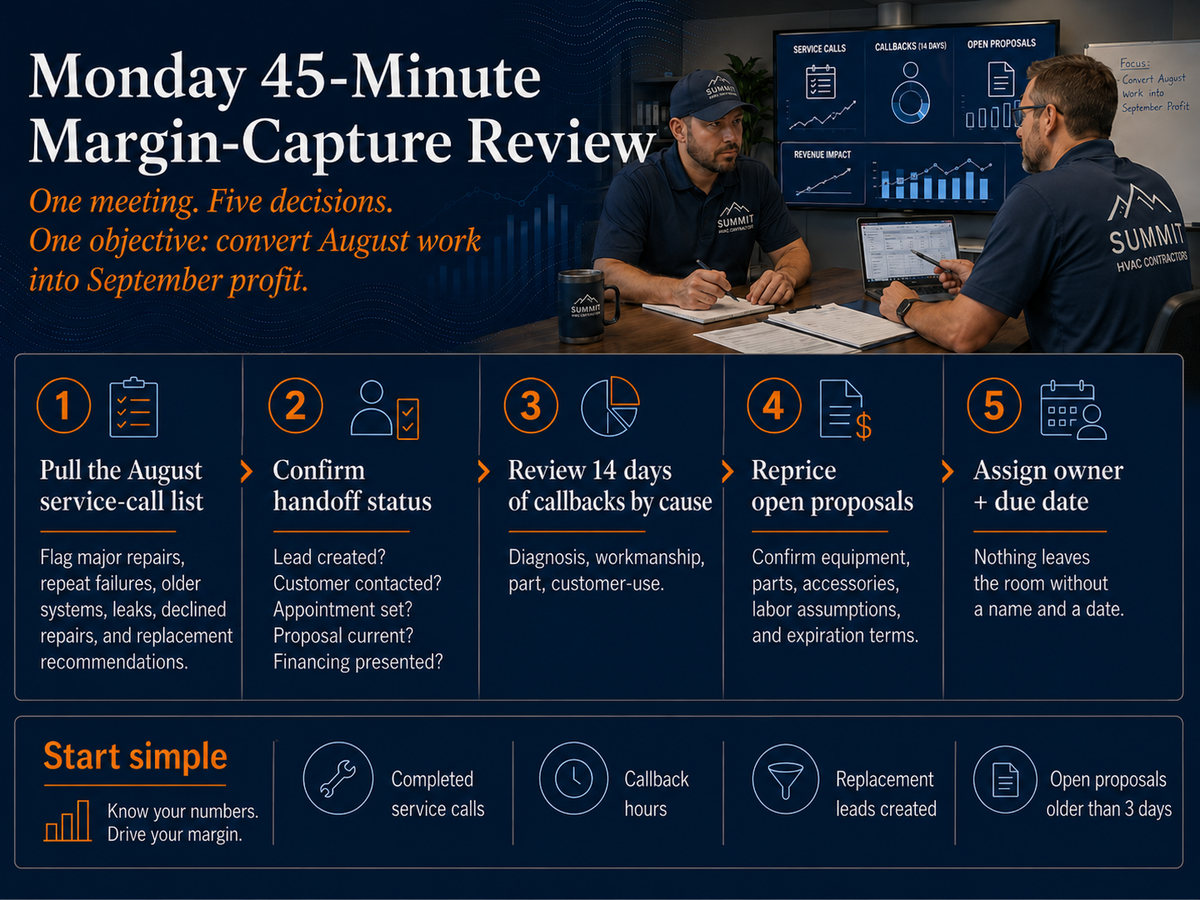
Monday 45-Minute Margin-Capture Review |
A single report. One meeting. Five decisions. Owner: GM or Service Manager. |
 |
|
|
Operator's Agenda · Week & Month |
|
|
Next 24–72 hours are owned by the Monday Review (Section 03). This section carries the week and month playbook.
This week
| P1 |
Reset dispatch priorities — with guardrails. Route by skill fit, urgency, geography, customer commitment, and economic opportunity — without compromising safety, contractual obligations (maintenance-plan members, warranty work, commercial agreements), or service standards. This is not a license to deprioritize low-ticket or low-income customers; it is a discipline against running "first call in, first call out."
Owner: Dispatch Lead + Service Manager · Review: this week
Expected outcome → gross profit per tech day improves while service commitments and safety standards hold
|
| P2 |
Tighten commercial cash controls. Review deposits, change-order approval, billing cadence, retainage, scope exclusions, escalation clauses, WIP margin, and AR aging by customer.
Owner: GM + Controller · Review: this week
Expected outcome → commercial backlog grows without creating slow-pay growth
|
| P3 |
Complete two separate refrigerant-readiness audits.
A2L track: technician training completion, model-specific procedures, approved tools, leak detection, recovery equipment, cylinder handling, refrigerant logs, warranty workflow, customer scripts, and service-manager signoff.
R-290 track: technician authorization, charge-limit and application-boundary rules, ventilation and ignition-control practices, vehicle and jobsite storage, manufacturer instructions, documentation, and warranty compliance.
Owner: Operations Lead + Training Manager · Review: this week
Expected outcome → callbacks, warranty leakage, safety exposure, and field hesitation all decline
|
|
|
This month
| P4 |
Update flat-rate books and proposal templates. Confirm updates across ServiceTitan/CRM/ERP, comfort advisor templates, good-better-best options, financing payment examples, accessory/IAQ add-ons, and commercial escalation language.
Owner: Pricing Manager / Sales Manager · Review: monthly
Expected outcome → price override and discount rate drop; installed GM consistency improves
|
| P5 |
Cash-flow and contract review. AR aging, change-order approval, billing cadence, retainage, deposits, escalation clauses, warranty language, slow-pay customers, commercial WIP, margin fade.
Owner: CFO/Controller + Project Manager · Review: monthly
|
|
|
|
Contractor Scorecard · Your Own Numbers |
This week's focus: gross profit per tech day — one important lens when call volume normalizes, read alongside sold-vs-installed margin, maintenance conversion, and lead quality. |
| KPI |
Management guardrail |
Owner |
| GP per tech day ◄ THIS WEEK'S DEEP DIVE |
Hold or improve as call volume normalizes |
Service + Finance |
| Callback rate |
Manage under ~3–5% |
Service + Install |
| Quote aging |
Reprice or requalify over 14 days |
Sales Ops |
| Replacement leads per 10 svc calls |
Track by equip. age + severity |
Service + Sales |
| Installed GM vs sold GM |
Installed should track sold |
Finance + Install |
| Commercial AR > 60 days |
Investigate rising balances |
Controller |
| Maintenance-plan conversion |
Conversion + renewal rate |
PM / Ops |
| A2L/R-290 readiness |
Training + tools complete by team |
Training + Ops |
Guardrails vary by service mix, system age, geography, technician experience, and commercial complexity. Use your own history to set final targets. A shop with 60% commercial mix, an older residential base, or a rural service footprint will land in a different band than a metro replacement-heavy shop. |
|
This week's deep dive · GP per tech day, operationally defined
Without a working definition, GP per tech day becomes branch theater. Start with the same numerator and denominator across the shop, or the number will not compare.
|
Working definition · Service GP per available tech day
Numerator: service revenue less direct field labor and payroll burden, materials, and direct warranty/rework cost.
Denominator: available service-tech days (not paid days, not dispatched days).
Separately track: replacement-generated gross profit so the service department is not credited with margin it does not control. Keep commercial technicians in their own pool so mix does not distort the number. |
Companion measures that keep this honest: callback hours as a percent of available hours, service-to-replacement lead rate and kept-appointment rate, and sold-vs-installed gross margin on completed replacements. Read them together.
Two ways this number degrades quietly this month: (1) sold margin holds on new estimates but installed margin fades because scheduling ran off stale costs — a discipline problem, not a market problem; (2) call count holds but callback hours consume material billable capacity. In the illustrative Branch A vs Branch B case above, the 5-point callback gap (3% vs 8%) is the visible symptom. Do not adopt those figures as benchmarks — calculate your own callback burden from payroll and dispatch records. Even a few percentage points of capacity loss can erase the benefit of a full board.
| Watch pattern |
Likely cause |
First fix |
| Revenue holds, GP/tech day falls |
Mix shifting to lower-margin repairs; discounting on aged quotes; stale equipment cost in scheduling |
Monday step 4 + agenda P1 |
| Same techs, different results |
Dispatch routing, not skill; handoff quality between service, sales, and install |
Agenda P1 |
| GP/tech day OK, overtime rising |
Callbacks and rework absorbing evening hours; not visible in the daily number |
Monday step 3 |
| Sold margin OK, installed margin fades |
Equipment cost variance, labor overruns, missed accessories, permits/crane, change orders, poor job-costing |
Monday step 4 + monthly job-cost review |
Illustrative patterns, not benchmarks. What "good" looks like depends on service mix and commercial complexity — a commercial-heavy shop should not compare its residential-heavy peer's tech-day numbers head to head. |
|
|
|
Business Quality / M&A Lens |
Did summer demand prove the operating system — or expose dependence on weather, owner heroics, and overtime? |
|
A stronger contractor exits August with
| ▸ |
Profitable replacement backlog carried into September |
| ▸ |
Stable gross profit per tech day and low callback drag |
| ▸ |
Current pricing and installed GM tracking sold GM |
| ▸ |
Growing maintenance-plan density |
| ▸ |
Commercial work supported by clean AR — and less owner intervention, not more |
|
|
|
A weaker contractor exits August with
| ▸ |
High revenue but weak installed margin |
| ▸ |
Stale proposals still in the pipeline |
| ▸ |
Poor service-to-replacement conversion; rising callbacks |
| ▸ |
Commercial revenue growth with slow-pay exposure |
| ▸ |
Owner-controlled follow-up and dispatch decisions — no measurable September carryover |
|
|
|
|
The diligence question this week
Which of this August's revenue would a buyer normalize away as weather-driven — and which capabilities would survive a normalized September? |
|
|
Six things to check in your own shop this week
| ▸ |
Gross margin: Do you know whether price, mix, overtime, or material inflation is moving your margin — or are you guessing? |
| ▸ |
August harvest: Can your service manager produce, by tomorrow, a list of the August calls most likely to become September installs? |
| ▸ |
Maintenance agreements: How many are active, renewing, and actually producing replacement leads? |
| ▸ |
Technician productivity: Can you pull GP per tech day, first-time fix, callback rate, and overtime hours right now? |
| ▸ |
Commercial AR: Is any of your commercial growth being financed by your own working capital? |
| ▸ |
A2L/R-290: Could every technician explain the process — and pass a random check of recovery logs, cylinder tracking, and refrigerant documentation? |
|
|
|
|
This Week's Contractor Checklist |
|
| ☐ |
Pull August service calls with replacement potential |
| ☐ |
Reprice proposals older than 14 days |
| ☐ |
Review callbacks by cause, not just count |
| ☐ |
Compare sold margin with installed margin |
| ☐ |
Rebalance dispatch by market conditions |
| ☐ |
Review commercial AR over 60 days |
| ☐ |
Run A2L and R-290 audits as two separate checklists |
| ☐ |
Track gross profit per tech day daily |
|
|
|
This week's management question
"Can your team show which August service calls became September gross profit — and how many technician hours were lost to preventable rework?" |
|
|
Each item is thesis-based: confirm / weaken / reverse. |
| HEAT PATTERN |
Whether heat re-expands beyond the lower Mississippi Valley.
Confirms → heat stays regional; teams complete follow-up and cleanup. Weakens → heat fades while replacement backlog remains thin. Reverses → broad heat returns and emergency dispatch becomes the bottleneck again. |
REPLACEMENT
CONVERSION |
Whether August service calls turn into September installs.
Confirms → August service customers produce September installs. Weakens → follow-up slows or customers defer. Reverses → service volume normalizes with no carryover backlog. |
INSTALLED
GROSS MARGIN |
Whether repriced proposals actually hold margin through install.
Confirms → installed GM tracks sold GM. Weakens → discounting or equipment-cost variance rises. Reverses → material margin fade appears across scheduled installs. |
COMMERCIAL
CASH CONVERSION |
Whether commercial growth is being financed cleanly.
Confirms → backlog grows while AR and WIP margin remain controlled. Weakens → billing lag and unapproved change orders rise. Reverses → AR over 60 days rises materially as commercial revenue grows. |
A2L AND R-290
EXECUTION |
Whether readiness on both tracks translates to clean field execution.
Confirms → both audits close out; callbacks stay low. Weakens → technician uncertainty slows jobs on either refrigerant. Reverses → warranty, safety, or documentation failures become material — especially R-290 charge/storage. |
PUBLIC COMP
SENTIMENT |
CARR, TT, LII, WSO, FERG on the tape.
Confirms → market keeps rewarding margin clarity over generic HVAC exposure. Weakens → sector rebounds without margin evidence. Reverses → strong OEM/distributor commentary signals broader demand acceleration. |
|
|
Final bottom line
A busy company runs calls. A valuable company converts demand into repeatable profit. Strong contractors turn August activity into September installs, clean gross margin, recurring relationships, and recovered technician capacity. Weak contractors turn it into stale quotes, callbacks, overtime, margin fade, and empty boards when the phones slow down. |
|
|
About this brief
Built for HVAC contractor owners, CEOs, presidents, and GMs who need to know what changed this week, what it means, and what to do about it. Every item sourced and dated.
Blue Ops supports HVAC contractors and their investors across the operating and investment lifecycle. See our HVAC practice → |
|
|
|
|
|