HVAC Distribution · Executive Intelligence · Week of Sept 7, 2026
The volume showed up.
The margin still has to.
The week in one line
HARDI's July jump was real, but weather did the work — and the 12-month line is still +2.7%. Treat volume as useful, not durable: protect freight recovery, A2L execution, and legacy-stock aging before you chase the print.
Three numbers that matter this week
1
HARDI distributor sales +6.7% in July, 12-month growth still +2.7%. Best monthly gain of the year on comparable billing days. HARDI itself tied the strong regions to cooling-degree-day gains. Read as weather pull, not replacement-cycle recovery.
2
Diesel $5.599/gal, down 5.3¢ WoW but up $1.865 YoY. A one-week dip does not fix a stale freight-recovery table. Fully-loaded delivery cost is still ~50% above last September. Every branch running free-freight habits is still leaking contribution.
3
Watsco Q2 gross margin 27.5% vs 29.3% prior year — 180 bps down. The company cited about 130 bps of 2025 pricing/A2L transition benefit that is now anniversarying. The market is shifting from inflation-aided gross margin to execution-driven clean margin. It is a public read on where private branches are next.
Do these three by Friday
1
Segment July/August sales into weather-pull vs recurring demand
2
Audit freight recovery on the top 25 delivery accounts per branch
3
Stress-test aged legacy inventory and A2L readiness before Q4
This week's deep dive is freight recovery — Section 05. Full agenda in Section 03.
Delivery-heavy branches (freight recovery) · weather-lifted Sunbelt / Central branches (segment July before setting September stock) · builder- and project-heavy branches (watch cohort AR) · legacy-refrigerant-heavy locations (aged-stock stress test).
From last week — still active
Last week's attachment and price-file discipline still matter. This week the bigger risk is assuming weather-driven volume fixed branch economics. Watsco's Q2 print quantified the pressure — 180 bps of GM compression, roughly 130 bps of it 2025 pricing/A2L anniversary that is now gone.
01
Signal Board
TakeawayDemand printed better in July. Freight, aged stock, A2L, and tariff risk decide who converts it. Six signals below — numbered.
The six branch-economics signals we watch — status, what it means, one action.
1 · Demand
STRENGTHENING · NEW
HARDI July +6.7% — best month of the year — but 12-month growth is only +2.7% and HARDI tied strong regions to cooling-degree-day gains. Weather pull, not replacement-cycle recovery.
Do this → segment July/August sales by weather-sensitive parts vs recurring service before raising any inventory target
2 · Pricing
NORMALIZING · STRENGTHENING
Watsco Q2 GM 27.5% vs 29.3%; ~130 bps of the drop was 2025 pricing/A2L anniversary. Pricing lift is no longer doing the work — invoice margin, freight recovery, and rebate capture are.
Do this → tie branch-manager incentives to clean gross margin plus rebate capture — not sales alone
3 · Commodity basket
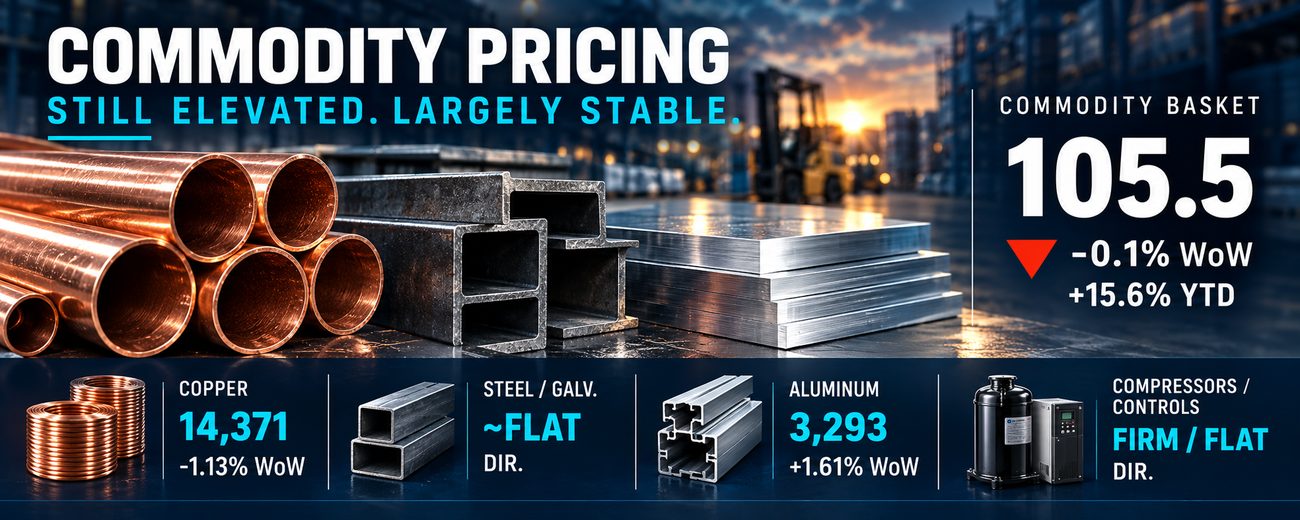
105.5 · −0.1% WoW
Copper eased ~1.1% ($14,371), aluminum firmed ~1.6% ($3,293). Basket flat WoW, YTD +15.6%. Not relief — two confirmed metals moving in opposite directions across coils, motors, sheet metal.
Do this → reconfirm cost basis on both copper- and aluminum-heavy SKU classes this week
4 · Freight / fuel
ELEVATED · STRENGTHENING
Diesel $5.599/gal, down 5.3¢ WoW but +$1.865 YoY. The weekly dip is noise. A branch on last year's recovery table is leaking contribution every route.
Do this → reprice delivery minimums, emergency fees, and fuel surcharges by branch density — not last year's defaults
5 · Regulation / trade
POLICY RISK · NEW
HARDI/AHRI/ACCA/PHCC asked USTR to preserve USMCA benefits and Section 232 relief. AHRI also filed a D.C. Circuit petition on the EPA Technology Transitions rule. Tariff and refrigerant policy churn on top of live A2L execution.
Do this → build country-of-origin and tariff exposure list for top 200 SKUs; give branch managers visibility before they quote long-duration jobs
6 · M&A / Capital
QUALITY PREMIUM · CONTINUING
Watsco's Jackson Supply close (~$230M 2025 sales, 25 Sunbelt locations) is still the marker in a 2,100+ distributor market. Public comps pay for margin durability and cash conversion — not top-line volume.
Do this → sellers, clean the WC/KPI package; buyers, normalize 2025 pricing/A2L windfall out of trailing EBITDA
02
Thesis of the Week
Two branches, same +7% July, different Q4.
The strong branch converted heat-driven traffic into disciplined counter margin, freight recovery, and repeat contractor loyalty. The weak branch matched competitors on equipment price, honored stale quotes after vendor files moved, ran free delivery, and finished the month with slower-moving inventory and stretched project AR. Same top line. Very different Q4.
The arithmetic
On a $20M branch, 130 bps of GM (Watsco's 2025 anniversary effect) is $260,000 that has to come from clean invoice margin, rebates, freight recovery, or aged-stock discipline. Add a 200-bp freight-recovery gap on $2M of delivery cost: +$40,000. Add a 25% haircut on $200K of aged legacy equipment: +$50K. Same top line, roughly $350K less contribution. That gap is what separates the two branches above.
03
Operator's Agenda
Three by Friday. Three this month. Two this quarter. If your branch can't produce category-turns or cohort AR yet, the Friday three still work — start with the top 25 delivery accounts and open quotes older than 14 days.
By Friday · three non-negotiables
#
Required action
Owner
Measure
P1
Segment July/August branch sales by weather-sensitive vs recurring. HARDI told you July was weather-tied. Do not raise September inventory targets off one hot month without margin and turns proof.
COO / branch ops
Category GM & turns
Weather-basket sales share
P2
Audit freight recovery on the top 25 delivery customers per branch. Diesel −5.3¢ WoW but still +$1.86 YoY. Free delivery or no fuel surcharge on emergency runs is a subsidy. Deep dive: Section 05.
Branch managers
+ finance
Freight recovery %
Delivery contribution / stop
P3
Review open quotes older than 14 days on cooling and copper-heavy SKUs. Copper eased ~1.1%, aluminum firmed ~1.6% — cost basis moved both ways. 50–150 bps of GM at stake where old quotes are still floating.
Pricing lead
+ branch managers
Quote age (%>14d)
Quote-margin variance
This month · three operating reviews
M1
Re-rank branches by clean gross margin, not revenue growth
HARDI's +6.7% will look like a bonus event at every branch. It isn't. Isolate branches where weather lifted the top line while GM% deteriorated — that is where false positives land in bonus math and in a diligence book.
Rebuild branch budgets around contribution per labor hour and per delivery stop
Better productivity signal and better diligence artifact than sales growth. Watsco's e-commerce mix at 37% of LTM sales is the leverage point private branches need to catch up on.
Q2
Segment contractor credit by service/replacement vs project/new construction cohorts
HARDI's blended DSO held under 37 days. Averages hide project-heavy contractors who stretch when timelines slip — with starts −12.4% MoM, that stretch is where AR pressure lands first.
If your branch reporting is still immature
You do not need a perfect dashboard to find the leak. Start with the top 25 delivery accounts (recovery gap $), open quotes over 14 days on cooling and copper-heavy SKUs, and aged inventory over 120 days by refrigerant generation. Three lists on paper this week beats a dashboard next quarter.
04
Blue Ops Baskets & Market Dashboard
TakeawayBasket essentially flat WoW as copper eased and aluminum firmed — but YoY costs remain structurally elevated. Cost-file discipline stays the margin lever.
How to use the basket
Early warning, not a price index. Copper and aluminum are market-confirmed; other components directional. Action thresholds: basket up >2 pts in 14 days → refresh open cooling-side quotes. Either metal up >3% in 14 days → cost-file review on affected SKUs. Manufacturer price-file change on file → freeze quote extensions past the effective date.
Basket settled at 105.5 with the two confirmed metals moving in opposite directions — copper closed near $14,371 on 9/4 (down ~1.1% from $14,535 on 8/28) while aluminum firmed to $3,293 (up ~1.6% from $3,240). WTI near $92 keeps freight-cost assumptions elevated. This is not the beginning of relief — a flat WoW headline masks two separately volatile cost streams. Copper eases coil and lineset pressure; aluminum firmness re-loads sheet-metal and equipment-casing exposure. Do not price September quotes on August cost files without confirming both metals at the SKU class level.
Component
Weight
This week
What it means
Copper
30%
14,371 · −1.13%
Modest ease from 52-week highs; still elevated YTD — hold quoted margin on coils, motors, linesets, wire, service parts
Steel / galvanized
30%
~Flat · dir.
Directional this week; S232 tariffs keep domestic steel firm — no basis to give back price
A2L models continue to carry premium; cost pressure remains directional
Motors
8%
Firm · dir.
Copper ease offsets some pressure; aluminum firmness offsets some ease
Controls
7%
~Flat · dir.
Directional flat; monitor as A2L system controls change
Index = weighted weekly move of six components, Jan 2025 = 100. Copper and aluminum from Markets Insider closes 9/4 vs 8/28; steel, compressors, motors, controls are directional this week.
Core Equipment Basket
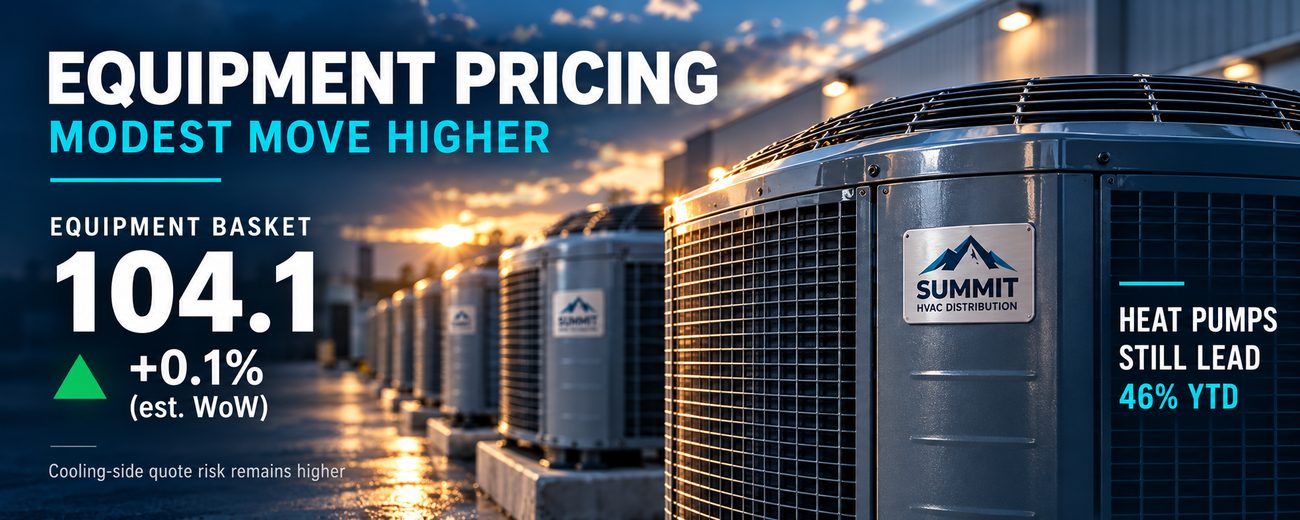
HEAT PUMPS STILL LEAD · 46% YTD
104.1
Index · Jan 2025 = 100 · directional
+0.1% WoW +4.1% since base
Heat pumps ~+0.2%, AC ~+0.1%, furnaces ~flat
13-week trend
Equipment basket ~104.1 — directional read, not a rate. AHRI June: 605,033 unitary AC and 418,538 heat pumps (YTD HP ~46% of unitary). Cooling-side quote risk remains higher than furnace risk — age out cooling quotes over 14 days first.
Basket index · rolling 13-week + YTD
Index
6/15
6/22
6/29
7/6
7/13
7/20
7/27
8/3
8/10
8/17
8/24
8/31
9/7
WoW
YTD
Commodity
99.4
99.2
99.8
100.5
101.1
101.8
102.9
104.2
104.8
104.9
105.1
105.6
105.5
−0.1%
+15.6%
Equipment
100.8
101.0
101.2
101.4
101.6
101.8
102.0
102.3
102.6
103.5
103.8
104.0
104.1
+0.1%
+4.1%
Both baskets: Jan 2025 = 100. YTD is measured from Jan 1, 2026. Copper and aluminum are market-confirmed; steel, components, and all equipment inputs are directional.
Public comps & macro indicators
Instrument
Level / 7-day
What it means
Copper
14,371 · −1.13%
Modest ease from near-highs; still elevated — hold price on coils, motors, linesets, wire, service parts
Future work possible — but permits are not revenue; do not build inventory on the print
AHRI unitary shipments (Jun)
1.024M units
HP 41% of Jun
YTD HP mix 46%; branches need controls, coils, accessories, and training — not just outdoor-unit availability
Sources: HARDI July release (Sept 1); U.S. Census Monthly Construction Spending Jul (Sept 1) and New Residential Construction Jul (Aug 18); AHRI June shipment data (Aug 14). Housing and construction data are national; Sunbelt vs colder markets, and replacement vs new-construction branches, will vary.
05
Operator Scorecard · Your Own Numbers to Watch
TakeawayFreight recovery is the cleanest test this week of whether a delivery-heavy branch is turning traffic into contribution — or subsidizing accounts diesel is quietly making unprofitable.
These are your numbers. They decide whether market signals turn into profit.
Falling trend, or capture rate under ~70% of eligible invoices.
Clean gross margin %
Invoice-level GM by branch and by category (equipment / parts / accessories). Separate rebates so you see execution vs vendor programs.
Down >150 bps MoM — driver is cost-file lag, discounting, or mix.
Aged inventory $
>120-day and >180-day dollars by category and by refrigerant generation (A2L vs legacy).
Rising during peak season — write-down risk before Q4 close.
A2L return rate
A2L-related returns $ ÷ A2L transactions $, by branch and by contractor cohort.
Rising trend at a specific branch or contractor.
Quote age
Days since quote issued, by SKU class. Copper down / aluminum up means both directions of quote risk.
Any cooling or aluminum-heavy quote >14 days old.
AR by customer cohort
Days-to-pay weighted by invoice $, split into service/replacement / builder / commercial / retail. HARDI's blended DSO hides project stretch.
Builder or project cohort stretching past 45 days.
Starting definitions — calibrate to your own mix. Replacement/service-heavy branches sustain higher turns and lower AR days than project or builder-heavy branches. The question is whether each branch is improving against its own baseline, not whether it hits one network target. Extended KPI definitions and watch levels available on request.
This week's deep dive · Freight recovery %
Why it matters now
Diesel dipped 5.3¢ this week to $5.599 — but sits $1.865 above last year. That is not going back to 2024. And July's HARDI print produced more delivery runs at every branch that responded to heat. Higher run rate + stale recovery table = contribution walking out on every route.
How to measure it
Numerator: all delivery revenue — invoice delivery line, fuel surcharge, minimum-order fee, hot-shot premium, jobsite fee. Denominator:fully-loaded delivery cost — fuel, driver wage/benefits/OT, vehicle depreciation and maintenance, and allocated route overhead. If your ERP only shows fuel, the denominator understates the real bill by roughly 40–60% and the recovery % looks better than it is.
Where the leaks live — four inputs
(1) Route density — stops per hour; three drops on a rural route is a different problem than twelve on a metro route. (2) Invoice size per stop — a $250 capacitor drop and a $12,000 equipment delivery both take an hour. (3) Surcharge capture rate — the share of eligible invoices where fuel surcharge or delivery fee actually landed, not waived at the counter. (4) No-charge exception density — how many "just this once" waivers stacked into the top 25 accounts. Each is fixable branch by branch. None is fixable without measuring it.
What good looks like — by branch model
These are starting points, not industry rules. Calibrate to your own mix, geography, and route structure.
Branch model
Recovery focus
Main leak
Dense metro / high-stop
Full-recovery target achievable; hold surcharge discipline
Counter waivers stacking on top 25 accounts
Rural / long-route
Recovery per stop, minimum order size, will-call incentives
Small-invoice drops with no minimum; single-drop routes at $5.60 diesel
Emergency runs treated as goodwill; premium waived to keep contractor happy
The rule: if surcharge capture is under ~70% of eligible invoices, or if the top 25 delivery accounts pay less-than-list on delivery, the branch is subsidizing customers who did not ask to be subsidized. Fix the recovery table before the next diesel move makes the leak visible in EBITDA.
Do this week → pull invoice-level delivery revenue vs fully-loaded cost by branch. Rank the top 25 delivery accounts by "recovery gap $." Set a 30-day plan to reprice, reclassify, or convert to will-call the top 10.
Worked example: 40 delivery stops/day, 5 days/week, 15-mile route legs at 8 MPG and $5.60/gal = ~$210/day in fuel across all stops. Add driver time, vehicle, and overhead, fully-loaded cost per stop is roughly $18–28. A $5 delivery fee on a $250 invoice covers about 20% of that. Fine as a one-off; not as a policy on 500 invoices a week.
Last week: inventory turns / aged stock. Next week: cost-file lag — the copper-down / aluminum-up split as the walk-through.
06
National Channel Intelligence
TakeawayVolume is present but weather-influenced; margin normalization confirmed at the public comp; policy and inventory risk are moving in parallel. Distribution valuations reward margin, digital, and discipline — not headline growth.
Best monthly gain of the year on comparable billing days — but HARDI tied strong regions to cooling-degree-day gains. Use the lift; do not extrapolate. HARDI →
All operators — segment weather-tied vs recurring before setting September stock
~130 bps of the 180 bp GM drop is 2025 pricing/A2L anniversary now gone. Diligence should isolate that windfall from repeatable branch earnings. Watsco →
Buyers/lenders — normalize windfall out of trailing EBITDA
Watsco Jackson Supply: ~$230M 2025 sales, 25 Sunbelt locations Jun 26
Density, contractor relationships, and line-card position still command a premium in a 2,100+ distributor market. Sellers should clean the WC and KPI package now.
Sunbelt operators — benchmark contractor experience against Watsco locally
HVACR coalition urges USTR to preserve USMCA benefits Sept 1
HARDI, AHRI, ACCA, PHCC ask covers Section 232 relief and rules-of-origin exemptions. Whatever the outcome, tariff exposure needs SKU-level visibility before it hits margin. HARDI →
Supply chain — build tariff exposure list for top 200 SKUs
AHRI's D.C. Circuit petition on the EPA Technology Transitions rule and Watsco's Q2 A2L SKU expansion (10,000+ new SKUs across 650 locations) are covered in Section 07.
07
Regulatory & Product Transition
A2L readiness — six things to walk branch by branch
□
Counter staff trained on approved substitutions and refusal cases
□
Storage, ventilation, and cylinder-handling procedures posted
□
Match-up documentation available at counter; compatibility verified against manufacturer bulletins
□
Returns reason codes coded distinctly for A2L transactions
□
A2L return rate tracked weekly by branch and by contractor
□
Legacy R-410A disposition plan active — return, transfer, discount, or write-down
TakeawayTwo policy tracks live: AHRI's AIM Act litigation and USMCA/Section 232 preservation. Both raise the value of inventory and price-file discipline.
A2L / AIM Act litigation
POLICY UNCERTAINTY · NEW
AHRI filed a D.C. Circuit petition for review of EPA's Technology Transitions Reconsideration Final Rule. Regardless of outcome, policy churn raises the value of tight inventory discipline and rapid price-file updates.
Response → keep A2L SKU communications tight; keep legacy inventory disposition plans active branch by branch
USMCA / Section 232 preservation
TARIFF RISK · NEW
HARDI/AHRI/ACCA/PHCC coalition asked USTR to preserve USMCA benefits, Section 232 relief, and rules-of-origin exemptions. Trigger to build country-of-origin visibility now — before policy forces reactive repricing.
Response → tariff / USMCA exposure list for top 200 SKUs
Metal whipsaw / cost files
CONTINUING RISK
Copper eased ~1.1% while aluminum firmed ~1.6%. Basket looks flat but the two moved in opposite directions. Quotes older than 14 days carry risk from either side.
Response → reconcile ERP cost basis to vendor files weekly on both copper- and aluminum-heavy SKUs
08
Regional Heat Map
TakeawayNOAA CPC 6–10 day valid Sept 12–16 favors above-normal temperatures across most of CONUS, with possible unseasonably warm mid-September conditions in the East. Confidence average (3/5). Read as late-season service/parts pull, not equipment stocking event.
East / Southeast
ABOVE-NORMAL · STRENGTHENING
NOAA CPC 6–10 day favors above-normal temperatures across most of CONUS east of the Rockies; unseasonably warm mid-September temperatures possible in the East. Supports emergency parts, capacitors, motors, refrigerant, and replacement quoting. Do not overbuy slow-moving equipment on one late-season heat window.
Deal read → favor branches with proven emergency-parts fill rate and disciplined counter margin; watch rush-order and hot-shot delivery pricing
Midwest / Central
ABOVE-NORMAL · MODERATE
Broad warmth likely across the Midwest and Central Plains through Sept 12–16 with some pattern uncertainty. Supportive for service parts and replacement quotes; do not assume builder / install recovery. Separate service/replacement sales from new-construction backlog in every weekly branch review.
Deal read → prioritize branches with clean split reporting between replacement/service and project revenue
Pacific Northwest / N. Plains
NEAR- TO BELOW-NORMAL · MONITORING
Near- to below-normal temperatures favored in portions of the Pacific Northwest and Northern Plains. Cooling urgency softer; watch staffing and inventory after hot-weather assumptions. Tighten reorder points and prioritize year-round failure parts.
Deal read → tighten inventory buys; monitor aged cooling items; do not transfer slow equipment into weaker-weather branches
California / West Coast
FREIGHT COST HIGH · CONTINUING
Diesel remains elevated on the West Coast (well above the $5.599 US average). High fuel cost makes free delivery especially expensive; a route-density-tuned recovery table matters more here than anywhere else.
Deal read → buyers will care about the recovery table because it shows whether branch economics are real
09
M&A / Capital Markets Radar
TakeawayPublic market rewards margin durability, not top-line growth. Private diligence pivots to demand quality, freight recovery, A2L execution, and inventory age by refrigerant generation.
Public comp tone — margin normalization confirmed
CAPITAL MARKETS · CONTINUING
Watsco Q2 quantified what the tape had been telegraphing: revenue +2%, GM down 180 bps (~130 bps of it 2025 pricing/A2L anniversary). Public buyers pay for scale, procurement leverage, and cash conversion — not top-line volume.
Watch → do not accept "distributor" comps as fair value for private assets without margin, freight recovery, and cash conversion evidence
Private-market posture — Jackson Supply as the marker
STRATEGIC COMP · CONTINUING
Watsco's Jackson Supply close (~$230M 2025 sales, 25 Sunbelt locations, ~5,000 customers) remains the strategic comp in a 2,100+ distributor market. Premium: Sunbelt density, balanced mix, defensible OEM lines, branch-manager continuity. Caution: weather-spike revenue with weak margin, legacy inventory, informal pricing, owner-dependent sales.
Watch → sellers, prepare the WC and branch-KPI package now; buyers, normalize A2L / pricing windfalls out of trailing EBITDA
Demand quality as diligence focus
DILIGENCE · STRENGTHENING
Diligence pivots to replacement/service mix, invoice-level freight recovery, A2L documentation, inventory aging by refrigerant generation, and AR quality by cohort. "Strong contractor relationships" without process evidence is a caution flag — they may be funded by unrecovered delivery, aged inventory, or stretched terms.
Watch → require the seller to produce margin, freight recovery, inventory aging, and days-to-pay by branch and by customer cohort
Bottom line
SUMMARY
Premium goes to replacement/service mix, strong parts and accessories attachment, disciplined freight recovery, documented A2L readiness, low aged inventory, clean rebate capture, and branch managers running process. Caution goes to builder-heavy volume, free-freight cultures, stale legacy inventory, contractor concentration, and revenue that depends on the owner staying in the seat.
10
The Deal Lens · What This Week Says
What this week says to favor
▸
Replacement/service-heavy branches with 95%+ fill rate on critical A2L items and same-day availability
▸
Documented freight recovery by branch and by account — not free-freight culture at $5.60 diesel
▸
Visible A2L readiness — match-up docs, counter scripts, cylinder/reclaim process, low return rate, active legacy disposition plan
▸
Commercial service/retrofit mix with recurring maintenance demand — supported by Census nonresidential +0.4% MoM
▸
Branch managers running process — segmented sales reporting, weekly margin reviews, cohort AR discipline
What this week says to avoid
▸
Equipment-volume growth created by price concessions or one hot month with no margin bridge
▸
Builder- and new-construction-heavy branches against −12.4% MoM starts and −16.8% YoY completions
▸
Aging R-410A or mismatched A2L inventory without an active liquidation plan
▸
Free-freight cultures, no fuel surcharge on emergency runs, or long jobsite routes with no over-threshold pricing
▸
Vendor economics that are not transferable at close, or top-manufacturer relationships owned by the seller personally
This week's key diligence question
Can management reconcile July/August sales growth to clean branch contribution — after freight, rebates, returns, warranty, inventory aging, and AR — by branch and by customer cohort? If the answer is no, the revenue is not yet underwritable.
11
Next Monday's Watchlist
MONTHLY
HARDI August print + regional commentary — July's +6.7% was weather-tied. Confirm: August moderates and strong regions still align with heat. Weaken: August also runs hot and starts to look broad-based. Reverse: multiple regions post sustained growth independent of weather with clean GM% and stable DSO.
WEEKLY
NOAA CPC 6–10 / 8–14 day outlook — late-season heat drives service/replacement urgency east of the Rockies. Confirm: heat pattern holds or extends. Weaken: heat signal moderates. Reverse: broad cool-down cuts emergency call volume.
WEEKLY
Diesel / freight recovery — one-week dip does not fix the year-over-year picture. Confirm: diesel stays elevated and branches recover surcharges. Weaken: diesel keeps dropping and branch recovery improves at pace. Reverse: diesel falls materially and customers accept explicit delivery pricing.
WEEKLY
A2L returns and warranty claims — transition risk shows up at the branch cost line. Confirm: returns, misorders, or tech-support calls rise. Weaken: training and match-up docs cut error rates. Reverse: D.C. Circuit ruling or EPA action changes the compliance roadmap.
MONTHLY
Residential starts / permits / construction spending — builder exposure remains a caution. Confirm: starts stay weak, completions keep declining. Weaken: permits convert to starts. Reverse: builder demand accelerates on better affordability.
INTERNAL
Operator scorecard — freight recovery % this week; aged stock carry-forward; quote age and AR by cohort weekly. Confirm: recovery % rises and aged buckets shrink. Weaken: flat recovery with rising delivery cost. Reverse: aged buckets grow while sales moderate.
Management question for this week
Of the branches that beat plan in July, which ones improved clean gross margin, freight recovery, and inventory turns at the same time — and which ones grew top line while quietly losing ground on all three?
That second group is where September inventory and December bonus math will lie to you. The Section 05 dashboard is what tells you which is which.
Source Notes
Sources checked Sept. 7, 2026:
HARDI — "HARDI Distributors Report 6.7% Revenue Increase in July" (Sept 1): July 2026 distributor sales +6.7%; 12-month growth +2.7%; DSO <37 days
HARDI / AHRI / ACCA / PHCC — "HVACR Coalition Urges USTR to Preserve USMCA Benefits" (Sept 1): coalition ask on USMCA, Section 232, rules of origin; cited 1.9M workers
U.S. Census Bureau — Monthly Construction Spending, July 2026 (Sept 1): total $2.1576T SAAR, −0.5% MoM, −3.8% YoY; private residential $859.0B −1.3% MoM; private nonresidential $755.2B +0.4% MoM
U.S. Census Bureau — Monthly New Residential Construction, July 2026 (Aug 18): permits 1.443M SAAR, starts 1.239M SAAR (−12.4% MoM), completions 1.212M (−16.8% YoY)
AHRI — June 2026 U.S. Heating and Cooling Equipment Shipment Data (Aug 14): unitary AC 605,033, heat pumps 418,538; YTD AC 2,560,139, HP 2,156,549 (HP ~46% of YTD unitary)
Watsco — Q2 2026 release (Jul 29): revenue +2%, same-store +1%, GM 27.5% vs 29.3%, op margin 11.3% vs 13.2%; e-commerce $2.7B LTM / 37% of sales; Jackson Supply close (~$230M 2025 sales, 25 Sunbelt locations)
EIA — Gasoline and Diesel Fuel Update (Sept 1): U.S. on-highway diesel $5.599/gal for 8/31/26, −$0.053 WoW, +$1.865 YoY
NOAA Climate Prediction Center — 6–10 day outlook updated Sept 6, valid Sept 12–16; above-normal temperatures across most CONUS; confidence 3/5
AHRI — D.C. Circuit petition for judicial review of EPA Technology Transitions Reconsideration Final Rule (procedural AIM Act challenge)
Markets Insider — commodities and public comps snapshots (accessed Sept 7): copper ~$14,370.85, aluminum ~$3,292.50, WTI ~$92.66
Blue Ops commodity and equipment basket indices (copper and aluminum confirmed; remaining components directional)
How this brief is built
Outside view (signals, baskets, market dashboard, channel and regulatory news) paired with an inside view (operator agenda, scorecard). Confidence: High = official release or filing; Medium = credible trade reporting not independently confirmed. Where equipment basket components lack a public weekly series, we mark them directional. Scorecard targets are starting points — calibrate to your own branches.
Blue Ops supports HVAC distribution companies across the investment lifecycle — from branch-level performance improvement to acquisition diligence and value-creation planning. See our HVAC practice →