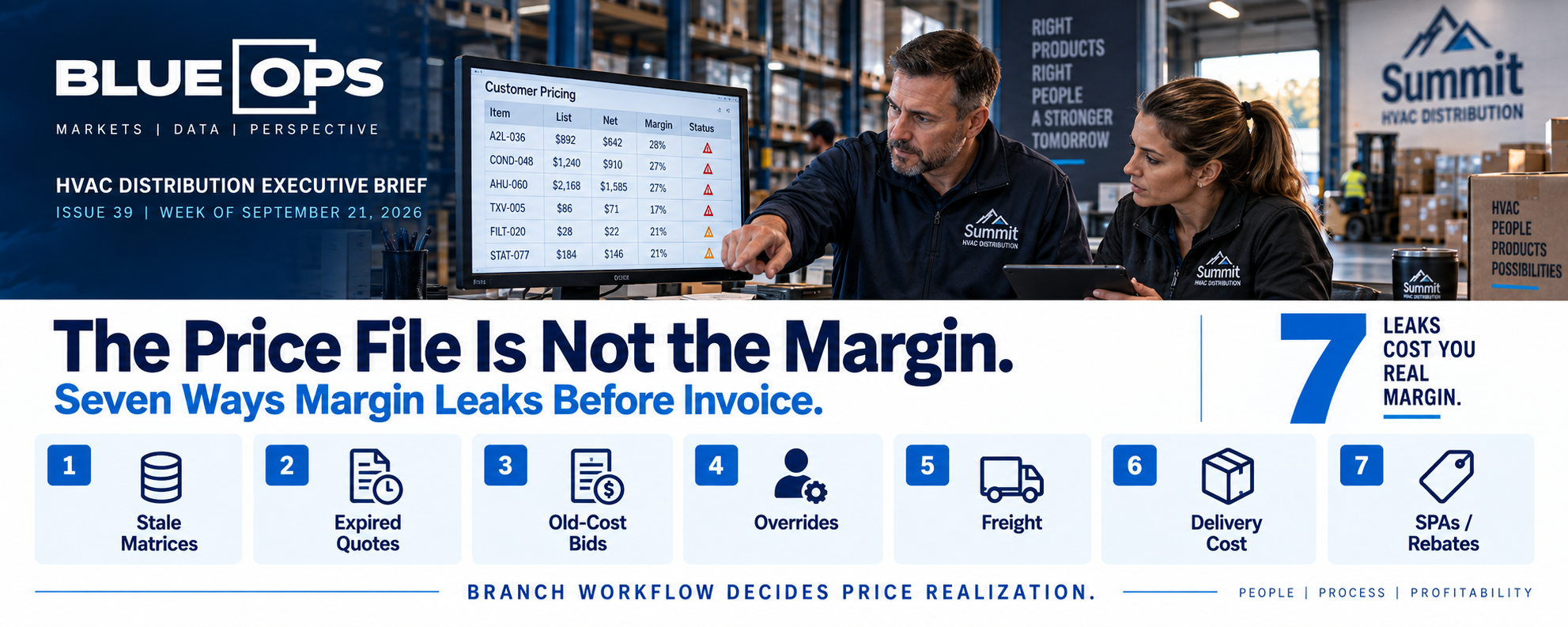
The Price File Is Not the Margin. Seven Ways Margin Leaks Before Invoice.
September 21, 2026
ISSUE NO. 39
HVAC Distribution · Executive Intelligence · Week of Sept 21, 2026
The Price File Is Not the Margin. Seven Ways Margin Leaks Before Invoice.
A 72-hour branch audit for stale quotes, overrides, freight, bids, SPAs, and delivery cost — with branch-calibrated escalation triggers.
10 MIN FULL · 3 MIN BRIEF · 30 SEC SCAN
This week · the operating question
Where does margin disappear after cost changes but before invoice realization — and which control fails first at the branch?
Price realization is the share of an intended price or cost adjustment that survives through the transaction and is retained in invoice gross-margin dollars, after matrices, quotes, bids, overrides, freight, delivery, SPAs, and rebates. It is a branch workflow, not a price-file event. Seven leakage paths sit between the price or cost move, invoice margin, and ultimately cash realization — any one of them can absorb the entire move before it reaches the invoice or the bank.
Last week → this week
Last week we separated reported branch GM from normalized earnings — Clean GM tells you what the branch earned. This week we identify the operating controls that determine whether a cost move ever reaches invoice margin — quote-to-invoice leakage tells you why the branch did not keep more. Normalization is an accounting exercise. Leakage control is a workflow exercise. Both matter; they are not the same tool.
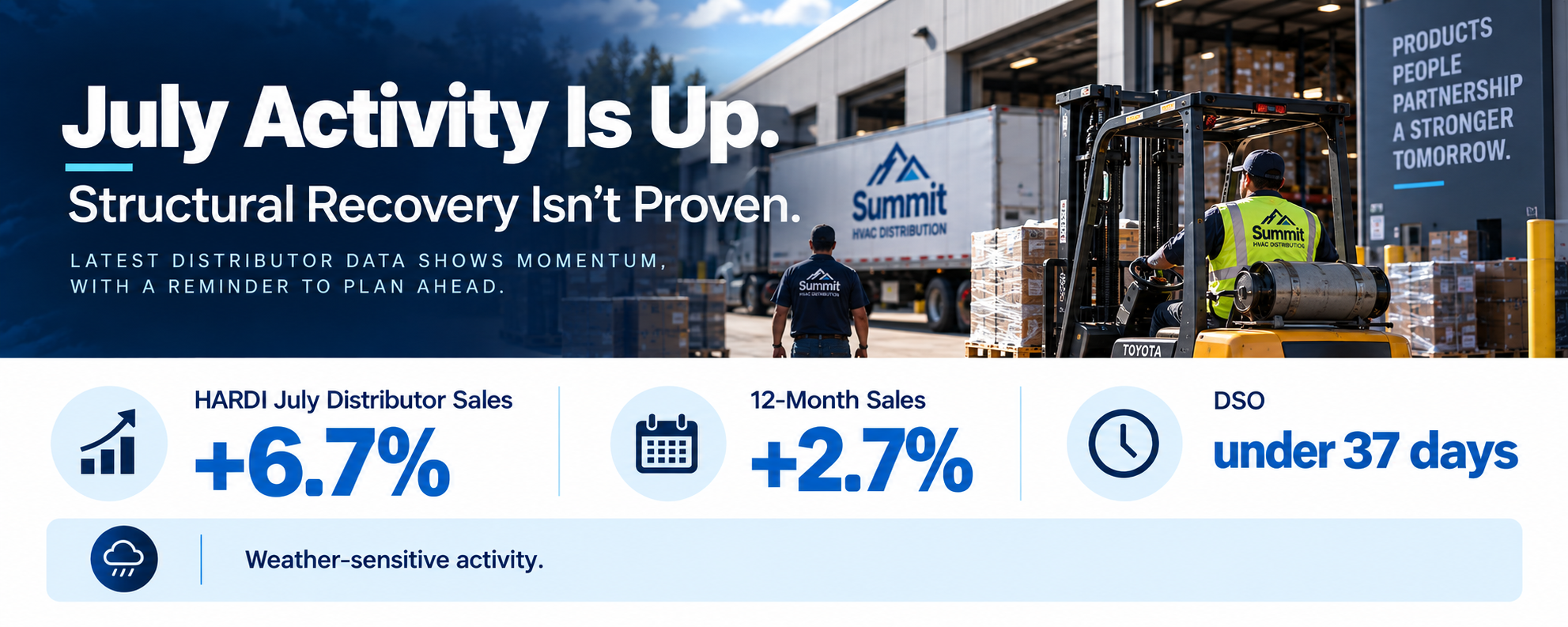
+6.7%
HARDI July revenue
12-month sales +2.7%. HARDI flagged regional strength/weakness tracking cooling-degree-day change. Weather-sensitive activity, not proof of structural recovery.
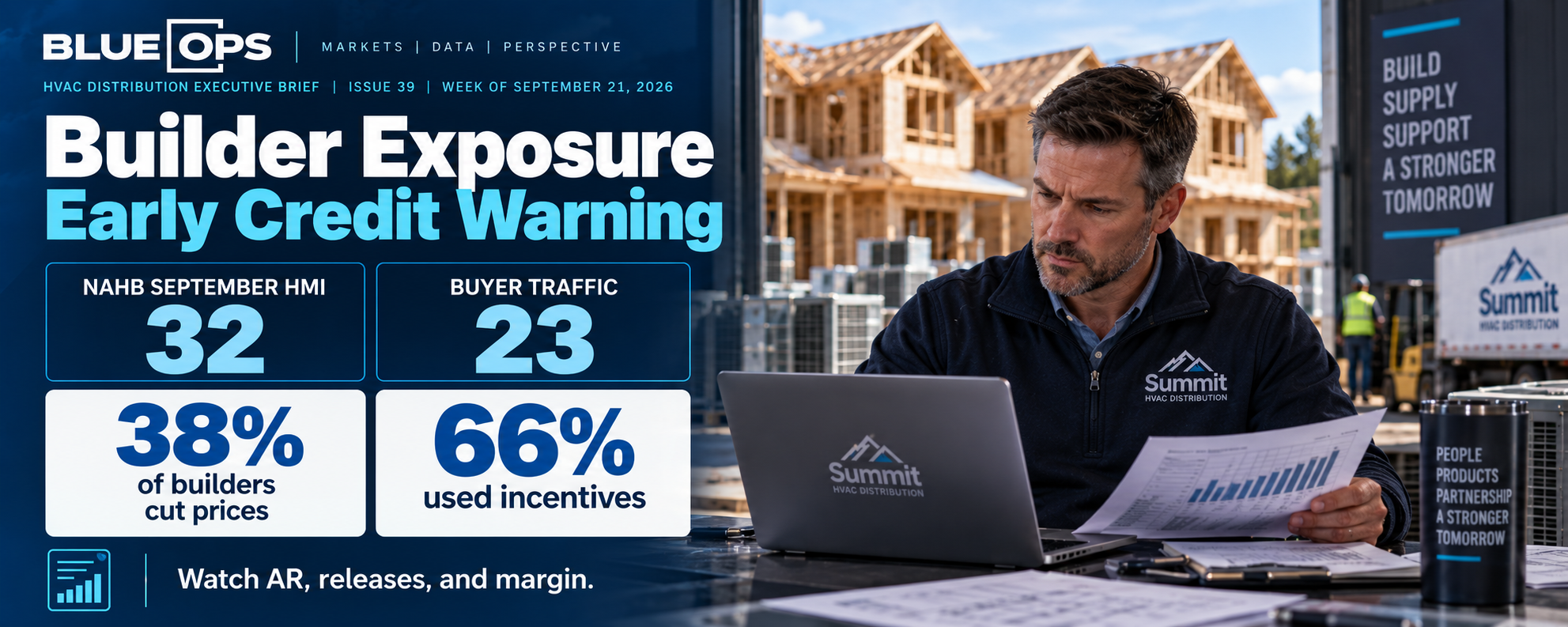
Current sales 35 · expectations 37 · buyer traffic 23. 38% of builders cut prices, 66% used incentives. Early credit and working-capital warning, not a demand collapse.
Contractors see potential price/logistics upside — but worry about technical support, training, warranty help, local relationships. An opening for regionals and independents — if the support is measurable.
The vendor increase is not the profit. Where does branch price realization actually leak?
Quote-to-invoice margin leakage — the seven paths between any intended price or cost move and realized invoice margin: stale matrices, honored expired quotes, old-cost bids, counter and outside-sales overrides, unrecovered freight, hot-shot and delivery cost, SPA / rebate leakage. Includes the leakage waterfall, the 72-hour audit checklist, an operating maturity table, and six branch-calibrated escalation triggers.
HARDI July, NAHB September HMI, big-box ownership read, OEM price watchlist (source-quarantined), A2L / refrigerant transition, commercial-applied exposure. Each with source quality, distributor impact, branch action, and what would change the read.
02
Thesis of the Week →
2 min read
Two branches both posted higher July invoice dollars. Only one kept the margin and the cash. Why the difference is a management problem, not a market problem — and what the next 72 hours look like at each.
03
Operator's Agenda →
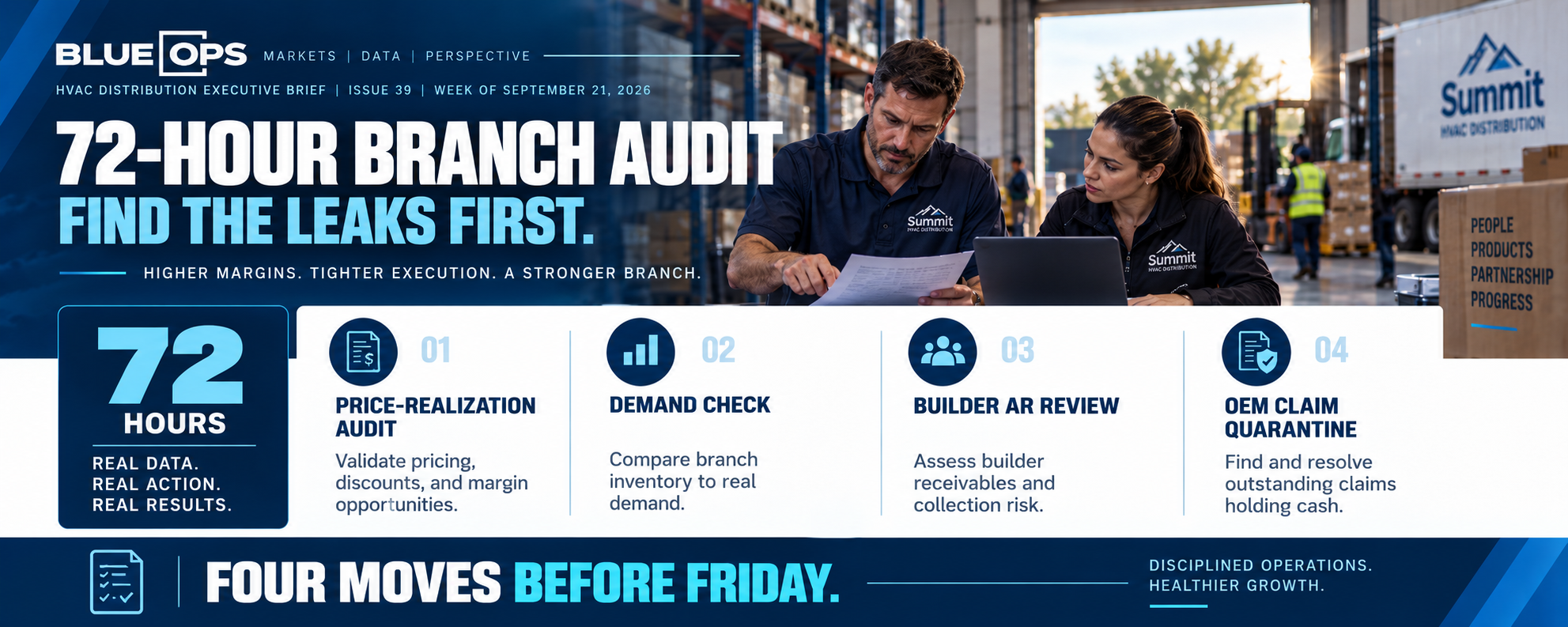
Do these by Friday
Next 24–72 hours: price-realization audit, branch-trade-area demand check, builder AR / release review, and OEM claim quarantine. Each item with expected outcome, management check, and failure mode.
04
Economic Mechanisms & Market Dashboard →
Six mechanisms · directional
Demand · pricing · inventory · working capital · contractor behavior · commercial exposure. Each with the leading indicator, the escalation trigger, and the branch proof required. Baskets directional this week; OEM-specific vendor claims held out.
05
Operator Scorecard →
This week: Quote-to-invoice leakage
Six operating KPIs on rotation — quote-to-invoice margin leakage, override %, first-pass fill rate on emergency SKUs, transfer + hot-shot cost per sales dollar, DIO and aging by platform, DSO by contractor type. Compare each branch against its own trailing-13-week baseline. This week's focus goes deep below.
06
Regulatory & Product Transition →
A2L: OEM-specific execution
A2L / refrigerant transition is not one workflow. It is an OEM-specific counter execution problem — matched-system validation, accessory/tool applicability, documentation access, warranty protection, attachment capture. Plus the platform-inventory question that decides whether the branch has stock or dead stock.
07
Big-Box Ownership · The Independent's Opening →
Support is measurable · or it's marketing
ACHR's contractor interviews say the same thing distributors have said privately: price and logistics upside, real worry about technical support, training, warranty help, and the counter relationship. That is either an opening or a warning — depending on whether the independent can prove support with numbers.
08
Distributor Archetype Impact →
7 archetypes
Service/replacement-heavy · new-construction-heavy · commercial mechanical/applied · regional independent · PE-backed / branch-dense · OEM-concentrated · acquisition target. What matters this week for each — and the specific operator move required.
09
The Deal Lens →
Favor · Discount
What to favor, what to discount, plus the one diligence question that separates a repeatable earnings story from a weather-and-rebate story: If July weather tailwinds and vendor rebates are normalized out, what branch EBITDA and cash conversion remain?
10
Next Monday's Watchlist →
7 items
August HARDI detail, primary OEM notices (or absence), Census release, builder AR movement, big-box service benchmarks, A2L attach data, and the rebate accrual-to-cash reconciliation that decides whether reported growth is real.
Prefer to scan the whole thing? Keep scrolling. The 30-second executive read (week in one line · three numbers · three actions) is right below.
The week in one line
HARDI July revenue +6.7% and 12-month sales +2.7% — but HARDI itself flagged the regional split as cooling-degree-day-driven. NAHB's September builder sentiment fell to 32. Big-box ownership in distribution puts a premium on measurable branch support. The operating question is not whether sales are up. It is whether branches converted activity into price realization, first-pass fill rate, inventory productivity, receivables discipline, and cash — before the weather tailwind fades and before any confirmed cost-file change (or other replacement-cost movement) finds its way into stale quotes.
Three numbers that matter this week
1
HARDI July distributor sales +6.7%; 12-month +2.7%; DSO under 37 days, comparable to July 2025 (HARDI TRENDS release, Sept. 1). HARDI's own note: the strongest regions had the biggest cooling-degree-day gains; the weakest had the biggest declines. Treat as weather-sensitive activity, not proof of structural recovery. Check branch-level GM dollars, fill rate, transfer cost, and AR before changing inventory posture.
2
NAHB September HMI 32 · current sales 35 · six-month expectations 37 · buyer traffic 23. 38% of builders cut prices, 66% used incentives (NAHB / Wells Fargo release, Sept. 16). Not a stand-alone construction-volume forecast, and not proof of equipment sell-through decline — but a clear early-warning signal for builder-exposed AR, project releases, credit holds, and margin by account.
3
Big-box ownership of HVAC distribution (SRS / Mingledorff's) — contractor feedback is mixed (ACHR News, Aug. 11). Contractors see potential price and logistics benefits but explicitly worry about technical support, warranty help, training, and local relationships. That is the independent and regional distributor's opening — if the support is real, measurable, and faster than the alternative.
Do these four by Friday
1
Price-realization audit — pull open quotes, expired quotes, bid jobs, customer matrices, SPAs, counter overrides, freight recovery, rebate / claim-back exposure. Flag anything priced before current replacement cost or vendor program terms.
Builder AR / release review — segment builder exposure (national production, regional private, custom, developers, multifamily, mechanical subs) and review AR against normal project-billing patterns.
4
OEM claim quarantine — do not communicate any alleged September Carrier / Trane residential price actions, tariff attributions, or exact A2L warranty assertions unless original notices are in hand with effective date, SKU scope, price protection, freight and program treatment.
This week's deep dive: Quote-to-invoice margin leakage — the seven places branch price realization gets erased (Section 05). Full 24–72hr / this-week / this-month agenda in Section 03.
Distributor CEOs and CFOs (price realization and rebate-normalized EBITDA) · pricing leads and counter managers (quote aging, override control, SPA leakage without unverified OEM claims) · regional independents facing big-box-owned competitors (the technical-support and warranty-cycle proof window is now) · new-construction-heavy branches and credit teams (builder AR and release-schedule review after NAHB HMI 32) · M&A teams underwriting July trailing EBITDA (normalize for weather, restocking, rebate accruals; do not pay for revenue growth).
From last week — still active, with source-discipline updates
Last week's deep dive on Branch (Clean) Gross Margin frames this week's work. This week we drop the alleged Carrier / Trane September residential increases (no original OEM notice in hand), state-level cooling-degree-day figures, August Census starts/permits/completions, the Freddie Mac 30-year print, and any exact A2L warranty-failure assertion. The operating thesis on pricing discipline stands regardless — replacement-cost exposure and freight sensitivity are enough to warrant a price-file, quote, and bid-backlog audit whether or not any specific vendor action is confirmed this week — but we hold specific-vendor claims until primary sources verify effective date, SKU scope, protection rules, and freight treatment.
01
Signal Matrix
TakeawayHARDI says July activity improved. NAHB says September builder sentiment cracked further. ACHR says contractors are testing whether big-box ownership can substitute for local distribution support. On OEM September price actions and A2L specifics, we hold source-discipline: prepare the workflow, do not repeat unverified claims. Six signals with source quality, distributor impact, branch action, owner/investor implication, and what would change the read.
Evidence vs inference labeled. Each signal ends with the leading branch action and the observation that would break the read.
1 · HARDI July revenue
+6.7% · 12-MO +2.7% · HIGH
Fact: HARDI TRENDS release (Sept. 1) reports July distributor sales +6.7%, 12-month sales +2.7%, DSO less than 37 days and comparable to July 2025. HARDI also noted regional performance tracked cooling-degree-day changes. Inference: Real channel activity, but weather-aided; volume vs price vs restocking mix not visible from the public summary. Revenue growth alone does not prove branch-level margin capture or cash conversion.
Branch action → check GM dollars, fill rate, transfer cost, and AR by branch before changing inventory posture. Owner read → revenue growth is useful only if it converts to contribution margin and cash. Disconfirming → branch contribution margin and sell-through fail to improve while DIO and AR deteriorate.
2 · NAHB September builder sentiment
HMI 32 · TRAFFIC 23 · HIGH
Fact: NAHB / Wells Fargo release (Sept. 16) reports September HMI 32 (down from 35), current sales 35, six-month expectations 37, buyer traffic 23. 38% of builders cut prices, 66% used incentives. Inference: Early-warning credit and working-capital signal for builder-exposed accounts — not a stand-alone construction-volume forecast and not proof of equipment sell-through decline.
Branch action → review builder-exposed AR, project releases, order timing, credit holds, and margin by account. Owner read → discount new-construction-heavy branches unless releases, AR aging, and margin quality are clean. Disconfirming → local starts / permits / releases and distributor sell-through improve.
3 · Big-box ownership · SRS / Mingledorff's read
CONTRACTOR MIXED · HIGH
Fact: ACHR News (Aug. 11) reports contractor feedback on big-box ownership in HVAC distribution — potential price and logistics upside, but worry about technical support, training, warranty help, and local relationships. Inference: Independent and regional distributors have a defensible position — if the support is measurable and faster than the alternative. Loyalty is not free. It is bought with technical-support response time, warranty cycle time, first-pass fill rate, and counter competence.
Branch action → protect training, warranty support, counter expertise, emergency availability, account responsiveness. Owner read → local relationship and technical support are enterprise-value assets when measurable. Disconfirming → contractors shift primarily on price despite superior support.
4 · OEM price / input-cost pressure
SOURCE-QUARANTINED · WATCHLIST
Status: Source-limited unless original OEM notices exist. The operating thesis still holds — potential manufacturer- and freight-related cost movement is sufficient on its own to justify a price-file, quote, and bid-backlog audit, and the price file is where distributors keep or lose margin either way. But we do not communicate alleged September Carrier / Trane residential price actions, or tariff attributions, without primary source verification of effective date, SKU scope, price protection, surcharge / freight treatment, and program impact. Inference: Preparation is not a claim; the pricing-control workflow should be live regardless of what any specific OEM notice ultimately says.
Branch action → audit price files, quote expirations, SPAs, bid work, override behavior, and freight recovery — the standard playbook, run without an OEM claim to justify it. Owner read → management quality shows in price realization, not the price letter. Disconfirming → primary OEM notices verify (or refute) alleged actions.
5 · A2L / refrigerant transition
OEM-SPECIFIC · DIRECTIONAL
Fact / inference: Directional trade-source evidence plus known regulatory and product-transition context. Platform transition is a real counter, inventory, attachment, warranty-support, and documentation issue. It is not one universal workflow — matched-system requirements, applicable accessories and service tools, and approved documentation vary by OEM and product family. Distributors should not assume contractor installation responsibility or apply generic transaction rules.
Branch action → use OEM-specific counter workflow; validate matched-system requirements, identify applicable accessories / tools, direct contractors to current approved documentation, protect warranty support, capture attachment. Owner read → A2L readiness improves loyalty and GM dollars only when branch execution is OEM-specific. Disconfirming → contractors buy and install confidently without distributor support or attachments.
6 · Commercial / applied exposure
REV UP · CASH DOWN · MED
Fact / inference: Directional trade evidence; commercial and applied activity can offset softer residential new construction. But the economics are different: project credit, submittal workload, jobsite delivery cost, and technical-sales capacity all consume working capital and management attention. Inference: Commercial growth is not automatically cash-efficient growth.
Branch action → track submittal workload, jobsite delivery cost, account concentration, credit exposure, and margin by project. Owner read → discount commercial growth that increases backlog optics while consuming working capital. Disconfirming → projects convert to cash quickly with low service burden and strong GM dollars.
02
Thesis of the Week
Follow one order — from quote to cash — and price realization either survives or it doesn't.
A commercial mechanical contractor gets a written quote Tuesday morning on a $42K equipment-and-controls package. Wednesday the branch hears that replacement cost on the largest line item has moved. Thursday the customer's specific pricing matrix — untouched since spring — is still driving the ERP calculation. Friday the vendor cost change is confirmed on the price file; the open quote is not re-priced. Saturday the contractor calls in an add-on parts order and asks for hot-shot delivery on the whole ticket to hit a Monday jobsite. The counter honors the Tuesday quote number on the equipment ("we already sent it"), waives the delivery fee to keep the account happy on the add-on, and books the ticket. The SPA claim on the equipment vendor is filed the following week, half of it late enough that the vendor's cycle rejects it. On Monday the branch P&L shows reported GM% almost exactly on target — because the ticket invoiced within the customer's normal range. Nobody has seen the leakage, but it happened at every step: stale matrix, honored expired quote, unrecovered freight, hot-shot cost inside fleet expense, late SPA claim. The invoice looks clean. The margin does not. Multiply this across a busy weekend and it is a category-level margin event nobody can point to.
Where the leakage was, path by path
Matrix not refreshed against current replacement cost · quote honored past what should have been re-priced against a known cost move · freight absorbed on a rush ticket priced as normal service · hot-shot cost recorded in fleet, not on the customer invoice · SPA claim filed late enough to lose partial recovery. Five of the seven paths on one order. None of them show up as a single line in the P&L. All of them add up on the cash statement.
03
Operator's Agenda
Four by Friday. Four this week. Three this month. Each item paired with expected outcome, management check, and failure mode. The point is whether the list holds up under review — not whether it sounds ambitious.
Next 24–72 hours · four non-negotiables
#
Required action
Owner
Management check
P1
Price-realization audit. Pull every quote, bid job, customer-specific matrix, and SPA tied to affected product families. Flag anything priced before current replacement cost or vendor program terms. Review override activity on equipment, parts, refrigerant, controls, accessories. Confirm freight recovery on invoice vs freight incurred. Failure mode: the branch honors expired quotes, counter staff override pricing to avoid friction, freight leakage stays inside GM.
Pricing lead
+ branch managers
Which branch has the highest override rate — and on which lines?
P2
Branch-trade-area demand check. Replace state-level weather reads with branch call volume, emergency orders, will-call velocity, fill-rate movement, transfer activity, and contractor call patterns. Check first-pass fill rate on capacitors, contactors, motors, compressors, refrigerant, coils, disconnects, filters, condensate. Failure mode: buyers forward-buy on weather-aided activity and create shoulder-season inventory risk.
Purchasing
+ regional ops
Is fill rate on urgent SKUs improving, or is DIO just rising?
P3
Builder AR / release review. Segment builder exposure by account type — national production builders, regional private, custom, developers, multifamily contractors, mechanical subs — and review AR against normal project-billing patterns, not against a total-company DSO average. Cross-check with project releases and credit-hold frequency. Failure mode: builder AR deterioration is missed because total DSO still looks stable.
CFO / credit
+ sales leadership
Which builder segments are stretching first — and by how much?
P4
OEM claim quarantine. Do not communicate alleged September Carrier / Trane residential price actions, tariff attributions, or exact A2L warranty assertions unless original OEM notices are in hand with effective date, SKU scope, price protection, surcharge / freight treatment, and program impact. The pricing-control workflow still runs — but without unverified vendor claims attached to it. Failure mode: the sales force repeats a market rumor as fact, contractors lose confidence, or the distributor becomes the source of a claim it cannot substantiate.
Category management
+ marketing
Is anyone in the field quoting an OEM action we cannot back with a notice?
Contractor implication · how to enforce without losing wallet share
Quote expirations, freight recovery, and override discipline are not applied uniformly to every account. The rule is: apply policy consistently, document strategic exceptions, and make sure every exception has an owner, a rationale, an expiration date, and a measured economic return. Segment top accounts first: (a) strategic top-20 — advance notice on quote expirations, approved exception path, alternative product options where relevant; (b) service-heavy loyal — communicate freight-recovery changes early, tied to reliable availability and technical support; (c) builder / project accounts — bid protection eligibility documented, old-cost exposure re-negotiated with contract terms in view; (d) PE-backed and consolidated groups — expect professional procurement; formal exception register beats individual sales-rep discretion; (e) discretionary / transactional — full policy enforcement with no default exceptions. Losing an account to enforcement is expensive. Losing margin to un-owned exceptions is more expensive over time.
This week · four operating reviews
W1
SKU exception report
Identify the top 25 SKUs by stockout, transfer cost, aged dollars, and emergency demand. The overlap between "high transfer" and "high stockout" is where local min/max logic is broken and where central replenishment is not responsive to trade-area demand. Failure mode: transfer expense is treated as fleet cost rather than a signal about wrong-location inventory.
Owner: Purchasing + branch ops · Expected outcome: a defensible short list of SKUs where the fix is stocking discipline, not more inventory
W2
A2L counter workflow review
Validate OEM-specific matched-system requirements, applicable accessories and service tools, documentation access, and escalation scripts. Track the attach opportunity — detectors, recovery, labels — as a branch KPI, not as a hope. Failure mode: the branch treats A2L as one universal SKU family and misapplies rules from one OEM to another.
Owner: Counter management + technical services · Expected outcome: a branch-by-branch readout of which OEM workflows are live and where the gaps are
W3
Rebate / SPA cash-conversion review
Compare accrued program economics with actual collected cash and the inventory burden required to earn the rebate. A marginal rebate tier that requires incremental inventory with poor turns, elevated aging risk, or uncertain collection may be value-destructive after carrying cost — treat it as a capital-allocation decision, not a purchasing win. Failure mode: EBITDA is optically supported by accruals that never fully convert, and the branch is overweight in the categories where the vendor most needs the help.
Owner: CFO + category management · Expected outcome: a vendor-by-vendor view of accrual vs realized cash and inventory pull required to earn the last dollar
W4
Commercial mechanical review
Track submittal workload, jobsite delivery cost, project credit, lead time, account concentration, and gross-margin dollars by project. Commercial growth deserves credit when it converts to cash. It deserves a discount when it increases backlog optics while consuming working capital and technical-sales capacity. Failure mode: commercial revenue is celebrated at the enterprise level without the working-capital and service-cost intensity that goes with it.
Owner: Commercial sales leadership + CFO · Expected outcome: project-level P&L that separates cash-efficient commercial from working-capital-consuming commercial
This month · three structural moves
M1
Branch contribution margin by archetype
Separate service/replacement, construction-heavy, commercial/applied, OEM-concentrated, and counter-parts-heavy branches on their own P&L. Different archetypes carry different inventory intensity, different fill-rate expectations, different AR profiles, and different rebate economics. A single enterprise number hides which model is actually working. Failure mode: strong archetypes subsidize weak ones invisibly, and the wrong branches get investment or acquisition capital.
M2
M&A diligence dashboard
Build a board-ready view of original inventory receipt date, transfer history, rebate-normalized EBITDA, AR aging by contractor segment, line-card assignability and change-of-control clarity, and branch manager depth. This is the minimum dataset an experienced buyer would ask to see. Building it internally first is how a seller sets its own price. Failure mode: diligence starts on someone else's timetable and the seller loses control of the narrative.
M3
Seasonal reset rules
Define — in writing, by branch — when the operation stops chasing cooling demand and starts building heating readiness. The trigger should be trade-area evidence (call volume, service dispatch mix, contractor conversation), not calendar dates or a national outlook. Without written rules, branch managers extend the cooling season by feel and end up with the wrong SKU mix going into November. Failure mode: heating stockouts in Q4 despite a full warehouse.
04
Economic Mechanisms & Market Dashboard
TakeawaySix mechanisms — demand, pricing, inventory, working capital, contractor behavior, commercial exposure — each with the leading indicator and the escalation trigger. Baskets are directional this cycle; the mechanisms below matter more than the tick. OEM-specific vendor claims held out pending primary source.
How to use the dashboard this week
Read baskets as an early-warning cost signal, not a price index. The six mechanisms table below carries the operating weight — each with the leading indicator, the level at which to escalate, and the trigger that changes the story. Both baskets directional this cycle; specific OEM-branded vendor increase claims held out until primary notices confirm.
Six mechanisms · leading indicator · watch level · escalation trigger
Mechanism
First / second-order
Escalation trigger
Demand
1st: HARDI July says activity improved. 2nd: HARDI's own note says the regional split tracked cooling-degree-day change — weather-aided, not proof of structural recovery. Leading: branch-level service-call activity, emergency-order mix, will-call velocity. Watch: branches read temporary urgency as durable demand.
Wrong-location inventory and transfer expense rise after the weather tailwind fades
Pricing
1st: manufacturer cost pressure creates a pricing window regardless of any specific OEM claim. 2nd: value is captured only through ERP price-file updates, matrix updates, quote resets, override control, freight recovery, SPA discipline, and rebate accuracy. Leading: override % in affected categories vs 13-week baseline. Watch: quotes honored past effective dates.
1st: emergency SKU availability protects contractor loyalty and margin. 2nd: A2L / R-410A creates platform-inventory risk (installability, regulatory eligibility, OEM support, contractor willingness to buy, expected turn, liquidation value). Leading: DIO by refrigerant platform and receipt date. Watch: "available" inventory that is not productive.
Aged R-410A or slow A2L grows after weather demand fades
Working capital
1st: NAHB HMI 32 with 38% price cuts and 66% incentives is an early credit signal for builder-exposed accounts. 2nd: builder AR deterioration is often invisible in total-company DSO because service/replacement accounts pay on time and hide the drift. Leading: AR by builder segment vs normal project-billing pattern. Watch: total DSO steady, builder AR extending.
Builder-segment AR-over-60 expands while total DSO looks flat
Contractor behavior
1st: ACHR's contractor interviews on big-box ownership highlight that support is what distinguishes distribution. 2nd: independent and regional distributors have to prove why the branch matters — technical-support response, warranty cycle, first-pass fill, counter competence. Leading: top-20 contractor wallet share; repeat / basket-split behavior. Watch: loss of a top account without an obvious price trigger.
Service-heavy contractors move emergency-parts spend to a competitor despite price parity
Commercial / applied exposure
1st: commercial and applied can offset residential softness on revenue. 2nd: it also consumes project credit, submittal workload, jobsite delivery cost, and technical-sales capacity. Leading: project-level GM dollars and cash conversion. Watch: commercial backlog rises while working-capital days lengthen.
Commercial revenue grows without corresponding growth in cash flow
Commodity and freight exposure remains directionally relevant for copper/aluminum-heavy and delivery-intensive categories. Branches should refresh cost assumptions at the SKU-class level rather than rely on prior-month files — regardless of whether any specific vendor action has landed. Component-level detail below is directional; treat it as a signal to audit the price file, not a rate you should quote from.
Component
Weight
This week
What it means
Copper
30%
Softer · dir.
Off recent highs on a month view but still elevated YTD — do not give back quoted margin on coils, motors, linesets, wire, service parts
Steel / galvanized
30%
Firm · dir.
Domestic steel firm; sheet-metal cost pressure continues to support directional equipment-basket read
Aluminum
15%
~Flat · dir.
Coil and casing exposure remains; refresh quote basis with current cost files
Compressors
10%
Firm · dir.
A2L platforms continue to carry premium; cost pressure remains directional
Motors
8%
Firm · dir.
Copper ease helps; aluminum firmness and steel pressure offset
Controls
7%
~Flat · dir.
Directional flat; monitor as A2L system controls evolve
Weighted six-component index; steel, compressors, motors, and controls remain directional. Practical rule: do not price September quotes off stale August cost assumptions — refresh copper/aluminum-heavy and freight-linked SKUs first. OEM-specific price actions held out pending primary notices.
Core Equipment Basket
DIRECTIONAL · CLAIMS QUARANTINED
~104.3
Index · Jan 2025 = 100 · directional
+0.1% WoW (est.) +4.3% since base
Replacement-cost exposure remains directionally relevant; specific OEM notices required before naming
13-week trend
Equipment basket ~104.3 — directional read, not a rate. Potential manufacturer- and freight-related cost movement is sufficient to justify a price-file, quote, and bid-backlog audit at the SKU-class level. The discipline is valuable whether a specific vendor action is confirmed this week or not. Specific OEM claims (naming Carrier, Trane, or any other manufacturer with an alleged September residential increase, effective date, or SKU scope) are held out until primary notices are in hand. The operating rule stands regardless: age out cooling-side quotes over 14 days first; sheet-metal and copper-linked SKUs next.
05
Operator Scorecard · Six KPIs This Week
Management heuristics, not universal industry standards. Each branch should compare against its own trailing-13-week baseline, prior-year seasonal pattern, local weather, product mix, and contractor mix.
KPI
Why it matters · Branch action
Focus
Quote-to-invoice margin leakage
Pricing pressure only helps if open work converts at current economics. Watch trigger: margin on invoiced jobs trails current replacement cost or target GM. Branch action: audit open quotes, expired quotes, bid jobs, customer agreements, SPAs.
▶ THIS WEEK ↓
Override % on affected vendor lines
Counter and outside-sales exceptions can erase price realization overnight. Watch trigger: override frequency rises materially vs trailing 13-week branch baseline. Branch action: manager approval on affected lines; review by product family.
◆ Covered
First-pass fill rate · emergency seasonal SKUs
Contractor loyalty is won when urgent items are available same day. Watch trigger: stockouts / substitutions on high-urgency SKUs. Branch action: reset min/max using branch-trade-area demand, not state averages.
◆ Covered
Transfer + hot-shot cost per sales dollar
Transfer activity can hide poor local inventory logic. Watch trigger: transfer / hot-shot expense grows faster than sales or GM dollars. Branch action: root-cause top transfer SKUs — forecast, supplier fill, local stocking, or central replenishment.
◆ Covered
DIO and aging by platform
Legacy or wrong-platform stock can look like inventory strength while tying up cash. Watch trigger: aged inventory grows in low-turn or transition categories. Branch action: separate productive, watch-list, and liquidation-risk inventory by platform.
◆ Covered
DSO / AR aging by contractor type
Construction and project exposure can consume cash before volume visibly drops. Watch trigger: AR extends beyond normal project-billing patterns. Branch action: segment AR by builder type, service/replacement, commercial mechanical, PE-backed, and top accounts.
◆ Covered
A2L attach rate
Detectors, recovery, labels, service tools attached per A2L transaction. The compact read on OEM-specific counter workflow — did the branch execute or just take the order?
◇ Next Monday
Each number is yours to pull, by branch, against your own baseline — not a network benchmark. Supporting KPIs to keep in the operating review, not repeat in every section: top-20 account concentration, SKU hygiene, rebate accrual-to-cash conversion, warranty cycle time, counter technical-resolution time.
This week's deep dive · Quote-to-invoice margin leakage
The seven places branch price realization gets erased
Stale matrices. Expired quotes. Old-cost bids. Counter overrides. Unrecovered freight. Hot-shot and delivery. SPA / rebate leakage. Between "vendor cost pressure" and "invoice margin," any one of these can eat the whole increase.
Why it matters now
Potential manufacturer- and freight-related cost movement is sufficient to justify a price-file, quote, and bid-backlog audit — even where specific OEM actions have not yet been verified. The discipline is valuable whether a specific vendor action is confirmed this week or not. Distributors that treat "the vendor increase" as the profit will be disappointed either way: a vendor letter (when and if it comes) is only the invitation. The distributor gets paid only if the price file, the quote book, the counter, the delivery, and the vendor-program collection all execute in the same direction. Any one of seven leakage paths can absorb the entire cost move before it reaches invoice margin. This week — the quote-to-invoice audit — is where a branch either keeps or loses the margin the P&L will eventually show.
The leakage waterfall — one branch, one category, one accounting period
Expected gross margin at current replacement cost ◆
The point is not accounting precision; it is to make the drop visible line by line, so a CFO and a branch manager can name where the retention broke. Reported GM% can look on-target while three or four steps of this waterfall each take a slice.
The seven leakage paths — walk each branch through the list
(1) Stale customer-specific matrices — locked pricing that has not been touched since the last increase; a top-20 account can quietly outgrow its terms. (2) Honored expired quotes — the counter takes the order at yesterday's number to avoid the friction of a re-quote; the invoice looks fine, the margin does not. (3) Bid jobs priced at old cost — commercial and project work booked pre-move, executed post-move; the shortfall is invisible until the job closes. (4) Counter and outside-sales overrides — one or two points given away, multiplied across an emergency-parts week, becomes a category-level margin event. (5) Unrecovered freight — freight recovery blended into GM instead of tracked separately, so the branch cannot tell whether delivery is a paid service or a subsidy. (6) Hot-shot and delivery cost — emergency delivery and rush orders eat GM through fleet, overtime, and third-party expediting nobody bills the customer for. (7) SPA and rebate leakage — special-price agreements not matched to actual cost, rebates not fully claimed, accruals that do not convert to cash. Each path has its own audit trail. The point of the 72-hour audit is not accounting perfection — it is to know which branch is bleeding on which path, before Q4 close forces the answer.
The 72-hour audit checklist — pull these files, in this order
(a) Every open quote by branch, product family, and days since issue. Flag anything past a normal 30-day validity or past a known vendor effective date. (b) Every bid job with backlog dollars, priced at cost as of what date. Flag anything more than 45 days old. (c) Customer-specific matrices for the top 20 accounts by revenue and by GM dollar. Compare embedded margin against current replacement cost. (d) All active SPAs by vendor and by end-user, with claim-back cadence and cash-realized status. (e) Counter override log for the trailing 30 days, sorted by branch, by employee, and by product family. Compare to the trailing 13-week baseline. (f) Freight-recovery ratio by branch — freight recovered on invoice divided by directly attributable freight and premium-delivery cost. A result below the branch's approved recovery target represents an intentional or unintentional subsidy that should have an owner, a customer rationale, and a funding source; targets vary by branch archetype, route density, order type, customer segment, and service model. (g) Hot-shot and premium-delivery cost per sales dollar, by branch, trailing 4 weeks. Rising cost with flat sales is a signal that emergency behavior has become routine.
Operating maturity — where does the branch actually sit
Maturity level
How quote-to-invoice discipline is run
Main leak
Best-in-class
ERP enforces quote expirations; override authority defined by role and category with manager approval on affected lines; matrix reviews on a set cadence; freight recovery on its own line; SPA cadence measured by cash, not accrual
Rare — usually a small SPA-timing gap on top-20 accounts
Adequate
Quote validity understood but not enforced by ERP; override monitoring monthly rather than weekly; freight recovery blended into GM; matrix updates when someone asks
Category margin drifts down after any cost move; nobody can point to exactly why
At risk
Overrides ungoverned or "by relationship"; expired quotes honored without repricing; matrices treated as fixed; SPAs assumed to convert to cash at accrual rates; freight not measured
The next vendor cost move goes to leakage first, margin second — if at all
The rule: if you cannot tell — by branch, by category, and by leakage path — where price realization went between vendor cost pressure and invoice margin, you do not know whether any vendor increase is helping or hurting the branch.
Escalation thresholds — six triggers · example framework, calibrate to your own branches
Control area
Escalation trigger vs branch baseline
Immediate action
Owner
Cadence
Quote aging
Open quotes beyond stated validity, or beyond a known vendor effective date
Re-price, seek approval, or formally extend with revised terms
Manager approval; review pattern by employee, customer, product family
Branch mgr + sales lead
Weekly
Freight recovery
Branch or account segment below approved recovery target after strategic exceptions
Establish exception register with named owner; revise delivery terms or reprice
Ops + CFO
Weekly
Bid backlog
Material backlog priced before confirmed cost changes
Re-cost jobs; identify contractual pass-through and vendor bid-protection eligibility
Commercial sales + category
Bi-weekly
SPA / claim realization
Claims aging beyond normal vendor cycle; accrual-to-cash conversion slipping
Named owner; reconcile open claims to vendor portal and to cash receipts by vendor
Category mgmt + CFO
Monthly
Hot-shot / premium delivery
Rising cost per sales dollar without corresponding service charge on invoice
Change delivery rules, pricing, or route-approval process
Ops + branch mgr
Weekly
Final thresholds, owners, and cadence should be calibrated by branch archetype — service-heavy, construction-heavy, commercial/applied all carry different normal ranges and different escalation paths. Exception treatment (strategic account, contracted commitment, documented investment) should be named and time-bounded; ungoverned exceptions are how thresholds get quietly eroded. The point is that "monitor" and "act" have defined boundaries a branch manager can operate against without waiting for a monthly review.
Do this week → run the 72-hour audit at three representative branches (one high-heat, one construction-heavy, one commercial/applied). Rank leakage by path and by dollar. The distribution of leaks tells you where the pricing-control workflow needs its next investment.
Illustrative worked example — walk one branch through it. A $22M residential-and-service branch has $3.4M in open quotes: $520K past normal 30-day validity, of which $190K is on refrigerant and controls exposed to visible replacement-cost pressure. Counter overrides ran at 4.1% of affected category sales for the trailing 30 days, against an 8-quarter branch baseline of 2.6% — call it ~1.5 points of embedded leakage on maybe $2.8M of affected sales, or roughly $40K of monthly margin at risk if the trend holds. Freight recovery ratio 82% on ~$110K monthly freight incurred — another ~$20K/month subsidy. Add a small SPA-cadence gap on the top-3 accounts and the branch is looking at a mid-five-figure monthly Clean GM drag it cannot see in its P&L because reported GM% still looks fine. The point is not the number — it is that the branch can now name it and fix it, path by path.
Last week: Branch (Clean) Gross Margin. Next week: A2L attach rate — where OEM-specific counter workflow discipline shows up in one number.
06
Regulatory & Product Transition
A2L transition · OEM-specific counter execution
Not one universal workflow. Matched-system rules, accessories, tools, and documentation vary by manufacturer and product family.
The distributor's role at the counter is to validate matched-system requirements, identify applicable accessories and service tools, direct contractors to current approved documentation, protect warranty support, and capture the attachment opportunity — without assuming contractor installation responsibility. Applying generic rules across OEMs is where branches lose the loyalty and take on the warranty risk.
A2L readiness — six OEM-specific items to walk branch by branch
□
Matched-system requirements verified against each OEM's current bulletins — not applied from one OEM to another
□
Applicable accessories and service tools identified by OEM and product family; attach opportunity captured on transaction
□
Contractors directed to current approved OEM documentation (not last cycle's, not another OEM's)
□
Warranty support process protected — no counter substitutions that invalidate coverage
□
Counter staff trained on approved substitution vs refusal cases; escalation path defined
□
R-410A and legacy inventory evaluated for installability, regulatory eligibility, OEM support, contractor willingness to buy, expected turn, and liquidation value — not just historical turns or invoice cost
TakeawayA2L is not only a technical-readiness issue — it is a counter-workflow and attachment-margin issue that ties directly into this week's price-realization theme. Wrong matched-system advice, missed accessory or service-tool attachment, poor documentation routing, and unnecessary returns all show up as leakage in margin, labor, and contractor trust — the same pattern the deep dive tracks on standard SKUs, applied to a platform where the counter is still writing its own playbook. Working capital (wrong-platform stock, receipt-date discipline) and loyalty (counter substitution, attach) sit on the same execution surface. Exact warranty-failure claims and assertions about universal contractor confusion held out pending primary source.
A2L / R-410A platform economics
PLATFORM-INVENTORY EVENT · CONTINUING
Platform transition creates counter, inventory, attachment, warranty-support, and documentation risk. Correct language for the branch and the board: transition inventory must be evaluated for installability, regulatory eligibility, OEM support, contractor willingness to buy, expected turn, and liquidation value — not simply on historical turns or invoice cost. A branch can look well stocked while holding the wrong platform, wrong location, wrong season, or wrong customer demand.
Response → separate R-410A inventory by original receipt date; review refrigerant pricing and disposition weekly; evaluate each platform pool on the six criteria above
OEM price / cost pressure
WATCHLIST · SOURCE-QUARANTINED
Potential manufacturer- and freight-related cost movement is sufficient to justify a price-file, quote, and bid-backlog audit — even where specific OEM actions have not yet been verified. The discipline is valuable whether a specific vendor action is confirmed this week or not. Named OEM claims (including alleged September Carrier / Trane residential increases and tariff attributions) are held out until primary notices verify effective date, SKU scope, price protection, freight or surcharge treatment, and program impact. Management quality shows in price realization, not in the price letter.
Response → prepare the workflow now; add named OEM claims to the message only when primary source confirms
Freight / diesel exposure
DIRECTIONAL · CARRY-FORWARD
Freight-linked cost inputs remain directionally relevant. Freight recovery tables set earlier in the summer may be stale. Vendor equipment or accessory actions, when they land, should not carry stale freight assumptions inside the price file. And freight recovery belongs on its own line, not blended into GM — but the aggregate ratio (recovered on invoice ÷ incurred) is not sufficient by itself. Decompose it: standard route delivery, hot-shot / premium delivery, third-party expedites, customer pickup, transfer freight, and inbound freight. Some service models deliberately subsidize standard delivery to protect wallet share; that subsidy should be visible, deliberate, and economically justified — not hidden inside GM.
Response → reprice delivery minimums, emergency fees, and fuel surcharges alongside the next price-file cycle; measure recovery weekly by branch and by freight category, with strategic exceptions listed by name
07
Big-Box Ownership · The Independent's Opening
TakeawayACHR's reporting on big-box ownership in HVAC distribution (SRS / Mingledorff's, Aug. 11) shows contractors see potential price and logistics benefits but explicitly worry about technical support, warranty help, training, and local relationships. That is the independent and regional distributor's opening — if support is real, measurable, and faster than the alternative. Loyalty is not free. It is bought with response time, cycle time, first-pass fill rate, and counter competence — measured weekly, by branch.
Regional CDD / HDD figures and state-level weather callouts held out this cycle (no primary source in hand); branch-trade-area demand replaces them in the Operator's Agenda.
Contractor concern set
TECHNICAL · WARRANTY · TRAINING
Contractor concerns per ACHR: loss of technical support, warranty help, training programs, and local relationships as ownership consolidates. These are not soft concerns — they are the exact areas where a distributor either earns wallet share or loses it. Every one of them can be measured. If the independent cannot measure them, it does not know whether its "support" story survives contact with a big-box price and logistics offer.
Branch proof → technical-support response time, warranty cycle time, first-pass fill rate on urgent SKUs, counter technical-resolution rate
Wallet-share defense
TOP-20 REVIEW · WEEKLY
The right defensive posture is not price matching — it is measurable, faster support that the top-20 contractors can feel in the branch, at the counter, on the phone, and on delivery. Top-20 contractor share by dollar and by category is the leading indicator. If share is drifting on any account, the question is not "did we lose a bid?" — it is "what part of the support model did they stop believing?"
Branch action → top-20 wallet-share review weekly; training and accessory attach tracked by branch; account-manager check-in cadence set and enforced
Enterprise-value asset
MEASURABLE SUPPORT · MULTIPLE
Local relationship, technical support, warranty execution, and counter expertise are enterprise-value assets when they are measured, repeatable, and independent of a single manager. Owner-dependent relationships trade at a discount; systematized ones trade at a premium. This is where an independent's value story converts from anecdote to underwriting.
Owner read → build a repeatable support scorecard; owner-dependent accounts get a plan to transition; buyers pay for what they can verify
Disconfirming read
PRICE-DRIVEN LOSS · WATCH
The read breaks if top contractors shift primarily on price despite superior, measured support. If that happens, the story is not about big-box logistics — it is that the independent's support was oversold and undervalued relative to what contractors actually pay for. That is a harder problem, and it starts with an honest read on which support activities contractors will actually pay a premium for.
Response → segment support activities by contractor-paid vs distributor-absorbed; drop or reprice activities customers will not pay for
08
Distributor Archetype Impact
TakeawayUnderwriting a distributor without knowing its archetype is underwriting the wrong economics. Seven archetypes — each behaves differently right now on demand mix, pricing pressure, working-capital intensity, contractor loyalty, and enterprise value. What matters this week for each, and the specific operator move required.
Service / replacement-heavy distributor
EMERGENCY-PARTS DENSITY
What matters this week: emergency parts availability, counter accuracy, refrigerant / parts fill, hot-shot discipline. Operator action: tighten min/max on urgent SKUs; review fill rate and transfer cost daily. Risk: reading a weather-aided week as durable and overbuying into shoulder season.
New-construction-heavy distributor
CREDIT · RELEASES · AR
What matters this week: NAHB HMI 32, builder incentives, project releases, AR, DSO, bid work. Operator action: segment builder accounts and review release schedules before replenishment. Risk: total DSO looks stable while builder AR quietly stretches on national production or multifamily accounts.
Commercial mechanical / applied distributor
PROJECT · TECHNICAL SALES
What matters this week: lead times, submittals, project credit, delivery complexity, account concentration. Operator action: price technical support and jobsite delivery; monitor working-capital intensity. Risk: commercial growth that increases backlog optics while consuming cash and technical-sales capacity.
Regional independent
SUPPORT-PROOF WINDOW
What matters this week: local support and relationship value versus big-box / pro-channel scale. Operator action: prove — with numbers — technical support, warranty help, emergency access, and response time. Risk: assumed loyalty; the branch that cannot measure support is the branch that will lose accounts on price it did not have to lose.
PE-backed / branch-dense operator
STANDARDIZATION vs LOCAL
What matters this week: standardization vs local responsiveness. Operator action: centralize visibility, keep local accountability for stockouts, transfers, and overrides. Risk: central replenishment logic that is not responsive to local demand — visible in transfer cost per sales dollar before it hits margin.
OEM-concentrated distributor
PROTECTION · REBATE ECONOMICS
What matters this week: price protection, program economics, rebate dependency, line-card rights. Operator action: verify OEM notices (do not rely on rumor); quantify rebate-normalized EBITDA. Risk: line-card concentration with change-of-control ambiguity; rebate-supported EBITDA that does not convert to cash.
Acquisition target
DILIGENCE-READY · CASH QUALITY
What matters this week: branch EBITDA quality, DIO, AR, line-card assignability, manager bench. Operator action: prepare diligence around cash quality — not revenue growth. Risk: a good July revenue print that will not survive normalization for weather, restocking, and rebate accruals in a buyer's model.
09
The Deal Lens · What This Week Says
Favor · distributors with
▸
Price realization proven after overrides, SPAs, quotes, rebates, and freight
▸
High emergency SKU fill rate without bloated inventory
▸
Clean DIO and aged inventory reporting by platform and original receipt date
▸
Rebate-normalized EBITDA and strong cash conversion
▸
Diversified contractor base across service/replacement, commercial mechanical, and stable builder exposure
▸
Secure OEM line cards with assignability and change-of-control clarity
▸
Branch managers who can explain margin, inventory, and contractor loyalty in operating terms — not corporate slides
Discount · distributors where
▸
Revenue growth is weather, price, rebate, or forward-buy driven
▸
Branch transfers mask wrong-location inventory
▸
Customer matrices and quote discipline are weak
▸
Builder AR stretches without release / sell-through proof
▸
Commercial / applied growth consumes cash through project credit and technical workload
▸
A2L readiness is generic — not embedded into OEM-specific branch workflow
▸
Supplier concentration, rebate dependency, or non-assignable line rights threaten exit value
The one diligence question this week
If July weather tailwinds and vendor rebates are normalized out, what branch EBITDA and cash conversion remain?
Every other diligence question this cycle sits underneath that one. The seller who can answer it — with data at the branch and refrigerant-platform level — deserves the multiple. The seller who cannot is asking to be paid for a revenue print that will not survive a buyer's model.
10
Next Monday's Watchlist
MACRO / HARDI
1 · August HARDI detail — how much of July's +6.7% was volume vs price vs weather vs restocking, and does August moderate or accelerate? Confirm: August print holds and detail shows durable volume share. Weaken: August moderates and detail shows majority weather / restocking mix. Reverse: August turns negative.
PRICING
2 · Primary OEM notices — or absence — do original Carrier / Trane residential price notices surface with effective date, SKU scope, protection rules, and freight treatment? Confirm: primary notices arrive and support the trade-rumor narrative. Weaken: notices come but with narrower scope or protection than assumed. Reverse: notices do not surface at all — reframe the pricing story as cost-driven, not OEM-driven.
CONSTRUCTION
3 · Census release + builder AR movement — do updated starts, permits, and completions confirm the NAHB HMI-32 signal, and does distributor-side builder AR show early stretching? Confirm: starts and completions weaken while builder AR extends past normal project-billing. Weaken: Census stabilizes and builder AR holds. Reverse: starts and permits rebound alongside stable AR.
CONTRACTOR
4 · Big-box service benchmarks — is any measurable data emerging on technical-support response, warranty cycle, or fill rate at big-box-owned distribution vs regional independents? Confirm: support metrics favor independents materially. Weaken: big-box closes the gap on measurable service. Reverse: contractors shift on price despite support gap.
A2L
5 · A2L attach data — does branch-level accessory / tool attach data show OEM-specific counter workflow is executing, or is A2L being taken as a generic order? Confirm: attach rates rise by OEM and product family. Weaken: attach flat despite A2L volume growth. Reverse: return rates rise, indicating counter substitution or matched-system errors.
CASH
6 · Rebate accrual-to-cash reconciliation — do accrued vendor rebates convert to cash on schedule, or does Q3 close show slippage? Confirm: conversion rates hold by vendor. Weaken: conversion slips or threshold requirements slide out. Reverse: rebate-normalized EBITDA drops meaningfully vs reported.
M&A
7 · Diligence patterns — do trailing-July / August EBITDA multiples in early diligence conversations reflect normalization for weather, restocking, and rebate accrual, or are buyers underwriting the headline? Confirm: buyer models normalize the July print. Weaken: sellers holding out for headline-based valuations. Reverse: multiples compress broadly as normalization becomes standard practice.
Management question for this week
By branch and by category, what is the actual dollar value of quote-to-invoice leakage right now, which of the seven paths is driving most of it, and who owns the fix by Friday? If we cannot answer that, the price file is not the margin — and we do not yet know whether any cost move is helping or hurting us.
A price increase is an event. Price realization is a branch discipline. The winners will be the distributors that can trace every lost margin dollar from cost file to quote, counter, delivery, claim, and cash receipt — and correct it before quarter-end makes the loss permanent.
How this brief is built
Outside view (signals, baskets, market dashboard, channel and regulatory news) paired with an inside view (operator agenda, scorecard). Confidence: High = official release or filing; Medium = credible trade reporting not independently confirmed; Source-limited / quarantined = search-snippet, aggregator signal, or unverified trade rumor — held out until primary source is in hand. Where equipment basket components lack a public weekly series, we mark them directional. Scorecard targets are starting points — calibrate to your own branches. This cycle we specifically hold out alleged September Carrier / Trane residential price actions, tariff attributions, state-level cooling-degree-day figures, August Census starts/permits/completions, the Freddie Mac 30-year print, and exact A2L warranty-failure assertions pending primary source verification.
Blue Ops supports HVAC distribution companies across the investment lifecycle — from branch-level performance improvement to acquisition diligence and value-creation planning. See our HVAC practice →
Source notes · Sept. 21, 2026 · confidence labels per signal in Section 01
High-confidence sources used: HARDI — "HARDI Distributors Report 6.7% Revenue Increase in July," Sept. 1, 2026, reporting July distributor sales +6.7%, 12-month sales +2.7%, DSO under 37 days comparable to July 2025, with regional performance tracking cooling-degree-day changes · hardinet.org · NAHB / Wells Fargo — "Builder Sentiment Falls on Higher Interest Rates and Costs," Sept. 16, 2026, reporting September HMI 32, current sales 35, six-month expectations 37, buyer traffic 23, 38% of builders cutting prices, 66% using incentives · nahb.org · ACHR News — "Will Big-Box Ownership Change HVAC Distribution? Contractors Weigh In," Aug. 11, 2026, on SRS / Mingledorff's and contractor concerns about technical support, training, warranty, and local relationships · achrnews.com.
Directional / source-limited signals: refrigerant and A2L transition activity discussed as commercial and operating implication, not exact warranty or OEM-specific assertion; commercial / applied product activity treated as operating implication rather than quantified demand; commodity and equipment basket indices directional this cycle.
Deliberately excluded or quarantined this cycle: alleged Carrier / Trane September residential price increases; tariff attribution to specific OEM actions; state-level seven-day CDD / HDD figures; August Census starts / permits / completions; Freddie Mac 30-year mortgage-rate figure; exact A2L warranty-failure assertions. These return to the brief only when original source title, publication date, data period, direct URL, and calculation methodology are attached.
Evidence vs inference labeled per signal in Section 01; reasonable inferences distinguished from source facts throughout.