|
|
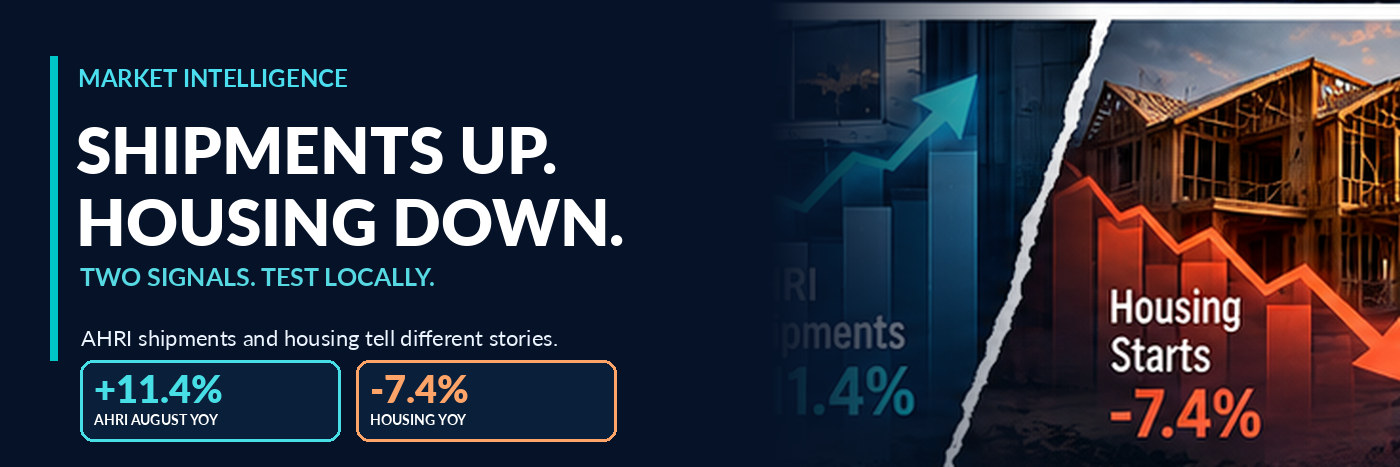
Shipments Are Up. Housing Is Down.
Triangulate First. Rule By Friday. |
|
AHRI August central AC + heat pump shipments rose 11.4% YoY — a directional signal requiring triangulation against branch sell-through, realized price, and cash. This week’s operating risk is contribution leakage, not volume. |
|
Catalyst · pending
Watsco Q3 2026 earnings call Tuesday Oct 27, 10:00 a.m. EDT. Readout and branch-evidence test in next week’s issue. |
|
|
|
Executive readout · the operating question
For every branch, vendor, and account combination this week: is activity converting into realized transaction contribution and cash — or is it channel-fill, pre-buy, or easier prior-year comps dressed as demand?
|
Two measures — use the right name
Realized transaction contribution = invoice GM dollars net of directly attributable, invoice-visible leakage. Cash conversion = whether that contribution is actually collected after AR, disputed credits, retainage, and release risk. Separate controls, not one metric. |
|
AHRI +11.4% needs triangulation, not dismissal
August gain can reflect any mix of: easier prior-year comp · production timing · pre-buy ahead of A2L change · regional timing · distributor replenishment after destocking · true replacement demand. Housing −7.4% YoY raises risk for builder/project-exposed branches; it does not disprove replacement demand — test locally through sell-through, quote mix, and contractor reorder behavior. |
|
|
|
|
|
|
Monday Management Dashboard · Top 3 Exposure Pulls |
Public sources do not disclose branch-level economics. These are Monday ERP / pricing / inventory / AR pulls, ranked by likely enterprise-value impact. Each row carries its exposure-type tag from the three-type hierarchy in §A11. |
| Exposure · type |
Dollar pull required |
Branch / vendor / account |
Decision owner |
Friday decision |
GM / cash consequence |
1 · Quote-to-invoice contribution leakage
TYPE: TRANSACTION |
Dollar pull required
Top 25 invoices by negative variance vs quote / approved margin floor; show GM dollars and bps leakage |
Branch / vendor / account
Stale quotes, freight misses, counter overrides, hot-shot-heavy accounts, affected vendor lines |
Decision owner
CFO + Regional GM |
Friday decision
Repriced / Recovered / AEL / Stopped |
GM / cash consequence
Prevents apparent sales growth from becoming weaker branch contribution and lower buyer-quality EBITDA. |
2 · Platform / transition inventory exposure
TYPE: WORKING CAPITAL |
Dollar pull required
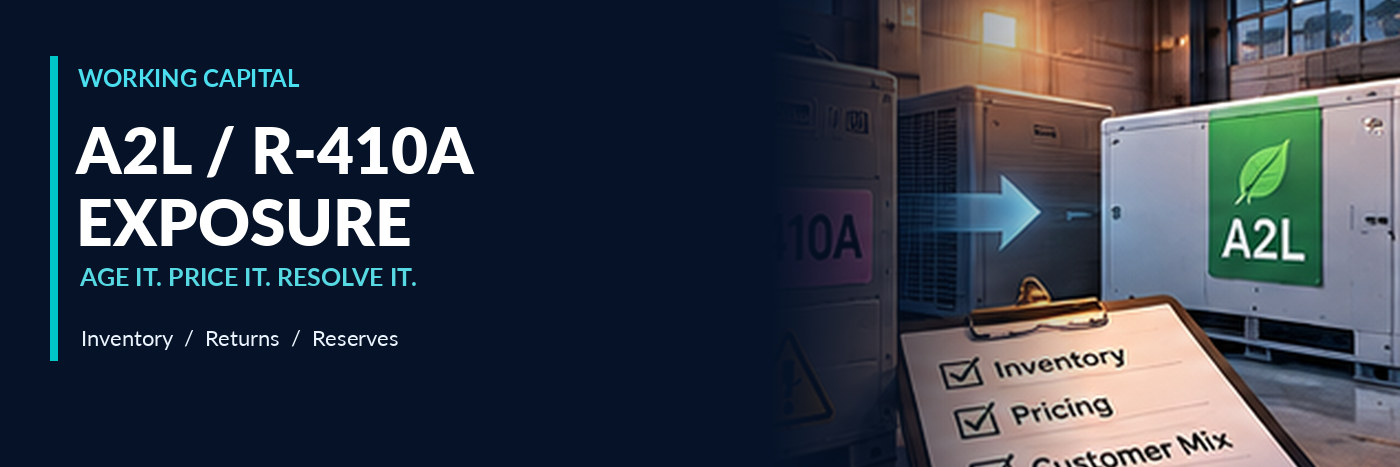
Aged R-410A / A2L inventory, open POs, returnable dollars, sell-through rate, supplier-protection dollars |
Branch / vendor / account
Vendor lines with transition exposure; branches with slow-moving or wrong-era inventory |
Decision owner
COO + Purchasing + Supplier Lead |
Friday decision
Returned / Transferred / Reserved / Escalated |
GM / cash consequence
Releases cash or forces a documented reserve only after returnability, rotation, price protection, and supplier recovery are exhausted. |
3 · Contractor credit / AR risk by account type
TYPE: WORKING CAPITAL |
Dollar pull required
AR >45 / >60 / >90, release schedules, lien rights, disputed credits, retainage, job-stage exposure |
Branch / vendor / account
Builder accounts, project-heavy mechanicals, PE-backed consolidators, stressed owner-led accounts |
Decision owner
CFO + Credit Manager + Branch GM |
Friday decision
Stopped / Recovered / AEL / Escalated |
GM / cash consequence
Protects cash conversion. Volume without release verification or collectability is not earnings quality. |
|
|
|
Watsco Q3 Catalyst · Readout Test & Granite Northeast Watch |
The one scheduled public catalyst that changes next week’s decisions. The brief dates Monday Oct 26 and goes out before the call. Below is what to log Tuesday and the exact items Blue Ops will test against branch evidence in next week’s issue. |
|
|
|
|
|
Tuesday Oct 27, 10:00 a.m. EDT · Watsco Q3 2026 earnings call
Results before market open per Watsco investor relations. Prior-period reference anchors (Q3 2025, not current): sales −4% to $2.07B, GM 27.5% (+130 bps), A2L ~55% of mix per management, Q4 pressure acknowledged. The call is a public catalyst, not internal evidence — log what is said, defer scoring until branch data corroborates. |
|
|
Seven readout items to log Tuesday & test next week
| |
What to log |
Branch evidence to test it against |
| 1 |
What to log
Sales growth by market and product category |
Branch evidence to test it against
Branch unit and dollar sales by platform (A2L / R-410A / legacy) and vendor line; replacement vs. new construction mix |
| 2 |
What to log
Gross-margin trajectory and price-cost commentary |
Branch evidence to test it against
Quote-to-invoice realization on released work, realized transaction contribution after freight/transfers/credits, stale-quote leakage |
| 3 |
What to log
Inventory and working-capital direction |
Branch evidence to test it against
Branch aging $, sell-through velocity, open-PO cancelability, aging-report movement (did it fall because of demand or transfers?) |
| 4 |
What to log
A2L conversion economics and R-410A inventory remarks |
Branch evidence to test it against
Branch A2L conversion cost (traceable only), R-410A disposition path by SKU, written supplier protection evidence (§A04) |
| 5 |
What to log
Contractor demand and mix commentary |
Branch evidence to test it against
Reorder cadence by segment (§03): residential replacement · service · builder/project · commercial · PE-backed national |
| 6 |
What to log
Acquisition / integration comments on Granite |
Branch evidence to test it against
Northeast shared-contractor and shared-vendor-line watch (below); supplier-contact log; local branch-density change |
| 7 |
What to log
Any claim that can be corroborated locally — or cannot |
Branch evidence to test it against
Branch sell-through, realized price, documented supplier recoveries, cash conversion — the five proof tests (§A12) |
|
|
Northeast watch · Watsco / Granite Group
Watsco completed The Granite Group acquisition Oct 12 (~$500M revenue, 82 locations across NH, VT, ME, MA, CT, RI, NY). Granite operates as independent subsidiary under existing leadership. No verified post-close program change this week. Northeast branches with shared contractor or vendor-line exposure should maintain an account-overlap and supplier-contact watchlist — do not treat post-close behavior as confirmed without written evidence. The acquisition matters because it may affect line-card leverage, branch density, contractor purchasing choices, supplier bargaining dynamics, competitor responses, and inventory network decisions. None of those are claimed here as current effects. |
|
|
|
Contractor Segment Watchlist · where behavior differs this week |
Different segments produce different economics. The Monday pulls become meaningful only when read by segment. Full account mechanics live in §A05. |
| Segment |
What to watch this week |
Primary test |
| Residential replacement |
What to watch this week
Price realization on larger A2L tickets, financing sensitivity and fall-through, A2L readiness, seasonal replacement inventory pull |
Primary test
Quote conversion rate; parts attach |
| Service contractor |
What to watch this week
Service-parts availability and fill rate, emergency freight/hot-shot economics, counter and service-ticket economics, wallet share |
Primary test
Counter override patterns |
| Builder / new construction |
What to watch this week
Release schedules against housing −7.4% YoY backdrop, AR aging migration, margin discipline on project material, project cancellation risk |
Primary test
Verified releases & lien rights |
| Commercial / mechanical |
What to watch this week
Bid-lock exposure, submittal / product-substitution risk, retainage and change-order flow, supplier technical support |
Primary test
Open-PO exposure |
| PE-backed / national platform |
What to watch this week
Centralized purchasing pressure, preferred-vendor shifts, standardization effects, share-of-wallet risk disguised as a “strategic account” label |
Primary test
Fully-loaded contribution (Ph.3) |
|
|
|
|
The one move
Force every red exposure through the Monday pull → Friday ruling cadence before buying ahead, extending project credit, or reserving platform inventory. Shipment data is directional context; branch-level sell-through, realized price, and cash are the proof. |
|
|
BY WEDNESDAY CLOSE
| · |
Top 3 Monday pulls populated with dollars, owner, type tag (§01) |
| · |
Watsco Q3 call logged against the seven readout items (§02) |
| · |
Contractor segment watchlist updated with this week’s heat (§03) |
| · |
Builder/project accounts named for release-verification review |
|
|
BY FRIDAY CLOSE
| · |
Every red item ruled by the eight-decision taxonomy (§A12), with expected GM and cash impact named |
| · |
No red item left as “monitor” |
| · |
30-day pipeline opened for structural items that cannot close by Friday |
| · |
Northeast overlap list updated against any Watsco/Granite evidence |
|
|
|
Operating annex
The Blue Ops operating standard — the Monday-to-Friday work behind the executive page.
Market signal matrix · branch economic exposure stack · threshold governance with materiality bands · supplier leverage and six-state recovery ladder · contractor segment economics · inventory and platform liability register · pricing/quote controls · working-capital/credit/AR · branch manager 24–72-hour plan · Friday red log · three-type exposure hierarchy · eight-decision taxonomy with proof tests · discipline rules · short M&A/EV readout. |
|
|
|
| Signal |
Fact |
Operating inference |
Conf. |
Branch action |
Supplier / M&A read-through |
| AHRI August shipments up |
Fact
Central AC + ASHP shipments 756,739, up 11.4% YoY; AC up 17.2%, ASHP up 5.0%. |
Operating inference
May reflect replenishment, channel mix, late-season sell-in, platform positioning, or actual demand. |
Conf.
High (fact); Med/Low (inference w/o branch data) |
Branch action
Pull sell-through by branch/vendor/account; compare equipment shipments to invoiced GM dollars and AR. |
Supplier / M&A read-through
Ask whether suppliers are clearing inventory, defending share, or supporting real demand; do not underwrite broad recovery from shipment data alone. |
| Housing starts down |
Fact
September starts 1.221M SAAR, −5.2% MoM, −7.4% YoY; single-family starts 859k, −4.6% MoM. |
Operating inference
New-construction demand remains uneven; distributor risk is credit/release timing, not just unit volume. |
Conf.
High |
Branch action
Builder-account review: release schedule, AR, lien rights, open quotes, committed inventory. |
Supplier / M&A read-through
Builder/new-construction accounts need tighter credit and release controls; over-indexed platforms deserve working-capital and AR discounts. |
| Completions below prior year |
Fact
Completions 1.192M, +2.2% MoM, −14.0% YoY; single-family completions 840k, −2.4% MoM. |
Operating inference
Completion timing can create local equipment/parts demand, but national data is not enough. |
Conf.
High fact; Med inference |
Branch action
Validate by local permit/completion pockets and contractor pickup demand. |
Supplier / M&A read-through
Supplier allocations/MOQs should be challenged if local completions are weak. |
| NOAA/CPC warm central/eastern outlook |
Fact
Nov. 2–8 favors above-normal temperatures across much of central/eastern CONUS; near/slightly below normal in parts of West. |
Operating inference
Conditional support for late cooling/parts activity; weak as a standalone distributor signal. |
Conf.
Medium |
Branch action
Act only if call-board, counter demand, or fill-rate stress shows up locally. |
Supplier / M&A read-through
Service contractors may need parts availability more than full-system inventory. |
| Broad precipitation outlook |
Fact
CPC favors above-normal precipitation across most Lower 48. |
Operating inference
Conditional watch only. |
Conf.
Med/Low for distributor action |
Branch action
Keep out of top billing unless specific branch footprint is materially affected. |
Supplier / M&A read-through
No enterprise-value impact without branch exposure. |
| A2L / R-410A platform transition |
Fact
No branch/vendor-specific public program change verified this week. |
Operating inference
Elevate only with measured exposure: inventory, open POs, sell-through, returnability, pricing, contractor readiness, or verified supplier program. |
Conf.
Source-limited |
Branch action
Maintain platform register; use Friday Court decision taxonomy when exposure is real. |
Supplier / M&A read-through
Poor transition records reduce quality of earnings and integration confidence. |
|
|
|
Branch Economic Exposure Stack + Contribution Proxy |
Use one stack before pricing, inventory, supplier, or account decisions. |
| Layer |
What to include |
Decision use |
| 1 · Invoice-visible economics |
What to include
Sell price, standard/actual cost, invoiced freight, delivery charge, counter override, credit memo/return issued, transfer charge, hot-shot or delivery exception cost if visible |
Decision use
Phase 1 weekly operating control |
| 2 · Documented recoveries |
What to include
Booked supplier credit, documented receivable, approved SPA/rebate support, RMA/return authorization, warranty reimbursement with evidence |
Decision use
Supplier accountability and margin bridge |
| 3 · Cash conversion |
What to include
AR bucket, disputed invoice, contractor credit status, project release schedule, retainage/lien/collection risk |
Decision use
Credit and earnings-quality control |
| 4 · Inventory quality |
What to include
Platform age, SKU velocity, branch sell-through, returnability, open PO exposure, transfer history, replacement-cost variance |
Decision use
Working-capital and reserve decision |
| 5 · Strategic account overlay |
What to include
Protected wallet share, attached parts pull-through, competitive defense, contract obligation, recovery plan, expiration date |
Decision use
Determines whether below-floor economics are strategy or leakage |
|
|
Rule
If the economics fail at Layer 1 and cannot be recovered or justified by Layers 2–5, it is leakage — not strategy. |
|
|
Weekly transactional contribution proxy
Phase 1 is a directional weekly management metric calculated only on incurred, invoice-visible economics. It includes invoice GM, visible freight recovery/cost, transfer charges, branch-coded logistics exceptions, returns/credits issued or incurred, counter overrides, and quote-release exceptions. It excludes supplier rebates, warranty recoveries, SPA support, verbal promises, delayed credits, and expected future recovery unless booked or documented as receivables. |
|
| Phase |
Name |
Included economics |
Use |
| P1 |
Name
Weekly transactional contribution proxy |
Included economics
Incurred invoice-visible economics only |
Use
Conservative weekly operating control |
| P2 |
Name
Documented supplier recovery layer |
Included economics
Booked or documented receivable rebates, SPAs, warranty, price protection, freight recovery |
Use
Supplier accountability and margin bridge |
| P3 |
Name
Fully loaded account contribution |
Included economics
Credit-loss reserve, technical-support burden, delivery exceptions, warranty burden, account cost-to-serve |
Use
Account profitability, pricing architecture, M&A diligence |
Required basis disclosures: returns/credits timing, freight recovery basis, transfer treatment, GM cost basis, replacement-cost variance, and SPA/rebate treatment. |
|
Static thresholds are default escalation triggers, not universal truth. Calibrate by branch size, GM-dollar base, product mix, seasonality, customer concentration, delivery profile, historical volatility, branch contribution, contractual terms, and vendor-line dependency. |
| Trigger type |
Example |
| Relative trigger |
Contribution proxy down >X bps vs 4-week average or seasonal baseline |
| Absolute trigger |
Leakage dollars exceed Y% of weekly branch contribution or GM-dollar plan |
| Concentration trigger |
One account/vendor/branch drives >Z% of leakage |
| Cash trigger |
AR or disputed credits consume more than approved exposure limit |
| Inventory trigger |
Platform inventory aging or open PO exposure exceeds approved branch plan |
|
|
Blue Ops rule
A $7,500 leakage issue may be immaterial at one branch and a Friday Red Exposure Court item at another. |
|
|
Illustrative materiality bands · starting point, calibrate per branch
| · |
Branch-level dollar threshold: single-item Friday Court gate at ~$10k for a $25M-revenue branch; ~$25k for a $100M branch; ~$50k+ for a $250M branch. |
| · |
Percent-of-weekly-GM threshold: any single item exceeding 2–5% of the branch’s weekly GM dollar plan automatically escalates, regardless of absolute dollar size. |
| · |
Repeat-offender trigger: same vendor line, account, or counter clerk appears in Friday Court three consecutive weeks → moves from transaction to structural tag; escalates one level. |
| · |
Reserve / escalation trigger: working-capital items at 90+ days with no documented demand, returnability, or supplier recovery path → Finance-approved reserve basis with reversal trigger named. |
These bands are illustrative. The combination of dollar, percentage, concentration, cash, and inventory triggers — applied to branch-specific baselines — is what makes the system operate; a single universal number does not. |
|
|
|
Supplier Intelligence + Leverage Map |
|
| Topic |
Current public evidence |
Required branch / vendor proof |
Supplier objective / behavior |
Distributor leverage / alternatives |
Action |
| Late-season equipment sell-in |
Current public evidence
AHRI shipments up in August; manufacturer shipment-level only. |
Required branch / vendor proof
Vendor-line receipts, sell-through, backlog, branch inventory days, open POs. |
Supplier objective / behavior
Factory utilization, share defense, inventory clearance, or true demand support. |
Distributor leverage / alternatives
Contractor pull-through, market coverage, alternative line, purchase share. |
Action
Do not buy ahead without sell-through or protection. |
| Platform transition support |
Current public evidence
Source-limited this week; no verified public branch-specific program change. |
Required branch / vendor proof
R-410A/A2L returnability, rotation rights, cost protection, warranty terms, training support. |
Supplier objective / behavior
Transition management or clearance. |
Distributor leverage / alternatives
Escalate through supplier leadership; compare competing vendor terms. |
Action
Build vendor-by-vendor recovery file. |
| Freight policy / delivery economics |
Current public evidence
No verified public change reviewed this week. |
Required branch / vendor proof
Freight adders, minimums, delivery-charge recovery, vendor freight credits. |
Supplier objective / behavior
Margin protection or cost pass-through. |
Distributor leverage / alternatives
Consolidated buys, pickup economics, alternative source, negotiated recovery. |
Action
Compare recovered freight vs actual/documented cost. |
| SPA / rebate reliability |
Current public evidence
Public details generally not visible. |
Required branch / vendor proof
Booked credits, claim aging, denied claims, buying-group support. |
Supplier objective / behavior
Channel discipline, margin management, share capture. |
Distributor leverage / alternatives
Purchase share, contractor loyalty, documented claim accuracy. |
Action
Move to Phase 2 only when booked/documented. |
| Direct-account / channel conflict risk |
Current public evidence
No verified current event included. |
Required branch / vendor proof
Accounts receiving direct terms, special pricing leakage, quote conflicts. |
Supplier objective / behavior
Direct-account strategy or national-account capture. |
Distributor leverage / alternatives
Local contractor relationships, service support, line-card alternatives. |
Action
Escalate if vendor bypass weakens branch economics. |
|
|
Per affected vendor line, capture
Vendor/brand/category · supplier objective · observed supplier behavior · distributor dependency · supplier dependency on distributor · alternative source · contractor switching risk · escalation path · requested remedy · evidence · Friday Court decision. |
|
|
Supplier recovery state ladder · what counts as an asset
| State |
Definition |
Phase treatment |
| 1 · Cash received |
Definition
Credit applied, check cleared, or offset confirmed by Finance |
Phase treatment
Closed; in realized margin |
| 2 · Documented receivable |
Definition
Written supplier approval or signed program document; aging tracked; expected timing named |
Phase treatment
Countable in Phase 2 margin bridge |
| 3 · Submitted claim |
Definition
Claim filed per supplier process; supplier has not yet accepted or denied |
Phase treatment
Watch; not an asset until (2) or (1) |
| 4 · Verbal commitment |
Definition
Rep assurance only; no written confirmation, no claim filed |
Phase treatment
Watch; disclose if assumed in branch forecast |
| 5 · Disputed claim |
Definition
Supplier contests scope, dollars, or eligibility; resolution path required |
Phase treatment
Escalate; may require reserve |
| 6 · Denied claim |
Definition
Supplier declines in writing; no path forward through standard process |
Phase treatment
Reserve or write off; escalate to supplier leadership |
Phase 2 contribution counts only states 1 and 2. The gap between the sum of states 1–2 and the sum of states 3–6 is the supplier risk the branch carries at any moment. |
|
|
Contractor Segment Economics + Account Exception License |
Demand quality, pricing tolerance, service expectations, financing sensitivity, inventory needs, and credit risk differ by contractor type. The table below pairs the segment with the expected behavior this week, so AR migration and quote mix make sense before they become red items. |
| Contractor type |
Expected behavior this week |
Distributor response |
When an exception is defensible |
| Owner-led residential replacement |
Expected behavior this week
Late-season replacements driven by failures; fast parts needs; financing sensitivity on larger A2L tickets; weaker quote-validity and financing-fallout discipline than larger shops |
Distributor response
Test quote conversion rate and financing fall-through; validate quote age, cost, freight recovery, parts attachment; protect equipment availability on moving platforms |
When an exception is defensible
Only if wallet-share gain and attached parts pull-through are documented |
| Mid-sized multi-crew / service-heavy |
Expected behavior this week
High-frequency, lower-ticket counter and delivery pulls; fill rate matters more than full-system inventory depth; override creep, returns, and warranty burden tend to build invisibly |
Distributor response
Protect counter availability and high-velocity service parts; recover hot-shot economics explicitly; audit override patterns by counter clerk |
When an exception is defensible
Rarely for below-floor equipment unless tied to measured high-margin service-parts pull-through |
| PE-backed / consolidated |
Expected behavior this week
Centralized procurement pressure, standardized terms, price-leverage posture; margin compression often arrives disguised as a “strategic account” label; purchasing may shift to national terms without the branch knowing |
Distributor response
Review fully-loaded contribution (Phase 3): invoice GM, delivery cost, rebate dependency, warranty burden, technical-support hours, AR behavior |
When an exception is defensible
Only with documented wallet share, contract obligation, recovery path, and expiration |
| Builder / new construction / project |
Expected behavior this week
Housing starts −7.4% YoY and completions −14.0% YoY exert direct release-schedule and AR-timing risk; staged deliveries create working-capital lockup; change-order disputes grow in weaker housing periods |
Distributor response
Validate release schedules against lien rights and credit authority; separate quoted material from committed releases; apply stop-work matrix on second missed release |
When an exception is defensible
Requires contract obligation, documented cash plan, and executive approval |
| Commercial mechanical / applied |
Expected behavior this week
Larger tickets, longer lead times, retainage, change-order and project terms; working-capital lockup compounds when AR and open PO exposure grow in parallel |
Distributor response
Separate quoted material from scheduled releases; control open-PO exposure; require lien-rights documentation on project accounts over threshold |
When an exception is defensible
Must identify strategic account value and cash protection |
| Thinly capitalized owner-led |
Expected behavior this week
Seasonal cash strain building into Q4; disputed credits appear; requests for extended terms rise; small ticket sizes mask concentration risk |
Distributor response
Tight credit limit vs weekly run-rate; COD or partial payment for red accounts; refuse extended terms without documented margin support |
When an exception is defensible
Almost never — small concessions aggregate quickly against a thin balance sheet |
|
|
Four questions for every strategic and overlap account
1. What share of addressable spend do we have today?
2. Which categories do they buy elsewhere — equipment, controls, refrigerant, IAQ, supplies, parts?
3. Why do they split — price, availability, brand, branch proximity, terms, delivery, technical support, relationship?
4. What would we give up to win that spend, and does the pull-through justify it? |
|
|
The six-field rule
A below-floor-margin exception requires six fields: protected wallet share, attached parts pull-through, contract obligation, competitive defense, recovery plan, and expiration date. If any field is missing, the transaction is leakage, not strategy.
Too many distributors defend a customer relationship by quietly funding an unprofitable one. The six-field rule and the account-defense walk-away point exist to prevent that. |
|
|
|
|
|
|
|
Inventory Quality & Platform Exposure Register |
|
| Register field |
Required Monday pull |
| Branch / Vendor / Product family / SKU |
Location, brand, product family, SKU or family |
| Platform |
A2L / R-410A / other |
| Inventory dollars and aging |
On-hand cost; 0–30 / 31–60 / 61–90 / 90+ / 180+ |
| Sell-through |
Current week / 4-week average / seasonal baseline |
| Open POs |
Dollars, units, cancelability |
| Recovery rights |
Returnability, rotation rights, price protection, warranty exposure |
| Contractor readiness |
Trained / partial / unknown |
| Recovery option |
Sell / transfer / return / rotate / reserve |
| Friday decision |
Repriced / Returned / Transferred / Reserved / Escalated |
|
|
Platform governance
A2L/R-410A exposure is conditional and branch/vendor-specific. Elevate only with demonstrated inventory, open POs, sell-through, returnability, pricing, contractor readiness, or verified supplier program changes. |
|
|
Platform-specific liability detail · A2L / R-410A / legacy / mixed
|
For each affected SKU or product family, capture: branch · vendor line · platform (A2L / R-410A / legacy / mixed) · units and $ · cost basis (standard / actual / replacement-cost variance) · A2L conversion cost identified separately (incremental training, technical support, delivery/handling, documented rework or compatibility cost — no generalized overhead) · age bucket · 4-week sell-through · open POs and cancelability · written supplier protection evidence (returnability, rotation, price protection, warranty terms) · contractor A2L readiness · disposition path (sell → return → transfer with demand → reserve → stop) · owner and Friday ruling. |
|
|
Finance rule · reserve triggers and R-410A context
Every pool carries a Finance-approved recovery probability and reserve requirement with named owner, deadline, and financial treatment. Reserve trigger: 90+ days with no documented demand, returnability, or recovery path; or replacement-cost variance exceeding branch-set threshold.
AHRI public commentary continues to describe R-410A supply as currently ample. Ample supply today does not reduce the forward disposition work — reclaim capacity remains the long-term constraint, and industry reporting indicates elevated R-410A inventories at many distributors. A2L converted lines carry the heaviest near-term price-file churn and conversion cost. |
|
|
|
Pricing / Quote / Override Controls |
|
| Quote age / condition |
Default action |
| 0–7 days |
Normal release if cost/freight unchanged |
| 8–14 days |
Validate replacement cost, freight, scope, and availability |
| 15+ days |
Manager approval required before release |
| Any quote below floor |
Account Exception License or reprice |
| Any vendor-line cost change |
Revalidate regardless of quote age |
|
|
Every override must capture: customer, account type, vendor line, SKU/category, original margin, approved margin, dollar concession, reason code, approver, expiration, recovery plan, and whether supplier support is documented. |
|
|
Control vs commercial action
Do not solve every leakage issue by raising price or restricting service. First determine whether leakage is recoverable, strategically justified, operationally correctable, or evidence the account is structurally unprofitable. |
|
|
|
Working Capital / Credit / AR by Contractor Type |
|
| Contractor type |
Credit risk |
Required control |
| Owner-led residential |
Credit risk
Personal liquidity, seasonality, dispute risk |
Required control
AR aging, credit hold rules, COD trigger |
| Replacement-focused |
Credit risk
Fast cycle but quote/financing volatility |
Required control
Quote validation, completed contribution review |
| Service-heavy |
Credit risk
Lower ticket but high frequency |
Required control
Credit limit vs weekly run-rate |
| Builder |
Credit risk
Release schedules, slow pay, concentration |
Required control
Verified release, lien rights, project AR review |
| Commercial mechanical |
Credit risk
Retainage, change orders, slow approvals |
Required control
Stop-work matrix, change-order documentation |
| PE-backed / consolidated |
Credit risk
Centralized terms, pricing pressure |
Required control
Account-level contribution and AR profitability |
|
|
AR red triggers
AR >60 rising faster than sales · unresolved disputed credits · unverified project releases · requests for extended terms without margin support · high-service-cost accounts below floor · supplier credits pending after the customer has already been credited. |
|
|
|
Branch Manager 24–72 Hour Action Plan |
|
|
MON · EXPOSURE PULL
Pull top 25 contribution-leakage invoices; platform inventory by vendor line; AR by contractor type and aging; stale quotes by vendor line and margin floor; supplier recovery claims by status. Output: exposure file with dollars, owner, and likely Friday decision. |
|
|
TUE · CLASSIFICATION
Classify each exposure as recoverable, operationally correctable, strategic exception candidate, structurally unprofitable, supplier escalation, or reserve candidate. Output: Friday Court draft docket. |
|
|
WED · COMMERCIAL / SUPPLIER ACTION
Decide whether leakage is recoverable, strategically justified, operationally correctable, or structurally unprofitable; then reprice, file recovery claims, request return/rotation/price protection, freeze unlicensed below-floor releases, or review project credit/releases. Output: action log with evidence attached and no control/commercial-action ambiguity. |
|
|
THU · FINANCE REVIEW
Validate Phase 1 proxy; separate invoice-visible leakage from documented supplier recovery; confirm reserves and exception licenses. Output: finance-approved exposure status. |
|
|
FRI · RED EXPOSURE COURT
Decide every red item using the Court taxonomy. Output: Repriced / Recovered / Transferred / Returned / Reserved / Stopped / Escalated / Account Exception License. |
|
|
|
Friday Red Exposure Log + Monday Follow-Up |
|
| # |
Branch |
Vendor line |
Account |
Exp. $ |
Issue type |
Friday decision |
GM impact |
Cash impact |
Owner |
Next status |
| 1 |
Branch
— |
Vendor line
— |
Account
— |
Exp. $
— |
Issue type
Quote leakage / inventory / AR / supplier recovery |
Friday decision
Repriced / Recovered / Transferred / Returned / Reserved / Stopped / Escalated / AEL |
GM impact
— |
Cash impact
— |
Owner
— |
Next status
Monday follow-up |
| 2 |
Branch
— |
Vendor line
— |
Account
— |
Exp. $
— |
Issue type
— |
Friday decision
— |
GM impact
— |
Cash impact
— |
Owner
— |
Next status
Monday follow-up |
| 3 |
Branch
— |
Vendor line
— |
Account
— |
Exp. $
— |
Issue type
— |
Friday decision
— |
GM impact
— |
Cash impact
— |
Owner
— |
Next status
Monday follow-up |
Every Friday item rolls into Monday with: decision made, expected GM/cash outcome, actual result, supplier recovery status, remaining exposure, root-cause correction, and whether the issue repeats next week. |
|
|
Exposure Classification Hierarchy · three types, every red item tagged |
“Contribution leakage” is useful shorthand but too broad to drive a decision. Three types govern the ruling. Fix the type; the Friday ruling follows. |
| Exposure type |
Typical evidence |
Primary action |
| Transaction leakage |
Typical evidence
Stale quote, override, freight miss, credit memo, hot-shot cost, unclaimed SPA, counter under-ring |
Primary action
Reprice, correct control, train, recover |
| Structural exposure |
Typical evidence
Unprofitable account, uneconomic branch model, weak service pattern, chronically wrong inventory positioning |
Primary action
Rework account/branch model, set walk-away point |
| Working-capital exposure |
Typical evidence
Aged stock, AR deterioration, pending supplier recovery, open PO exposure |
Primary action
Return, reserve, collect, cancel, recover |
|
|
Why the hierarchy matters
A transaction-leakage item gets fixed with repricing and training. A structural item does not — repricing a branch into profitability it cannot support masks the real problem for another quarter. A working-capital item frees cash but does not improve P&L until realized. Tagging separates the three so leaders stop solving the wrong problem. |
|
|
|
Friday Decision Taxonomy + Proof Tests |
Eight rulings; “monitor” is not among them. Paired with the five proof tests that would change the operating posture if branch-level evidence supports them. |
| Decision |
When used |
Required evidence |
| Repriced |
When used
Quote/invoice economics are below floor and commercially recoverable |
Required evidence
Current replacement cost, freight basis, quote age, customer notification |
| Recovered |
When used
Leakage is supplier-, freight-, rebate-, or warranty-recoverable |
Required evidence
Credit memo, documented receivable, RMA, SPA/rebate support |
| Transferred |
When used
All three must be true: receiving branch has documented demand, transfer cost is acceptable, and a defined sell-through path exists — otherwise it is relocating risk, not solving it |
Required evidence
Receiving branch sell-through, transfer cost, no aging-report gaming |
| Returned |
When used
Supplier return/rotation option exists |
Required evidence
RMA, return window, freight/restocking economics |
| Reserved |
When used
Exposure remains after recovery options are exhausted |
Required evidence
Finance-approved reserve basis, reversal trigger, owner |
| Stopped |
When used
Credit/project/release risk exceeds commercial value |
Required evidence
Credit authority, release schedule, AR status, lien/contract review |
| Escalated |
When used
Supplier or enterprise decision needed |
Required evidence
Vendor contact, spend leverage, alternative line, requested remedy |
| Account Exception License |
When used
Below-floor deal is strategically justified |
Required evidence
Protected wallet share, attached parts pull-through, contract obligation, competitive defense, recovery plan, expiration date |
|
|
Proof tests · what would change the operating posture
The posture changes only if branch-level evidence proves one of these:
· Sell-through proof: Equipment sell-through exceeds 4-week and seasonal baseline with stable or improving transactional contribution.
· Realized-price proof: Quote-to-invoice realization improves after freight, transfers, credits, and counter overrides.
· Supplier-recovery proof: Rebates, warranty recoveries, price protection, or return authorizations are booked or documented as receivables, not verbally promised.
· Inventory-quality proof: Platform inventory aging falls because of true contractor demand or supplier returns — not inter-branch transfers used to clean up one location’s aging report.
· Cash proof: AR and credit exposure improve while sales hold, especially among builder/project-heavy and high-service-cost accounts. |
|
|
Disconfirming risk
If shipment strength is paired with lower gross-margin dollars, more stale quotes, heavier hot-shot cost, or slower AR, the apparent demand bump is low-quality volume. That is the disconfirmation to listen for. |
|
|
|
Discipline Rules · what not to do this week |
|
| · |
Do not buy ahead without verified sell-through or supplier protection. |
| · |
Do not honor stale quotes without documented cost and freight validation. |
| · |
Do not transfer inventory merely to improve one branch’s aging report. |
| · |
Do not reserve platform inventory before returnability and recovery options are exhausted. |
| · |
Do not extend project credit against unverified release schedules. |
| · |
Do not interpret manufacturer shipments as local demand recovery without triangulation. |
|
|
|
|
Short M&A / Enterprise-Value Readout |
|
|
The buyer lens: pay for distributors that can prove branch-level contribution quality. Weak data linkage between quote, invoice, cost, freight, transfer, rebate, return, warranty, and project/customer code is itself a value and diligence risk. |
|
|
PAY PREMIUM FOR
| · |
Clean quote-to-invoice controls |
| · |
Documented supplier recoveries and rebate capture |
| · |
Low stale-quote leakage |
| · |
Inventory aging discipline by platform and vendor line |
| · |
AR segmentation by contractor type |
| · |
Branch managers who know fill rate, overrides, transfer cost, and account profitability |
|
|
DISCOUNT WHERE
| · |
Growth is concentrated in low-realization equipment volume |
| · |
Supplier economics are verbal, delayed, or undocumented |
| · |
Inventory “improvement” comes from transfers rather than sell-through or returns |
| · |
Builder/project accounts consume credit capacity without release verification |
| · |
A2L/R-410A exposure is discussed generally but not measured by SKU, branch, open PO, returnability, and supplier protection |
|
|
|
M&A posture
Favor platforms with branch contribution visibility and supplier leverage discipline. Avoid paying recovery multiples for late-season volume unless cash, realized price, and inventory quality confirm it. |
|
|
How this brief is built
Executive page: thesis, Top 3 Monday pulls (§01), Watsco Q3 catalyst with seven readout items and Granite Northeast watch (§02), contractor segment watchlist (§03), CEO move for the week (§04). Operating annex (A01–A14) carries the Blue Ops operating standard — market signals, exposure stack, threshold governance, supplier leverage and recovery ladder, contractor economics, inventory register, pricing controls, working capital, 24–72-hour plan, Friday log, three-type exposure hierarchy, decision taxonomy with proof tests, discipline rules, and M&A readout. Primary signals this week: AHRI August shipments, Census September construction, NOAA/CPC early-November outlook. Pending catalyst: Watsco Q3 call Tue Oct 27 — readout and branch-evidence test next week. Confidence: High = official release; Medium = credible trade reporting; Source-limited = held until primary source is in hand.
Blue Ops supports HVAC distribution companies across the investment lifecycle. See our HVAC practice → |
|
|
|
|
Source notes and caveats · October 26, 2026
|
AHRI Monthly Shipments. AHRI monthly reports cover combined U.S. manufactured shipments and are generally issued on the second Friday for shipments made two months prior. Latest visible 2026 release is August 2026, released in October. August central AC + ASHP shipments were 756,739, up 11.4% YoY; AC 418,323, up 17.2%; ASHP 338,416, up 5.0%. ahrinet.org
Census New Residential Construction. September 2026 release dated Oct. 20, 2026: permits 1.400M SAAR, down 0.2% MoM and 3.0% YoY; starts 1.221M, down 5.2% MoM and 7.4% YoY; completions 1.192M, up 2.2% MoM but down 14.0% YoY. census.gov
NOAA / CPC Outlook. Outlook issued Oct. 25, 2026, valid Nov. 2–8, 2026, favors above-normal temperatures across much of the central/eastern U.S. and above-normal precipitation across most of the Lower 48; CPC stated above-average 6–10 day forecast confidence of 4/5. cpc.ncep.noaa.gov
Watsco Q3 2026. Earnings call scheduled Tuesday Oct 27, 10:00 a.m. EDT per Watsco investor relations; results before market open. Brief is dated Monday Oct 26 and goes out before the call. Readout and branch-evidence test will land in next week’s issue. Prior reference anchors (Q3 2025): sales −4% to $2.07B, GM 27.5% (+130 bps), A2L ~55% of mix per management, Q4 pressure acknowledged.
Watsco / Granite Group. Watsco completed The Granite Group acquisition Oct 12, 2026 (~$500M revenue, 82 locations across NH, VT, ME, MA, CT, RI, NY). Granite operates as independent subsidiary under existing leadership. No verified post-close program change this week; Northeast overlap is a documented watch item, not a confirmed input.
Supplier programs / OEM-specific pricing / A2L returnability. Source-limited this week. No branch/vendor-specific public evidence was used for price increases, return programs, warranty changes, or supplier credit terms. Treat those as company-specific diligence pulls, not external facts.
Internal data required: every exposure pull in §01 requires branch-level ERP, pricing, inventory, and AR data. Where the ERP will not link quote, revision, order, invoice, cost, freight, transfer, rebate, return/credit, warranty, and project/customer code, the data gap itself is an enterprise-value issue. |
|
|
Bottom line
This is a quality-of-earnings week, not a volume week. AHRI shipment strength and warm-weather odds can help branches only if they become realized price, collected gross-margin dollars, clean inventory, and documented supplier recovery. The CEO move is to force every red exposure through Friday Red Exposure Court and refuse to let shipment headlines, weather chatter, or supplier verbal support substitute for branch-level economic proof. |
|