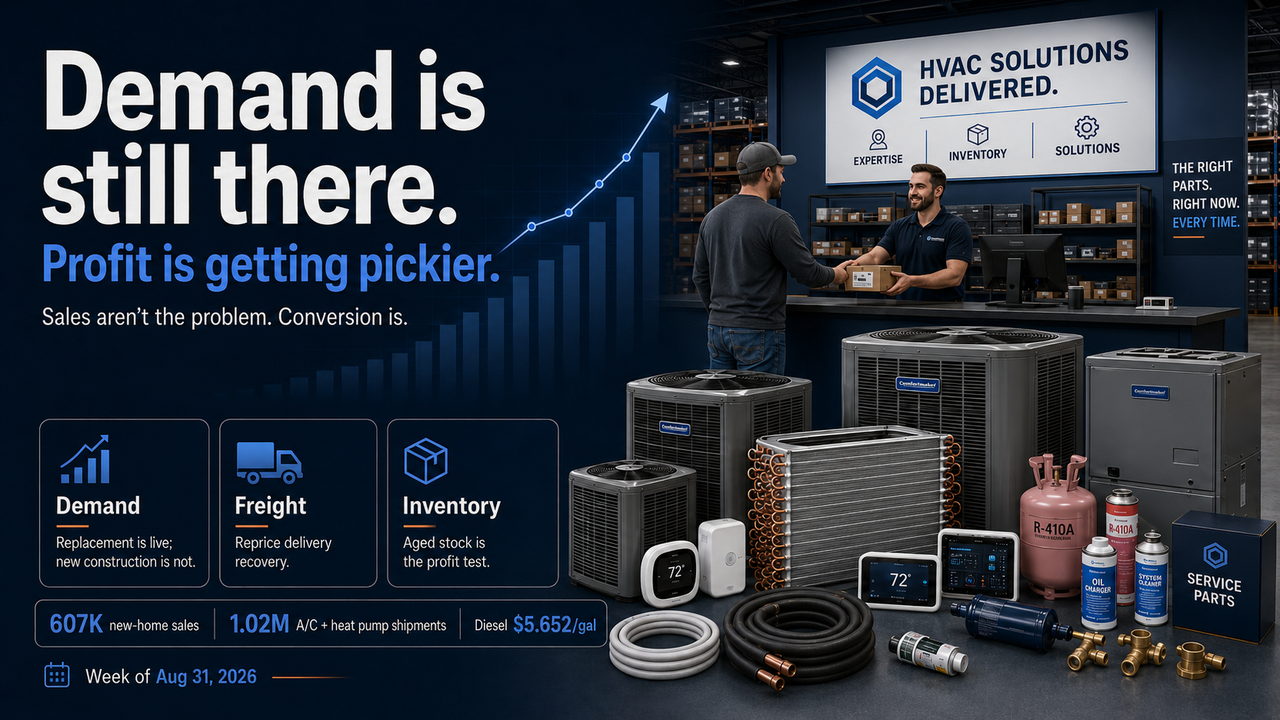
Sales aren’t the problem. Conversion is. Freight leaks, builder AR, stale cooling-side quotes, and legacy stock are where contribution is walking out this week — before Labor Day and before Q4 close.
August 31, 2026
ISSUE NO. 36
HVAC Distribution · Executive Intelligence · Weekly Brief · Week of Aug 31, 2026
The week in one line
Sales aren't the problem. Conversion is. Freight leaks, builder AR, stale cooling-side quotes, and legacy stock are where contribution is walking out this week — before Labor Day and before Q4 close.
Three numbers that matter this week
1
New-home sales 607K in July, 9.6 months' supply. Don't chase the +5% permits headline. Starts fell 12.4% MoM, sales fell 10% YoY. That's builder pull — the number your equipment inventory reacts to.
2
June combined A/C + heat pumps 1.02M units, +21.7% YoY. Manufacturer shipment. Not your counter. Benchmark your own sell-through and mix against it; do not backfill stock on the headline.
3
Diesel $5.652/gal, +19.8¢ WoW, +$1.94 YoY. Every branch with a soft freight recovery table is leaking contribution this week. Not next quarter — this week.
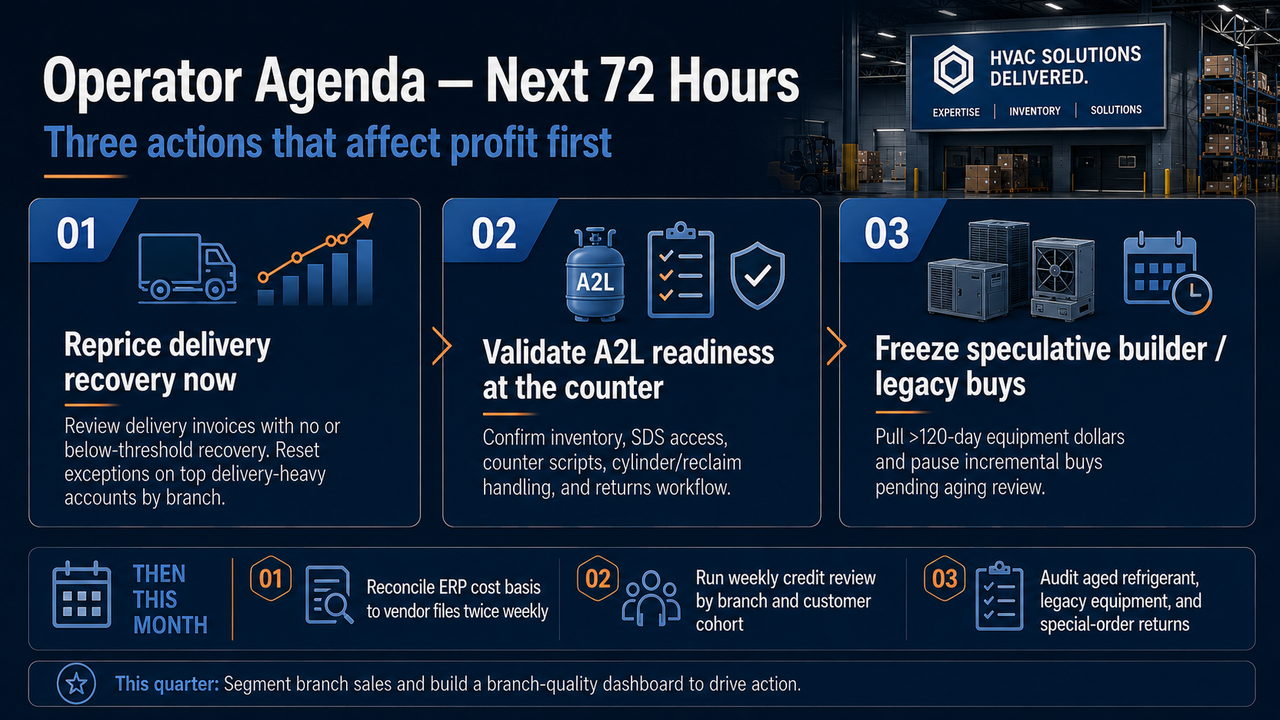
This week — three things
Reprice delivery recovery. Validate A2L readiness at the counter. Freeze speculative builder equipment buys. Table in Section 03; the center of gravity this week is aged stock — Section 05 deep dive.
Carry-forward from last week — still active (see the Signal Board above for what is new this week)
Heat-pump attachment rate: last week's deep dive still holds — GP dollars per heat-pump ticket, not units, is the right measure. This week's A2L emphasis reinforces it: attachment revenue is where replacement demand actually shows up as margin. Owner: Category + Branch Manager · Trigger: attachment rate below 30% on any branch running heat-pump volume.
A2L / R-290 execution: no new regulatory movement this week, but EPA's HFC allowance data comment period closed 8/27/26. The operational risk stays where it was — documentation, counter confidence, cylinder handling, and contractor training. Track A2L-related returns by branch and by contractor.
Public comp weakness (WSO/FERG/CARR/TT/LII): the residential manufacturer group remains the pressured cohort. Distribution comps (Watsco, Ferguson) still hold valuation on margin and cash conversion discipline. Use the split to temper seller expectations on residential-heavy private assets.
01
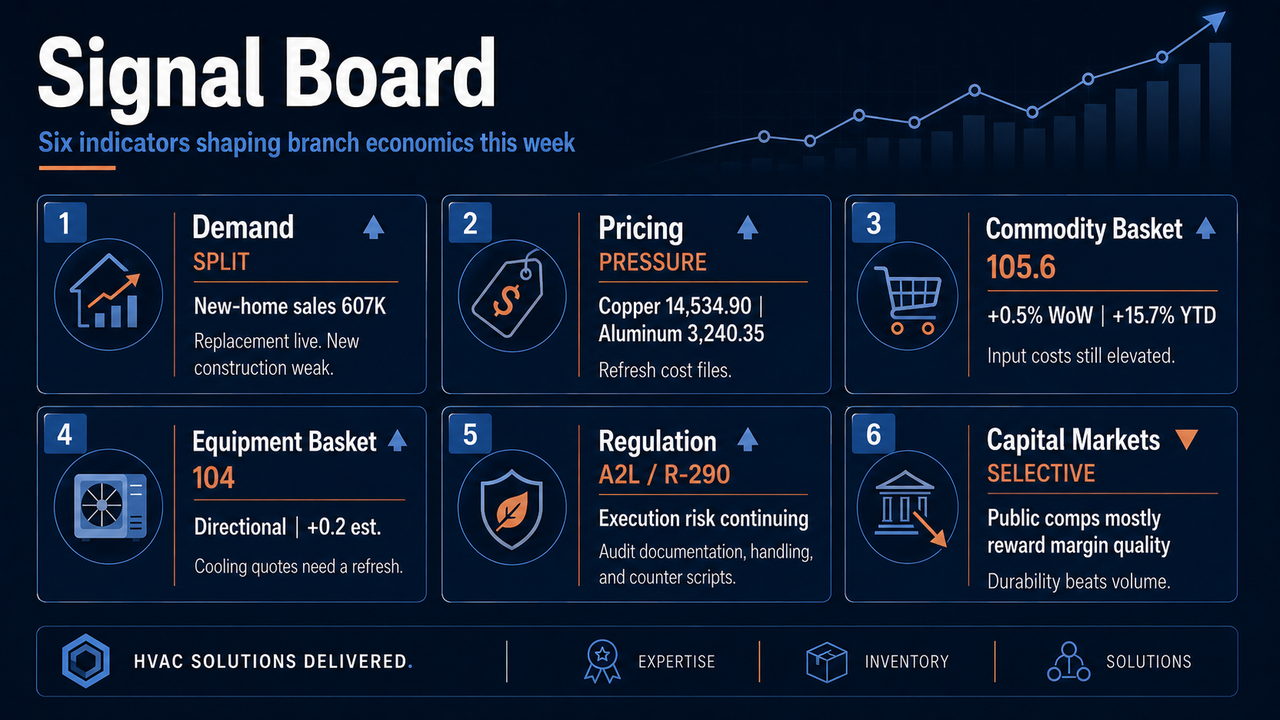
Signal Board
TakeawayReplacement is live. Freight, housing, and A2L execution decide who converts it. Six signals below — numbered.
The six branch-economics signals we watch — status, what it means, one action.
1 · Demand
SPLIT · NEW
New-home sales 607K in July, down from 678K. Combined A/C + heat pumps 1.02M in June, +21.7% YoY. Replacement is live. New construction is not.
Do this → split builder branches from replacement branches in every weekly margin and AR review
2 · Pricing
PRESSURE · STRENGTHENING
Copper 14,534.90 on 8/28, up 1.3% WoW. Aluminum 3,240.35, up 0.6%. If your ERP cost basis isn't reconciling to vendor files at least weekly, you're quoting yesterday's cost on today's copper — every day.
Do this → twice-weekly cost-file reconciliation on copper- and aluminum-heavy SKUs; freeze quote extensions past 14 days
3 · Commodity basket
105.6 · +0.5% WoW
Basket up on copper and aluminum; steel and components directional. YTD +15.7%. This is not "back to normal." Hold margin discipline through September.
Do this → hold quoted margin on coils, linesets, motors, and copper-heavy accessories; validate against current vendor files before extending any cooling quote
4 · Equipment basket
104 · directional · +0.2 est.
Cooling-side quotes carry higher near-term escalation risk than furnace quotes right now — but validate against current vendor files before extending any quote. The spread between drifting cooling and flat heating is what leaks margin on old paper.
Do this → refresh cooling-side quotes older than 14 days; furnace quotes get a lighter touch but still need vendor-file confirmation
5 · Regulation
EXECUTION RISK · CONTINUING
EPA HFC comment period closed 8/27. No hard rule change this week. The risk is not availability — it's documentation, cylinder handling, and what the counter says when a contractor asks about substitutions. Section 07 has the A2L readiness checklist.
Do this → audit refrigerant records, cylinder returns, reclaim workflow, and A2L counter scripts against the Section 07 checklist
6 · Capital markets
SELECTIVE · MONITORING
Watsco P/E ~27.5, Ferguson ~24.0 on 8/31. Public buyers still pay for scale — but the price is on margin durability and cash conversion, not top-line volume. Do not price a private branch off scale comps unless the target actually shows the reporting and margin discipline behind them.
Do this → buyers stress-test rebate capture, turns, and AR quality before crediting any revenue-growth adjustment
02
Thesis of the Week
Two branches, same sales, different P&L.
The strong branch turns the volume into margin, turns, and cash. The weak branch turns the same volume into freight leaks, past-due AR, and stock that ages out. Same top line. Very different Q4.
Why this actually matters — the arithmetic
A $20M branch can hold sales flat and still lose real money. Slip 80 points of margin, that's $160K gone. Add a couple points of freight recovery loss on a delivery-heavy book — call it 200 basis points on $2M of delivery cost — that's another $40K. Take a 25% haircut on $200K of aged legacy equipment as it goes to reclaim or discount — another $50K. Same top line, quarter-million lower contribution. That is the entire operating question for the next 60 days.
How to size the freight leak. A twenty-cent diesel move on one invoice is nothing. Across a fleet with a stale recovery table it's a recurring drain. The math is four inputs — route miles per week, fleet gallons per mile, invoice count per route, and per-invoice recovery — then compare against your fuel surcharge and delivery-fee capture. The real drag is usually diesel plus driver time plus low stop density plus no-charge exceptions stacked together. Do the math with your own data before it lands on the CFO's desk.
03
Operator's Agenda
Three by Friday. Three this month. Two this quarter. If your branch can't do cohort AR or category turns yet, the Friday three still work — start with your top 20 accounts and your top 50 delivery invoices.
By Friday · three non-negotiables
#
Required action
Owner
Measure
P1
Review delivery invoices with no or below-threshold recovery. Reset exceptions on the top 50 delivery-heavy accounts by branch. Diesel at $5.652/gal makes free-freight habits a contribution leak now, not next quarter.
Validate A2L readiness for top replacement part numbers and returns workflow. Inventory, SDS access, counter substitution scripts, cylinder / reclaim handling, returns process. Replacement demand only converts if all five are clean.
Category
+ operations
Fill rate on A2L SKUs
A2L-related returns
Counter training %
P3
Freeze incremental buys on slow-moving builder/legacy equipment pending aging review. Starts down 12.4% MoM, 9.6 months' new-home supply. Do not build stock on permit optimism; aging risk shows up in 60 days.
Inventory
+ branch
>120-day equipment $
PO exceptions
This month · three operating reviews
M1
Reconcile ERP cost basis to vendor files twice weekly on copper- and aluminum-heavy categories
Copper near 52-week highs, aluminum up ~0.6% WoW. Cost-file lag becomes silent margin leakage on quotes older than 14 days.
Owner: Pricing / category · Measure: Quote-refresh cycle time; cost-file lag days
M2
Weekly credit review by branch and by customer cohort
Days-to-pay and past-due AR often move before EBITDA weakness shows. Track builder cohorts separately; that is where softness will land first.
Owner: Finance / credit · Measure: Days-to-pay by cohort; 60/90+ past-due $; credit holds vs releases
M3
Audit aged refrigerant, legacy equipment, and special-order returns by branch
A2L transition plus softer housing raises obsolescence risk. Clean the aged buckets now, before Q4 close forces a write-down.
Segment branch sales weekly by replacement/service vs new-construction vs commercial project
Volume alone does not describe branch quality this cycle. Segmenting sales by work type makes demand quality — not just revenue — visible to management, and builds diligence-ready reporting as a byproduct.
Q2
Build a branch-quality dashboard: freight recovery %, equipment aging %, cost-file lag, A2L returns, days-to-pay, GP per equipment ticket
One page per branch, weekly. Anchors the operating review and shortens diligence when a transaction comes. Full metric list and denominators in Section 05.
Who should act most aggressively this week
Branch-level exposure varies. The three actions apply to everyone, but urgency and priority differ by branch model:
•
Builder-heavy Sunbelt branches — highest urgency on P3 (freeze speculative buys); build cash flow discipline into weekly reviews before starts weakness lands
•
Delivery-intensive rural and long-route branches — highest urgency on P1 (freight recovery); route density is thin, diesel impact is disproportionate
•
Replacement-heavy branches in early-A2L markets — highest urgency on P2 (A2L readiness); this is the demand pool actually converting to margin right now
•
Commercial retrofit and applied branches — focus M1 (cost-file discipline) and Q2 (dashboard build); project margin depends on quote-file freshness more than daily counter volume
•
Legacy-refrigerant-heavy locations — highest urgency on M3 (aged stock audit); write-down risk concentrates here before it shows anywhere else
04
Blue Ops Baskets & Market Dashboard
TakeawayBoth baskets moved higher again — input costs are not easing. Cost-file discipline is the margin lever this week.
Two Blue Ops baskets that translate raw-material and equipment cost movement into directional early-warning signals. Updated weekly.
How to use the basket
Early warning. Not a price index. Not a replacement for vendor cost files. Copper and aluminum are market-confirmed. Steel, components, and every equipment input are directional — read them as a signal to check, not a rate to quote from. Our action thresholds:
•
Basket up >2 pts in 14 days → refresh all open cooling-side quotes; freeze quote extensions beyond 14 days
•
Copper or aluminum up >3% in 14 days → cost-file review on affected SKU classes; validate ERP basis vs vendor file
•
Manufacturer price-file change on file → freeze quote extensions beyond the effective date; brief the counter
The basket climbed to 105.6, with copper closing at 14,534.90 on 8/28 (up ~1.3% from 14,342.85 on 8/24) and aluminum at 3,240.35 (up ~0.6%). WTI oil around $86 on Markets Insider screens keeps freight-cost pressure elevated. Steel is directional this week but S232 tariffs continue to keep domestic pricing firm. The read for branches: costs are not settling, so cost-file discipline is where margin is protected or lost. Do not price August or early-September quotes on July cost files.
Component
Weight
This week
What it means
Copper
30%
14,535 · +1.34%
Near 52-week highs; hold margin on coils, motors, linesets, wire, service parts
Steel / galvanized
30%
~Flat · dir.
Directional this week; S232 tariffs keep domestic steel firm — no basis to give back price
A2L models continue to carry premium; cost pressure remains directional
Motors
8%
Firm · dir.
Copper move raises motor input cost; directional estimate
Controls
7%
~Flat · dir.
Directional flat; monitor as A2L system controls change
Index = weighted weekly move of six components, Jan 2025 = 100. Copper and aluminum from Markets Insider closes 8/28 vs 8/24; steel, compressors, motors, controls are directional this week.
Core Equipment Basket
HEAT PUMPS STILL LEAD
104
Index · Jan 2025 = 100 · directional
+0.2% WoW +4.0% since base
Heat pumps ~+0.3%, AC ~+0.2%, furnaces ~flat
13-week trend
The equipment basket is at ~104 — a directional read, not a rate. Heat-pump and A/C cost pressure keeps drifting through manufacturer files; furnaces are essentially flat. That spread is what matters: a cooling-side quote priced on pre-August cost files loses margin faster than the index shows. Furnace quotes get a lighter touch, but validate them against your current vendor files before extending anything. Age out and refresh cooling-side quotes older than 14 days first.
Basket index · rolling 13-week + YTD
Index · Jan '25 = 100
6/8
6/15
6/22
6/29
7/6
7/13
7/20
7/27
8/3
8/10
8/17
8/24
8/31
WoW
YTD
Commodity
98.8
99.4
99.2
99.8
100.5
101.1
101.8
102.9
104.2
104.8
104.9
105.1
105.6
+0.5%
+15.7%
Equipment
100.6
100.8
101.0
101.2
101.4
101.6
101.8
102.0
102.3
102.6
103.5
103.8
104.0
+0.2%
+4.0%
Both baskets: Jan 2025 = 100. YTD is measured from Jan 1, 2026. Copper and aluminum are market-confirmed; steel, components, and all equipment inputs are directional.
Public comps & macro indicators
Instrument
Level / 7-day
What it means
Copper
14,535 · +1.34%
Near 52-week high; hold price on coils, motors, linesets, wire, service parts
West Coast $6.41, CA $7.04. Reprice delivery minimums and surcharge tables this week
WTI oil
~$86
Supports elevated freight cost assumptions
Natural gas (Henry Hub)
~$2.88–2.91
Limited direct branch impact; furnace category still pressured by mix/seasonality
30-year mortgage
6.66% · flat
Affordability brake on new construction and discretionary replacement
Watsco WSO
$308.66 · P/E 27.5
Scale distribution still valued; buyers pay for margin and cash-flow durability
Ferguson FERG
$226.25 · P/E 24.0
Broad distribution comp; margin discipline is the valuation anchor
Equity and commodity figures from Markets Insider snapshots accessed Aug. 31, 2026. Diesel from EIA weekly retail survey for 8/24/26. Mortgage rate from Freddie Mac PMMS 8/27/26.
Housing & demand dashboard · July data
Series
Latest
Change
What it means
New-home sales
607K SAAR
↓ from 678K
Not where to chase equipment volume; watch builder-linked AR
New-home inventory
488K · 9.6 mo
Elevated
Builders may pressure contractors on price and timing; protect terms
Housing starts
1.239M SAAR
−12.4% MoM
Near-term equipment pull is weaker; keep builder part numbers lean
Building permits
1.443M SAAR
+5.0% MoM
Future work possible, but do not build inventory on permit optimism
A/C + heat pump shipments (Jun)
1.02M units
+21.7% YoY
Replacement demand live; June 2025 was weak, so read as directional
Sources: Census/HUD New Residential Sales (Aug 25) and New Residential Construction (Aug 18); AHRI June shipment release via ACHR (Aug 18). Housing data is national — Sunbelt vs colder markets, and replacement vs new-construction branches, will vary.
05
Operator Scorecard · Your Own Numbers to Watch
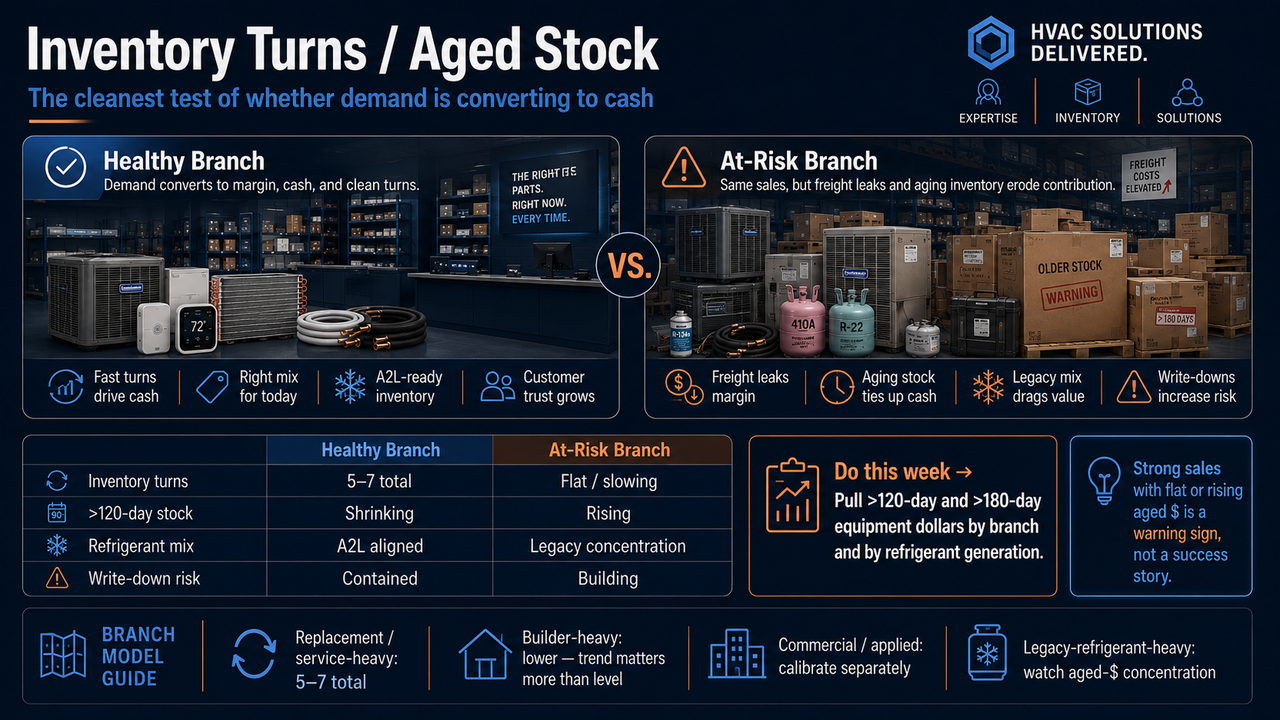
TakeawayInventory turns and aged stock are the cleanest test of whether recent demand is converting to cash or to write-down risk.
These are your numbers. They decide whether market signals turn into profit.
On-shelf availability on A2L critical part numbers at time of counter or delivery request.
Target 95%+ on critical SKUs; investigate falling trend by branch or SKU class.
Freight recovery %
Delivery revenue (surcharge + fees + delivery-line pricing) ÷ fully-loaded delivery cost (fuel + driver time + vehicle + allocated route overhead). Track by branch and by account cohort.
Falling trend, or below branch-set target. Which routes and accounts consume capacity without recovery?
Margin by category
Category margin — both GP $ and GP % — vs plan and vs prior 4-week average, split by equipment / parts / accessories / refrigerant. Watch the dollars, not just the percent.
Any category down >150 points MoM. Is the driver cost-file lag, discounting, or mix?
Inventory turns / aged stock ◄ THIS WEEK
Total-dollar turns (COGS ÷ avg inventory) at branch; category turns; >120-day and >180-day $ by category. Deep dive below.
Rising aged $, especially legacy refrigerant / A2L concentration. What can be returned, transferred, or discounted?
Cost-file lag
Days since ERP cost basis last reconciled to current vendor file, by SKU class. Open quotes tied to superseded costs.
Any quote >14 days old on cooling-side categories in a rising basket. Which need refresh or reprice?
A2L returns
A2L-related returns $ ÷ A2L transactions $ (dollar-weighted, not unit count), by branch and by contractor cohort.
Rising trend concentrated at a branch or contractor. Is the root cause training, substitution, handling, or documentation?
Days-to-pay / AR aging
AR days weighted by invoice dollars (not simple invoice average), by cohort (builder / replacement contractor / commercial / retail). Past-due 60/90+ $ and credit hold count.
Rising among builder or high-volume cohorts. Are we financing accounts that do not earn adequate contribution?
GP per equipment ticket
Equipment GP $ + attachment GP $ (linesets, disconnects, thermostats, IAQ, refrigerant, pads) ÷ equipment ticket count. Threshold set by branch model, not network-wide.
Falling trend. Are counter teams capturing accessory and replacement pull-through, or writing bare-box tickets?
These are starting definitions, not network-wide mandates. Replacement/service-heavy branches sustain higher turns and lower AR days than project, applied, seasonal, or builder-heavy branches. The management question is not whether every branch matches one target — it is whether each branch is improving against its own mix-adjusted baseline without accumulating aged dollars or stretching AR.
This week's deep dive · Inventory turns / aged stock
Why it matters now
Two things are converging. Housing is soft — starts down 12.4% MoM, 9.6 months of new-home supply — which puts builder-linked equipment at risk of sitting. A2L is live, which puts legacy refrigerant, legacy equipment, and mismatched service parts at risk of aging out faster than the merchandising plan expected. Both hit the same P&L line: aged stock sells at discount, gets returned for partial credit, or gets written down. Turns are the cleanest early warning that either is happening — before finance runs the year-end review.
How to measure it — three ways, not one
First: total-dollar turns at the branch (COGS ÷ average inventory). The executive number. Second: turns by category — A2L equipment, legacy equipment, parts, accessories, refrigerant, special-order. The operator number. Third: aged-inventory dollars in >90-day, >120-day, and >180-day buckets, split by category and by branch. The write-down risk number. If your ERP can't produce all three yet, start with #1 at branch level and add the aged buckets by hand for the top five equipment SKUs. Better rough now than perfect in November.
What good looks like — by branch model
These are starting points, not industry rules. Calibrate to your own mix, geography, and season. The real management question is not whether you match a range — it is whether you are improving against your own baseline without piling up aged dollars.
Branch model
Starting turn range
Main aging risk
Replacement / service-heavy
5–7 total; parts & accessories 8+; equipment 3–5
Cooling equipment aging and quote-cost lag on old paper
Builder-heavy
Lower — mix-adjusted; trend matters more than level
Committed stock against cancelled or delayed builder releases; AR deterioration
R-410A and pre-A2L stock aging into write-down territory before Q4 close
The universal rule: aged buckets should be shrinking week over week during peak season. Strong sales with flat or rising aged $ is a warning sign, not a success story.
Do this week → pull >120-day and >180-day equipment dollars by branch and by refrigerant generation (A2L vs legacy). Rank the top five aged-dollar branches and set a 30-day plan to move or return the top ten items at each.
Rough numbers, worked example: a mid-size branch carrying $2M in equipment inventory with $150K sitting >120 days on legacy refrigerant equipment is running a 7–8% aging concentration on the most write-down-sensitive category. A 25% haircut on that pool is $37K of value at risk before any warranty or returns cost. Calibrate to your own data.
Last week: Heat-pump attachment rate (carry-forward above). Next week: Freight recovery % — why diesel volatility is now a branch-quality test, not a back-office line item.
06
National Channel Intelligence
TakeawayDigital workflow, serviceable product design, and technician pipeline are becoming table stakes. Distribution valuations reward margin quality, not volume.
Development
Why it matters
Who should act
Johnson Supply → Johnson HVAC Distribution rebrand + portal refresh across 25 TX / LA branches Aug 26
Digital account workflow — 24/7 inventory visibility, quote-to-order flow — is becoming table stakes in mid-tier and regional markets. Source (Aug 26) →
TX/LA competitors — benchmark account access, after-hours visibility, order flow
Greenheck CUE roof-ventilator redesign — 50% faster motor replacement, toolless hood entry Aug 30
Serviceability protects commercial replacement margin better than commodity box selling. Trained counter and technical support win the retrofit conversation. ACHR (Aug 30) →
Commercial branches — train counter on retrofit and code support
NTI Houston graduates 232 skilled-trades students, 112 in HVAC Aug 25
New-tech pipeline is a customer acquisition opportunity, not just a labor-market datapoint. Onboarding, training, and credit paths determine share. ACHR (Aug 25) →
Public distribution valuations hold — Watsco P/E 27.5, Ferguson P/E 24.0 Aug 31
Public buyers are paying for margin durability and cash conversion, not top-line growth. Stress-test aging, freight recovery, AR quality, and customer concentration before applying scale comps to private branches.
Buyers and sellers — validate reporting and margin durability before pricing on scale comps
June AHRI cooling recovery — combined A/C + heat pumps 1.02M units, +21.7% YoY Aug 18
Read as a base-effect story: June 2025 was a weak comp; June 2026 did not fully return to June 2024 A/C levels. Do not use the headline as a green light to build stock. ACHR (Aug 18) →
All branches — benchmark own sell-through and mix against; do not backfill stock on headline alone
07
Regulatory & Product Transition
A2L readiness — the auditable checklist
"A2L readiness" is too broad on its own. This is what actually needs to be true at each branch. Walk it. If any of these are red, that's the item to fix this week — not a general "we're on it."
□
Counter staff training completed on approved substitutions and refusal cases
□
Storage, ventilation, and cylinder-handling procedures documented and posted
□
Product and component compatibility verified against manufacturer bulletins (leak-detect, service valves, oil compatibility)
□
Returns reason codes established and coded distinctly for A2L transactions
□
Contractor-side training rolled out to top 25 accounts; documented per account
□
A2L return rate tracked weekly by branch and by contractor account
□
Legacy inventory disposition plan active — return, transfer, discount, or write-down decisions for R-410A and pre-A2L stock
R-290 is a separate conversation — smaller charges, different code path, different training. Do not fold it into the A2L bucket by default.
TakeawayA2L execution risk is a branch-process issue this week — documentation, cylinders, counter confidence — not a supply issue.
A2L / HFC allowances
EXECUTION RISK · CONTINUING
EPA's HFC page continues to highlight AIM Act actions, including CY2026 HFC allowance redistribution. The 2022–2025 allowance-allocation data comment period closed 8/27/26. Availability is not the acute risk today — documentation, cylinder handling, counter A2L confidence, and reclaim process are. Any branch that cannot cleanly answer a contractor's "which cylinder do I return?" question is leaking trust.
Response → audit refrigerant records, cylinder returns, reclaim process, SDS access, and A2L counter scripts this week; track A2L-related returns and warranty tickets by branch and by contractor
California reclaimed refrigerant
STATE COMPLIANCE · CONTINUING
ACHR RSS carried an Aug. 22 piece on California reclaimed refrigerant compliance tied to AB 663 / SB 1206 clarification. For California and multi-state distributors, this is a branch process issue — certified reclaimed refrigerant controls, documentation, and chain-of-custody — not just a corporate compliance line item.
Response → verify certified reclaimed refrigerant controls, chain-of-custody documentation, and counter/service-truck training in California branches; multi-state operators should map exposure by branch
Vendor cost files / price lag
CONTINUING RISK
Copper up 1.34% WoW, aluminum up 0.56%, and diesel up $0.198. If ERP cost files are lagging vendor increases on copper- and aluminum-heavy categories, quotes older than two weeks are leaking margin quietly.
Response → reconcile ERP cost basis to vendor files twice weekly; require branch overrides to carry documented cost-change reason codes; age out quotes older than 14 days on cooling categories
Freight policy / delivery economics
STRENGTHENING
Diesel at $5.652/gal, up nearly $1.94 above last year, moves delivery from a customer-service cost line into a margin issue. Freight recovery, jobsite delivery thresholds, and hot-shot after-hours policy need to be rebuilt by branch density and route length — not left at last year's defaults.
Response → rebuild freight policy by branch density and route length; reprice delivery minimums and jobsite thresholds where under-recovered; classify accounts into earned/paid/exception delivery tiers
08
Regional Heat Map
TakeawayAbove-normal heat favors most of the country east of the Rockies through Sept 5–9; PNW and parts of the West cool. Adjust regionally, not nationally.
Central & Southern Plains
ABOVE-NORMAL HEAT · HIGH CONFIDENCE
NOAA CPC 6–10 day outlook favors above-normal temperatures across parts of the region for Sept. 5–9 with high confidence. Supports late-season service calls, emergency parts (capacitors, motors, refrigerant), and replacement quoting. Do not overbuy equipment on one heat window — late-season heat is a service and parts opportunity more than an equipment stocking event.
Deal read → favor branches with proven emergency-parts fill rate and contractor pickup loyalty; watch margin on rush orders and hot-shot delivery
East of Rockies broadly
ABOVE-NORMAL · MODERATE
Above-normal temps favored across most of CONUS east of the Rockies. Replacement/service mix should remain active. Contractor cash stress and affordability may push repair-versus-replace conversations, especially with mortgage rates at 6.66%.
Deal read → prioritize branches with strong parts availability and financing-aware contractor support; watch AR aging on financing-sensitive contractors
Pacific Northwest / N. CA / Great Basin
BELOW-NORMAL · FAVORED
Below-normal temperatures favored in the Pacific Northwest, adjacent Northern California, and Great Basin. Less cooling urgency this window; emergency demand may slow. Do not assume national heat signal applies locally. In California, note diesel at $7.04/gal — freight economics matter here even more.
Deal read → tighten inventory buys, monitor aged cooling items, and prioritize freight recovery in this region
Gulf Coast / Florida
WETTER TILT · MODERATE
CPC notes a modest wetter-than-normal tilt. Gulf Coast diesel $5.481. Storm and rain can create service interruptions and emergency demand, but storm-driven spikes are not recurring demand — do not build inventory around them.
Deal read → maintain emergency-parts readiness but price hot-shot delivery correctly and watch cash conversion pressure post-storm
Texas / Louisiana
COMPETITIVE INTENSITY · NEW
Johnson HVAC Distribution rebrand across 25 branches raises the bar on contractor-facing identity, portal speed, and branch consistency. Branding alone does not equal branch quality — but for competing distributors, this is a benchmark event. Contractors in these markets will notice.
Deal read → benchmark counter experience, online account workflow, and after-hours parts visibility against Johnson locally before signing a valuation
Southwest / AZ / So. Cal
EASING · MONITORING
Heat pattern has moderated from prior weeks. Emergency demand may soften. Watch aged cooling inventory and prepare for shoulder-season mix — this is the season when speculative summer buys start to age.
Deal read → measure inventory aging concentration in cooling items; branches that are still running high aged stock heading into shoulder season are a caution
09
M&A / Capital Markets Radar
TakeawayScaled distribution valuations hold on Watsco and Ferguson; private diligence pivots this week to demand quality, freight recovery, and inventory age.
Public comp tone
CAPITAL MARKETS · TAPE
Watsco P/E 27.51, market cap $12.83B; Ferguson P/E 23.97, market cap $44.24B on 8/31 morning. Scaled distribution valuations continue to reward margin, procurement leverage, and cash conversion discipline. Private, single-region, branch-owner businesses should not assume these comps apply without evidence of the same process quality.
Watch → do not accept "distributor" comps as fair value for private assets without margin, cash conversion, and reporting discipline evidence
Demand quality as diligence focus
DILIGENCE · NEW
This week's signal set shifts diligence toward replacement/service mix vs new-construction exposure, invoice-level freight recovery, A2L training and documentation, inventory aging by refrigerant generation, branch-manager transferability, and AR quality by contractor cohort. "Strong contractor relationships" without process evidence is a caution flag — those relationships may be funded by unrecovered delivery labor, aged inventory, or stretched terms.
Watch → require the seller to produce margin, freight recovery, inventory aging, and days-to-pay by branch and by customer cohort
Manufacturer relationship risk
DEAL CHECKLIST
In distribution deals this cycle, transferability of the top manufacturer relationships, rebate program economics, and A2L technical support access sit at the top of the diligence checklist. A target running strong reported margin on one or two major manufacturer lines needs to demonstrate program continuity, not just current-year rebate capture.
Watch → confirm rebate program terms, transferability, and technical-support access before signing; assume nothing on standing programs
Inventory quality as valuation driver
CASH TIED UP · SIGNAL
With A2L transition ongoing and housing softening, inventory age is a valuation input, not just an operating metric. Stale legacy refrigerant, aged builder-linked equipment, and special-order returns build write-down risk that shows up in quality-of-earnings work. Buyers should stress-test the balance sheet on aging concentration, not just total dollars.
Watch → in QoE, review aging by category (A2L vs legacy, equipment vs parts) and by branch; a clean topline with concentrated aging is a valuation adjustment, not a rounding item
Bottom line
SUMMARY
Premium goes to distributors with high replacement/service mix, strong parts and accessories attachment, disciplined freight recovery, documented A2L readiness, low aged inventory, clean rebate capture, and branch managers running process — not personality. Caution goes to builder-heavy volume, free-freight cultures, weak online ordering, stale legacy inventory, contractor concentration, and revenue that depends on the owner staying in the seat.
10
The Deal Lens · What This Week Says
What this week says to favor
▸
Replacement/service-heavy branches with fill rate above 95% on critical A2L items
▸
Documented freight recovery by branch and by account — not free-freight culture
Low >120-day equipment dollars and shrinking aged buckets during peak season
▸
Branch managers running process — segmented sales, weekly margin reviews, days-to-pay by cohort
What this week says to avoid
▸
Builder-heavy volume against 9.6 months' new-home supply and starts down 12.4% MoM
▸
Free-freight culture and long jobsite delivery routes against $5.65/gal diesel
▸
Stale legacy refrigerant, unreconciled A2L inventory, and rising A2L return rates
▸
Weak online ordering in markets where independents are investing in portals and branch consistency
▸
Revenue described as "strong contractor relationships" with no process evidence in freight, AR, or margin
This week's key question
Show me margin, freight recovery, inventory aging, and days-to-pay by branch and by customer cohort — especially replacement/service accounts versus new-construction accounts. If management cannot produce that view, reported EBITDA deserves pressure.
11
Next Monday's Watchlist
WEEKLY
Diesel / freight recovery — the most immediate margin lever. Confirm: diesel stays elevated or rises again; freight recovery improves at exposed branches. Weaken: diesel stabilizes and branch recovery improves at pace. Reverse: diesel falls materially and freight pressure fades before repricing is complete.
WEEKLY
NOAA CPC 6–10 / 8–14 day outlook — late-season heat drives service/replacement urgency east of Rockies. Confirm: heat pattern holds or extends. Weaken: heat signal moderates. Reverse: broad cool-down reduces emergency call volume.
WEEKLY
Contractor payment behavior / AR aging — demand quality only matters if cash converts. Confirm: 60+ day AR rises among builder and project accounts. Weaken: AR stays current despite sales. Reverse: contractor cash improves and terms settle broadly.
WEEKLY
A2L returns and warranty tickets — transition risk shows up at the branch cost line. Confirm: A2L-related returns, misorders, or tech-support calls rise. Weaken: training and documentation reduce error rates. Reverse: A2L transactions settle with minimal admin cost.
MONTHLY
New-construction indicators — builder exposure remains a caution. Confirm: starts and sales stay weak, months' supply elevated. Weaken: permits convert to starts. Reverse: new-home sales rebound materially and inventory tightens.
WEEKLY
Blue Ops commodity and equipment baskets — copper, aluminum, steel, and component trend. Confirm: commodity holds at or above 105.6; equipment ~104 directional read continues drifting up. Weaken: copper/aluminum ease. Reverse: broad commodity decline gives back August cost increases.
INTERNAL
Operator scorecard — inventory turns / aged stock this week; heat-pump attachment carry-forward; fill rate and freight recovery weekly; returns/warranty and online ordering monthly. The numbers that turn market signals into profit. Confirm: aged buckets shrink and turns rise. Weaken: aged buckets flat with rising sales. Reverse: aged buckets grow while sales moderate.
Management question for this week
Which of my branches is reporting acceptable sales and quietly deteriorating on freight recovery, aged equipment, or builder-cohort collections?
That is the one branch to visit this week. If your answer is "I don't know yet," the Section 05 dashboard is what tells you.
Source Notes
Sources checked Aug. 31, 2026:
U.S. Census / HUD — New Residential Sales, July 2026 (Aug 25): 607K SAAR, 9.6 months' supply
U.S. Census — New Residential Construction, July 2026 (Aug 18): permits 1.443M, starts 1.239M
EIA — Gasoline and Diesel Fuel Update (Aug 25): U.S. diesel $5.652/gal for 8/24/26
Freddie Mac — Primary Mortgage Market Survey (Aug 27): 30-year FRM 6.66%
ACHR News — 'Cooling Equipment Rebounds in Q2 as Heat Pumps Continue to Climb' (Aug 18)
ACHR News — 'Greenheck Redesigns Ventilators With Contractors in Mind' (Aug 30)
ACHR News RSS — Aug 24–30 items including NTI Houston, Quilt, Ziehl-Abegg, SupplyHouse
Markets Insider / GlobeNewswire — Johnson Supply rebrand (Aug 26): 25 branches, new portal
NOAA Climate Prediction Center — 6–10 Day Outlook (issued Aug 30), valid Sept 5–9
EPA — HFC / AIM Act page (last updated Aug 7, 2026), including CY2026 allowance items
Markets Insider — commodities and public comps snapshots (accessed Aug 31): copper, aluminum, WTI, WSO, FERG
Blue Ops commodity and equipment basket indices (copper and aluminum confirmed; remaining components directional)
How this brief is built
This brief pairs an outside view (signal board, baskets, market dashboard, channel and regulatory news) with an inside view (operator agenda and scorecard). Confidence: High = official release or filing; Medium = credible trade reporting not independently confirmed. Where equipment basket components lack a public weekly series, we mark them directional rather than implying precision. Scorecard targets are starting points — calibrate to your own best branches and by branch model, mix, and geography.
Blue Ops supports HVAC distribution companies across the investment lifecycle — from branch-level performance improvement to acquisition diligence and value-creation planning. See our HVAC practice →