Cooling equipment rebounded. The real test is the basket.
August 24, 2026
ISSUE NO. 35
HVAC Distribution · Executive Intelligence · Weekly Brief · Week of Aug 24, 2026
What changed this week
What is confirmed: demand improved this week, and the public data now backs it up. AHRI’s June shipment release showed 605,033 unitary AC units and 418,538 heat pumps shipped in the month, with year-to-date totals at 2.56 million AC units and 2.16 million heat pumps. ACHR also highlighted the Q2 rebound and a stronger first half versus prior years. On the technical side, ACHR’s Aug. 19 coverage sharpened the A2L-versus-R-290 tradeoff discussion, while the Aug. 24 feed leaned toward VRF and smarter commercial-building applications. What the market is saying: public HVAC names softened again: Carrier down 4.7%, Trane down 5.1%, Lennox down 3.7%, and Ferguson down 2.4%, while Watsco held essentially flat at +0.1%.
What it means: demand improved, but branch quality will be determined by whether each equipment transaction pulls controls, accessories, refrigerant, service parts, and repeat contractor business behind it. Volume without attachment and pricing discipline is not a quality recovery.
Branch manager checklist — this week
1
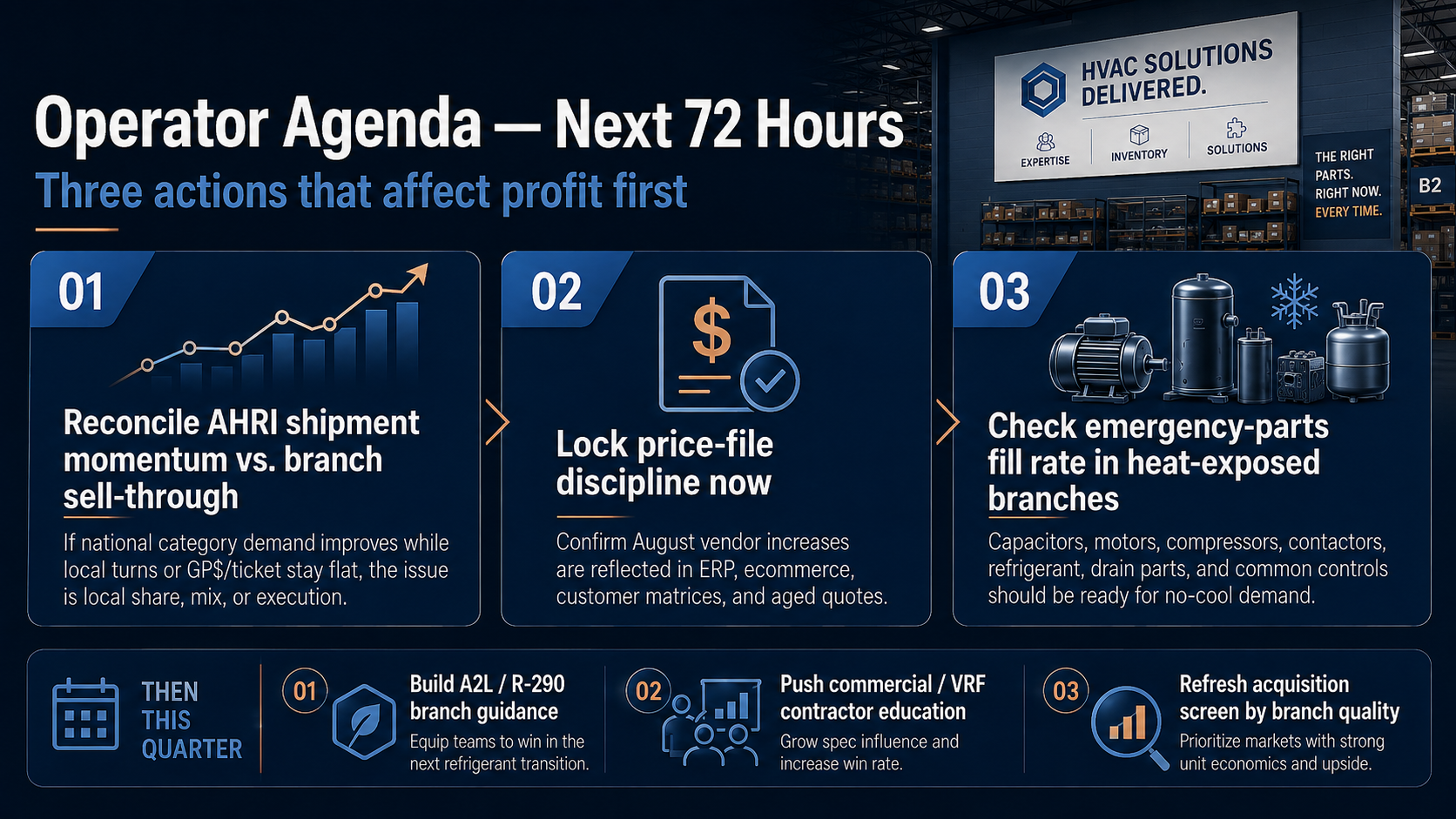
Audit your top 20 equipment orders from the last 30 days for attachment gaps — controls, line sets, pads, refrigerant, tools
2
Review branch quote overrides and aged pricing — any quote older than 14 days on pre-August cost files is leaking margin
3
Check emergency-parts fill rate on capacitors, motors, compressors, contactors, and refrigerant in your heat-exposed branches
The natural gas price spike (+7.10%). It was driven by supply-side dynamics, not HVAC distribution demand. It matters for end-user heating economics heading into winter, but it has no immediate implication for branch margin this week. Do not let it distract from the real work this week: price-file discipline, heat-pump attachment, and A2L readiness.
01
CEO Readout
Stance
Lean into commercial, service-parts, and heat-pump momentum — but measure profit by the transaction, not unit volume. Public AHRI data currently run only through June, so the latest manufacturer-side signal is directionally better, not real-time. The operating question is whether your branches are converting that demand into gross profit dollars per ticket, attachment, turns, and repeat contractor spend. Distributors should keep working-capital discipline tight. This is a fill-rate, price-file, A2L-readiness, and category-margin execution moment — not a "stock everything" moment.
What changed
Three things moved this week. First, AHRI put real numbers on the demand recovery: 605,033 unitary AC and 418,538 heat pump shipments in June, with year-to-date totals of 2.56 million and 2.16 million respectively. Second, the A2L-versus-R-290 conversation got sharper — ACHR's Aug. 19 coverage laid out the specific tradeoffs in lower-GWP commercial refrigeration, raising the bar for branch-level technical literacy. Third, commercial and VRF building needs led the Aug. 24 feed, reinforcing the quality-demand theme. On the weak side, public HVAC names mostly fell again — Carrier, Trane, and Lennox all down 3–5% — while Watsco held roughly flat. The market is not rewarding HVAC exposure without margin proof.
Action
If you operate: reconcile AHRI shipment data against branch sell-through before adjusting inventory plans. Lock your price files — August vendor increases should be fully reflected in ERP, ecommerce, and customer matrices by now. Build a branch counter guide for A2L vs. R-290 tradeoffs this week. If you're buying: use continued public comp weakness as leverage on seller expectations, and test whether a target captures full attachment economics on heat-pump sales — equipment, accessories, service parts, and repeat contractor loyalty — or just pushes units at thin margin.
From last week — still active
HARDI $32.9B industry sizing: No new data this week, but it remains a useful baseline for category-scale conversations with buyers and sellers. Use it when you need to push back on inflated seller expectations.
Days-to-pay by customer group: No change in signal this week, but keep tracking it. Heat-exposed contractors in Oklahoma, Texas, and Louisiana may start stretching payables if volume outruns cash conversion. Flag any customer group drifting past 45 days. Owner: Finance + Branch Manager · Trigger: contractors extending payment timing while branch inventory is also rising.
Johnstone Supply training center: No update this week, but the signal still stands — training capability is increasingly showing up as a diligence point, not a nice-to-have.
02
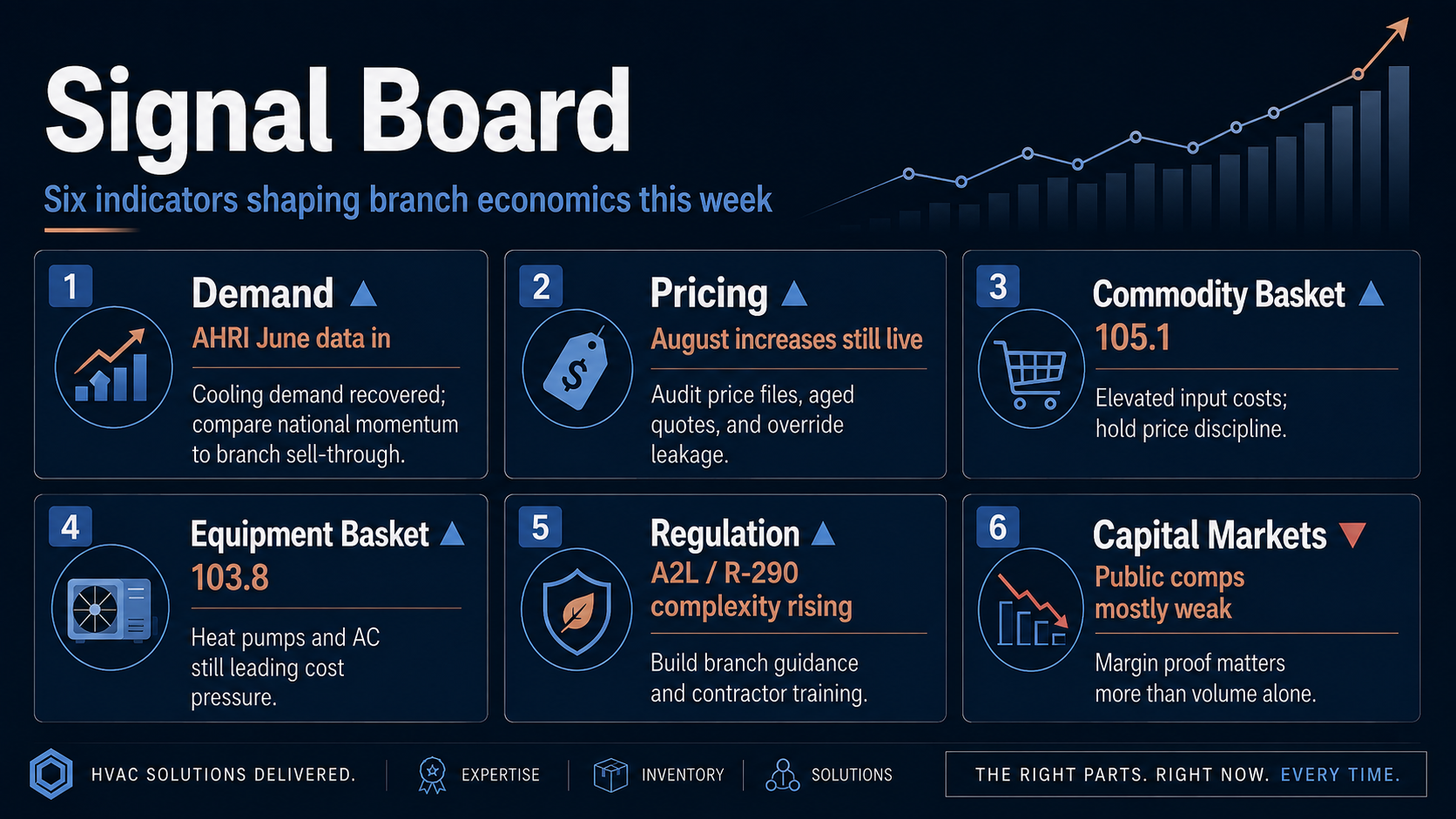
Signal Board
TakeawayDemand recovered, but the market is paying for margin quality and attachment — not volume.
Noisy market, simple test: these are the six indicators shaping branch economics this week.
03
Thesis of the Week
Better volume does not automatically mean better branch economics.
June AHRI shipments confirm that cooling demand recovered and that heat pumps remain structurally important. The distributors that win from here will not be the ones carrying the broadest inventory just for the sake of it. They will be the ones with the right local mix, strong fill rates on failure-prone service parts, clean A2L/R-290 guidance, disciplined price-file execution, and contractor relationships strong enough to win repeat order flow.
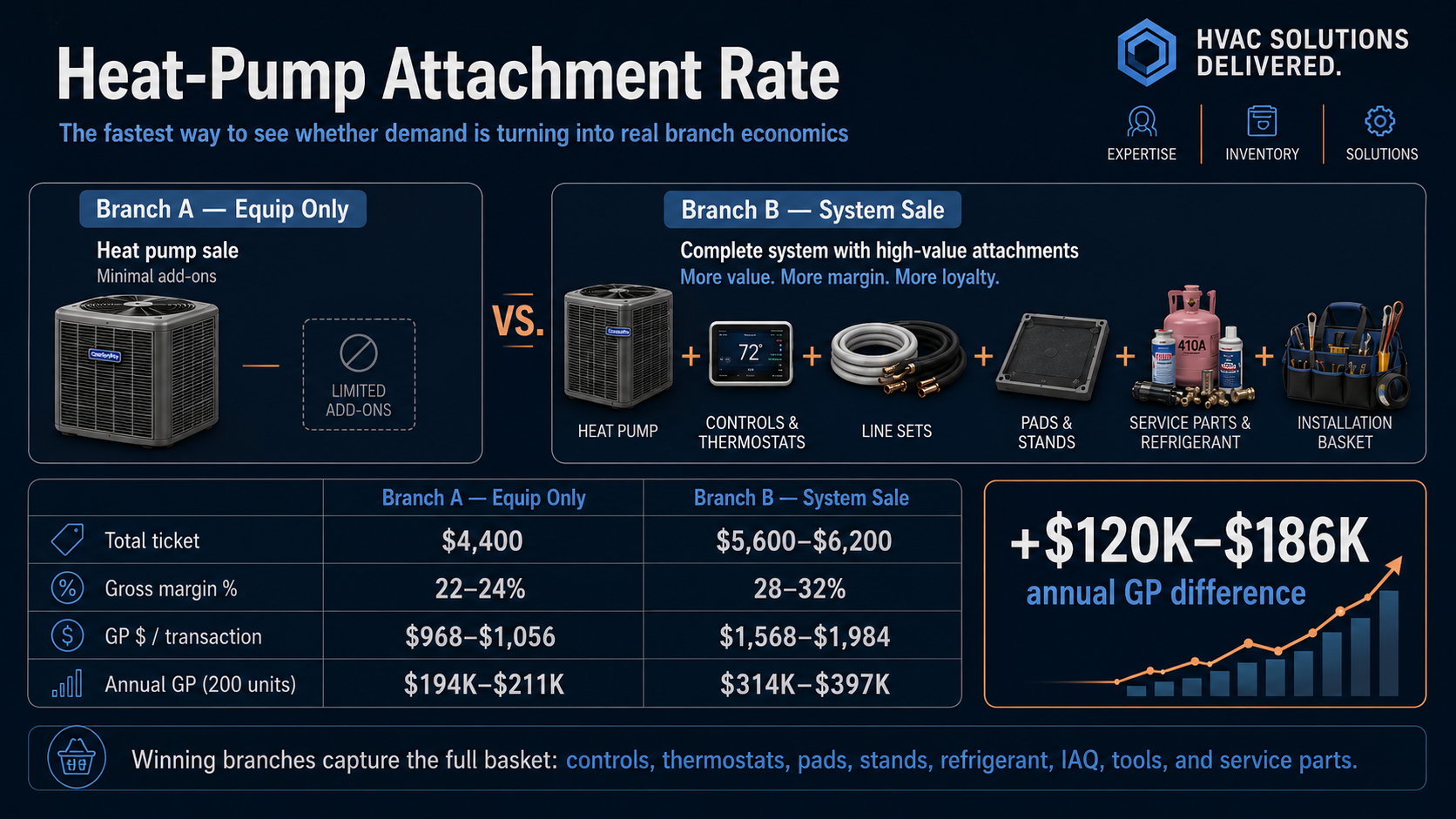
Weaker distributors will turn the same demand into aged inventory, discount leakage, returns, warranty friction, and working-capital drag. Two branches can sell the same heat-pump unit and produce very different economics. The branch that captures the full installation basket can earn roughly $600–$928 more in gross profit per transaction. That distinction appears to matter in public-market sentiment, and it is increasingly one of the things serious buyers test in diligence.
The risk is not missing the headline. It is turning better shipment data into aged stock and branch cash drag because local buying got ahead of contractor pull-through.
04
Operator's Agenda — Prioritized
Three actions for profit this week — then three more for the quarter.
05
Blue Ops Baskets & Market Dashboard
Two Blue Ops baskets that translate raw-material and equipment cost movement into simple margin signals. Updated weekly.
The basket held at 105.1, with all three primary metals now confirmed. Copper dipped slightly to $6.58/lb (−0.45%) but remains near record territory. Steel firmed to ~$1,197/st (+1.0%), with S232 tariffs keeping domestic pricing elevated. Aluminum was essentially flat at ~$1.46/lb (−0.04%), retreating from recent LME highs. The copper pullback and steel increase roughly offset each other. Crude rose 1.27%, which keeps freight pressure elevated. Natural gas spiked 7.10% on supply-side dynamics, but that has no immediate branch-margin implication. Bottom line: input costs are confirmed high, not easing. Hold price discipline.
Component
Weight
This week
Read-through
Copper
30%
$6.58 · −0.45%
Down slightly but still elevated; hold margin on coils, motors, line sets, wire, service parts
Steel / galvanized
30%
$1,197/st · +1.0%
Confirmed higher; S232 tariffs keeping domestic steel elevated. No basis to give back price
Aluminum
15%
$1.46/lb · −0.04%
Essentially flat; LME aluminum retreated from 7-week highs. No relief signal
Compressors
10%
Firm · dir.
A2L models still carry premium; cost pressure remains directional until confirmed
Motors
8%
~Flat · dir.
Copper flat, so motor cost pressure paused. Directional estimate
Index = weighted weekly move of six components, base 100 (May 18). Copper, steel, and aluminum confirmed this week; compressors, motors, and controls remain directional.
Core Equipment Basket
HEAT PUMPS STILL LEAD
103.8
Index · base 100 (5/5)
+0.3% WoW +3.8% since base
Heat pumps ~+0.4%, AC ~+0.4%, furnaces ~+0.1%
13-week trend
The equipment basket rose to an estimated 103.8 as August manufacturer increases continue through branch cost files. Heat pumps remain under the most cost pressure, driven by A2L redesign costs. The spread between heat-pump/AC escalation and flat furnace costs continues to widen — a branch that does not update cost files on heat-pump and AC jobs will lose margin faster than the index suggests.
Basket index · rolling 13-week + YTD
Index · base 100
6/1
6/8
6/15
6/22
6/29
7/6
7/13
7/20
7/27
8/3
8/10
8/17
8/24
WoW
YTD
Commodity
99.2
98.8
99.4
99.2
99.8
100.5
101.1
101.8
102.9
104.2
104.8
104.9
105.1
+0.2%
+15.2%
Equipment
103.2
100.6
100.8
101.0
101.2
101.4
101.6
101.8
102.0
102.3
102.6
103.5
103.8
+0.3%
+3.8%
Commodity base 100 = May 18 (YTD from Jan 2). Equipment base 100 = May 5 per the Blue Ops Equipment Basket Tracker (weight-adjusted move of heat pumps, AC, and furnaces). Copper, steel, and aluminum confirmed this week; remaining components directional.
Public comps & macro indicators
Instrument
7-day
Read-through
Copper
~$6.58 · −0.45%
Down but still elevated; hold discipline on coils, motors, line sets, wire, service parts
Crude oil
+1.27%
No broad freight relief; keep carrier surcharge talks data-specific
Natural gas
+7.10%
Supply-driven move; limited near-term branch impact — ignore for now
Watsco WSO
+0.11%
Stabilized after prior weakness; market still waiting on margin/inventory proof
Ferguson FERG
−2.37%
Broad distribution tone softer; valuation discipline matters
Steepest drop in the group; commercial strength not enough to satisfy investors on cycle
Lennox LII
−3.69%
Residential-heavy exposure still vulnerable; caution on residential-focused targets
Equity and commodity figures from Yahoo Finance chart data accessed Aug. 24, 2026, over the accessible 7-day daily range.
AHRI June shipment data · the numbers
Category
June
YTD
Read-through
Unitary AC
605,033
2.56M
Cooling demand recovered; test against branch sell-through
Heat pumps
418,538
2.16M
Strategic category; measure by basket, not just units
Gas warm-air furnaces
320,281
1.55M
Meaningful but secondary to cooling seasonality
Commercial gas water heaters
7,576
47,786
Non-HVAC adjacency for diversified distributors
Source: AHRI, Aug. 14 release. These are manufacturer shipment figures, not sell-through, and run through June only. Reconcile against your own branch data before drawing August conclusions.
06
Operator Scorecard · Your Own Numbers to Watch
TakeawayHeat-pump attachment rate is your best early indicator of whether demand is converting into real branch economics.
The numbers below are yours. They decide whether your branches turn the market signals above into profit.
The seven numbers we watch
Number / signal
Review
Owner
Fill rate / in-stock
Weekly
Branch
Gross margin by category
Weekly
Finance
Quote-to-invoice leakage
Weekly
Pricing
Heat-pump attachment rate ◄ THIS WEEK
Weekly
Category
Inventory turns / aged stock
Weekly
Ops
Returns / warranty rate
Monthly
Ops
Online ordering by branch
Monthly
Sales
How to measure it
Heat-pump attachment rate = accessory, control, and install-basket revenue tied to heat-pump tickets ÷ heat-pump unit sales. Track it by branch: average attachment revenue per unit, GP dollars per heat-pump ticket, accessory attach rate, and contractor repeat purchase rate. An attachment rate above 60% can support a premium valuation discussion. Below 30% usually raises discount questions. A wide GP spread between branches can signal process inconsistency, management gaps, or integration risk.
For multi-location operators: if you run 10+ branches, rank them by GP dollars per heat-pump transaction. If the spread between your best and worst branches exceeds $400, you likely have a management-process problem, not just a market problem. The bottom quartile is the first place to go to work.
Do this week → pull heat-pump attachment data for every branch, rank the bottom quartile, and target those branches for immediate training, counter scripting, and basket-selling improvement.
Illustrative assumptions: 200 units/year, ~$4,400 equipment price, $1,200–1,800 attachment basket, 22–24% equipment-only GM, 28–32% system-sale GM. Ranges reflect typical mid-market distributor economics. Calibrate to your own data.
Last week: Days-to-pay by customer group (carried forward above). Next week: Online ordering by branch — why branches with the highest online-order share are often the stickiest and most efficient locations in the network.
07
National Channel Intelligence
TakeawayThree new stories, one updated comp read, and sharper technical complexity — all pointing at execution, not exposure.
Demand · shipment data
Cooling equipment rebounded in Q2, while heat pumps kept climbing
AHRI’s June data puts real numbers behind the recovery: 605,033 unitary AC shipments and 418,538 heat-pump shipments. Year-to-date totals of 2.56 million AC units and 2.16 million heat pumps point to a stronger first half than prior years. Category managers should recalibrate replenishment using actual category data, not branch anecdotes.
Why it matters: better unitary and heat-pump demand supports the sector, but buyers still have to validate local sell-through and gross-margin quality. National shipment improvement does not mean your branch improved. It means you now have a benchmark to test against.
A2L vs. R-290: the tradeoffs are getting more technical, not simpler
ACHR’s Aug. 19 coverage moved beyond generic A2L-transition language and into specific tradeoffs between A2L and R-290 refrigerants for commercial refrigeration, including flammability, charge limits, system compatibility, tooling, and recovery requirements. This raises the bar for branch-level technical support and counter literacy.
Why it matters: branches that cannot clearly advise contractors on refrigerant selection, safe handling, and compatibility will lose trust and create returns, safety risk, and warranty friction. Technical-support capability is a real value differentiator, especially in refrigeration-heavy markets.
VRF and smarter commercial applications keep gaining attention
ACHR’s Aug. 24 feed continued to point toward commercial demand for more flexible, efficient systems such as VRF. Distributors pursuing this work need commercial sales capability, training depth, and vendor support beyond commodity unitary equipment — and the margin data to justify the investment.
Why it matters: commercial/VRF capability only deserves a premium if it comes with margin, service-parts pull-through, and repeat contractor business. Note: the current source set still does not support a hard VRF demand-trend call, so build capability without overcommitting inventory.
Public comp weakness continues despite better demand data
Carrier (−4.70%), Trane (−5.08%), and Lennox (−3.69%) all weakened further this week, while Ferguson fell 2.37%. Watsco was the exception, holding roughly flat at +0.11%. The market is not blindly rewarding HVAC exposure. Investors still want proof of margin durability, not just category momentum.
Why it matters: buyers still underwrite branch-level margin, customer concentration, inventory quality, and repeatability of commercial revenue. Better category data for a month or two does not justify peak multiples.
YAHOO FINANCE · AUG 24 · MED
08
Regulatory & Product Transition
TakeawayA2L/R-290 complexity is rising, not settling. AHRI data gives you a benchmark. Price files need weekly audits.
A2L / R-290
COMPLEXITY RISING
The A2L-vs-R-290 tradeoff discussion sharpened this week. Wrong product guidance creates returns, safety risk, and contractor frustration. A2L mix adoption moved sharply in 2026, making execution risk about training, stocking, and sell-through discipline — not about whether the transition is happening.
Response → create counter guides and training modules; stock compatible recovery equipment and cylinders; document refrigerant guidance. Review return rates on transition-sensitive SKUs weekly until error rates stabilize
AHRI shipment data
JUNE DATA OUT
AHRI data run through June only. Reconcile against your own branch sell-through before treating national momentum as a local demand signal.
Response → reconcile AHRI category data against local sell-through, backlog, and contractor order patterns
Tariff / price increases
CONTINUING RISK
ERP lag, price overrides, stale quotes, and customer matrix leakage remain active margin risks three weeks into August increases. The danger is that costs pass along slowly — cost hits before the customer price file updates, so quote margin erodes quietly.
Response → weekly price-file audit until vendor-cost changes stabilize; check ecommerce and customer-specific matrices; retrain counter teams not to use furnace pricing logic on heat-pump replacements
Commercial building complexity
STRENGTHENING
Branches underprepared for VRF, controls, and high-performance system questions will lose commercial quote opportunities. The source set points to growing interest but does not yet confirm a hard commercial-demand acceleration.
Response → vendor-led training, branch technical champions, and commercial quote-support process
09
Regional Heat Map
TakeawayHeat alerts narrowed versus last week — 12 of 134 active alerts. Concentrated in CA/AZ, FL, OK/TX/LA. Adjust regionally, not nationally.
Southwest / AZ / So. Cal
EXTREME HEAT WARNING
Extreme Heat Warnings in AZ and CA desert/inland markets. Emergency cooling parts, compressors, motors, capacitors, refrigerant, and replacement equipment should remain supported. Do not overcapitalize a short weather spike into long-term inventory. Check branch hours and counter staffing against demand patterns.
Deal read → favor branches with proven emergency-parts fill rate and contractor pickup loyalty
Florida / Gulf Coast
HEAT ADVISORIES
Heat advisories in Tallahassee and Florida regions; Puerto Rico also under Heat Advisory. Cooling service-parts and emergency replacement demand should remain healthy. Watch storm/seasonality risk and working-capital needs.
Deal read → strong market if service-parts turns are high and aged inventory is low
OK / TX / LA corridor
EXTREME HEAT / ADVISORIES
Heat Advisory / Extreme Heat Warning across Norman OK, Amarillo TX, Midland/Odessa, Lake Charles LA. Near-term demand for service parts, refrigerant, and emergency equipment. Contractor cash stress can emerge after prolonged heat demand. Have branch managers review AR aging by contractor group, not just total receivables.
Deal read → monitor AR aging by contractor group, not just sales volume; weather support only matters if branches can convert it into fill, controlled overtime, and cash collection
10
M&A / Capital Markets Radar
TakeawayPublic comps still weak. Demand improved. The diligence question is whether targets capture the full basket.
Public comp tone
CAPITAL MARKETS · TAPE
CARR −4.70%, TT −5.08%, LII −3.69%, FERG −2.37% versus WSO +0.11%. Sellers should expect more scrutiny around normalized EBITDA and branch margin quality. Investors are paying for evidence of profitable demand, not just unit movement.
Watch → use pressure on OEM valuations to temper seller expectations on private, residential-heavy assets
Heat-pump attachment as valuation input
DILIGENCE · NEW
Distributors with strong heat-pump vendor lines, training, and accessory attach capability deserve a premium. Do not just count heat-pump unit volume — measure gross profit per heat-pump transaction. An attachment rate above 60% can support a premium valuation discussion. Below 30% usually raises discount questions. A wide GP spread between branches can signal process inconsistency, management gaps, or integration risk.
Watch → audit attachment rate by branch before setting the multiple
Refrigerant transition as enterprise value
TECHNICAL · SIGNAL
A2L/R-290 tradeoffs are getting more operational attention. Technical support and compliant product guidance are part of enterprise value. Audit training records, returns, warranty patterns, refrigerant inventory, and contractor education programs.
Watch → in diligence, test whether training drives measurable share-of-wallet or is just marketing infrastructure
Commercial / VRF demand
COMMERCIAL · SIGNAL
Commercial-ready distributors may command stronger multiples if margin quality is proven. Separate high-quality commercial service/retrofit revenue from low-margin project volume. Commercial project volume with weak margin or slow-pay customers should not command the same multiple.
Watch → validate whether commercial revenue is repeatable service and retrofit, or lower-margin project volume dressed up as commercial
11
The Deal Lens · What This Week Says
What this week says to favor
▸
High service-parts fill rates in heat-exposed markets
▸
Strong heat-pump product lines with attachment rates above 60% and high accessory attach
▸
Technical training capability around A2L/R-290, VRF, controls, and commercial systems
▸
Commercial/light-commercial mix with repeat contractor relationships and provable margin
▸
Clean price-file discipline, low override leakage, and inventory that turns — not just looks broad
What this week says to avoid
▸
Equipment-heavy branches with weak parts/supplies margin and attachment below 30%
▸
Poorly documented A2L inventory or refrigerant-handling practices
▸
ERP/pricing systems that cannot reconcile quote-to-invoice margin leakage
▸
Revenue growth driven by temporary heat spikes rather than durable contractor behavior
▸
High aged inventory masked by recent unitary recovery or GP spread exceeding $500/transaction between branches
This week's key question
Is the target capturing the full economics of cooling and heat-pump demand — equipment, accessories, service parts, training, and repeat contractor pull-through — or merely pushing units through the branch at thin incremental margin?
12
Next Monday's Watchlist
THIS WEEK
Heat-pump attachment rate by branch — the single most actionable metric from this issue. Confirms thesis if GP dollars per heat-pump ticket rise with unit volume. Weakens if unit growth occurs without basket growth. Reverses if attachment falls while inventory builds.
THIS WEEK
A2L / R-290 contractor confusion — any reports of field confusion, product mismatch, or regulatory clarification. Confirms thesis if training and tool sales rise. Weakens if returns/warranty friction grows. Reverses if new regulation or OEM guidance materially changes stocking.
THIS WEEK
Commercial / VRF demand translation — whether interest translates into distributor orders and quote activity. Confirms thesis if commercial quotes and training attendance increase. Weakens if interest stays marketing-level. Reverses if commercial project delays accelerate.
WEEKLY
Public comps: WSO, FERG, CARR, TT, LII — confirms thesis if market keeps penalizing margin uncertainty. Weakens if multiples recover without earnings revisions. Reverses if public names re-rate on strong margin commentary.
WEEKLY
Branch working capital — inventory turns, aged stock, AR aging, and returns. Confirms thesis if turns improve without stockouts. Weakens if inventory rises faster than sell-through. Reverses if branches show clean turns, stable margins, and lower AR risk simultaneously.
WEEKLY
Blue Ops commodity and equipment baskets — the week's copper, steel, aluminum, and component trend, with full basket computation restored once all component data is confirmed.
INTERNAL
Operator scorecard — heat-pump attachment rate this week; days-to-pay carry-forward; fill rate and aging weekly; online ordering, returns, and retention monthly. The numbers that turn market signals into profit.
Source Notes
Sources checked Aug. 24, 2026:
ACHR News RSS feed
ACHR News — ‘Cooling Equipment Rebounds in Q2 as Heat Pumps Continue to Climb’ (Aug. 18)
ACHR News — ‘A2L or R-290? Understanding the Tradeoffs’ (Aug. 19)
ACHR News — ‘Creating Smarter Commercial Spaces: How VRF Solutions Can Help Meet Evolving Building Needs’ (Aug. 24)
AHRI — June 2026 U.S. Heating and Cooling Equipment Shipment Data (Aug. 14)
NWS Active Alerts API
Yahoo Finance chart data for WSO, FERG, CARR, TT, LII, copper, crude oil, and natural gas
Blue Ops commodity and equipment basket indices (estimated this week pending full component data)
How this brief is built
This brief pairs an outside view (signal board, baskets, market dashboard, channel and regulatory news) with an inside view (operator agenda and scorecard). Confidence: High = official filing; Medium = credible trade reporting not independently confirmed. Baskets grounded in manufacturer filings and DOE rulemaking. Scorecard targets are starting points — calibrate to your own best branches.
Blue Ops supports HVAC distribution companies across the investment lifecycle — from branch-level performance improvement to acquisition diligence and value-creation planning. See our HVAC practice →